admin
admin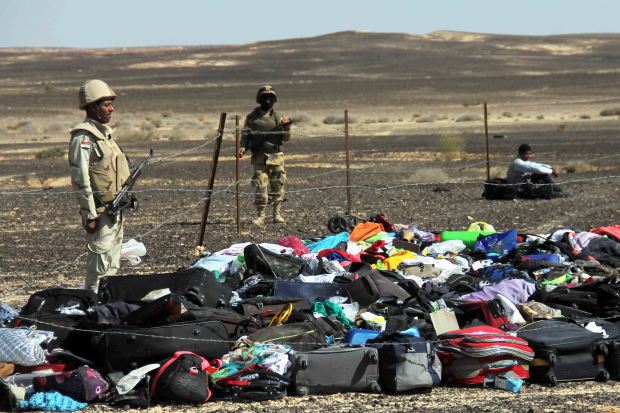
Wadi al-Zolomat — A Russian plane that crashed in Egypt broke up “in the air” strewing fragments across a wide area, an expert said on Sunday, as investigators probed the disaster that killed all 224 people on board. President Abdel Fattah al-Sissi urged patience to determine the cause of Saturday’s crash, after the Islamic State jihadist group claimed it brought down the A-321 in Egypt’s restive Sinai Peninsula.
“The disintegration happened in the air and the fragments are strewn over a large area,” said Viktor Sorochenko, a senior official with Russia’s Interstate Aviation Committee, quoted by the Russian news agency RIA-Novosti from Cairo. Sorochenko, who is heading an international panel of experts, said it was “too early to draw conclusions” about what caused the Sharm el-Sheikh to Saint Petersburg flight to go down.
Russian officials say they need to comb through an area of about 16 square kilometres in the Sinai Peninsula. Investigators have recovered the plane’s “black box” flight recorder and the Egyptian government said on Sunday its contents were being analysed. “In such cases, leave it to specialists to determine the cause of the plane crash because it is a subject of an extensive and complicated technical study,” Sisi said.
The crash site in the Wadi al-Zolomat area of North Sinai was littered with numerous blackened parts of the plane, as the smell of burnt metal lingered in the air, an AFP correspondent said. There were no bodies visible but soldiers guarded dozen of bags as well as black, red and orange suitcases of passengers from flight KGL 9268.
Nearby lay a tiny red jacket, probably of a child, underlining the horror of the tragedy that killed 17 children. Officers involved in search efforts said rescue crews had recovered 168 bodies so far, including that of a girl found 8KM from the main wreckage.
Flags were flying at half-mast in Russia on Sunday and entertainment television programmes were cancelled as part of a national day of mourning for the victims, most of them Russians, ranging in age from 10 months to 77 years. Cairo said there were 214 Russian and three Ukranian passengers on board, and seven crew members.
Cairo and Moscow have both downplayed the claim from the Islamic State’s (ISIS) branch in Egypt that it brought down the aircraft flown by Kogalymavia airline, operating under the name Metrojet.
Egyptian Prime Minister Sharif Ismail said experts had confirmed the militants could not down a plane at the 9,000m altitude at which the Airbus 321 was flying, while Russian Transport Minister Maxim Sokolov said the claim “can’t be considered accurate”. A Russian team including Sokolov and emergency minister Vladimir Puchkov visited the scene in a remote part of the Sinai.
Two air accident investigators from France — Airbus’s home country — were also to travel to Egypt along with six experts from the aerospace giant to help with the probe.
Germany’s Lufthansa, Emirates and Air France all said they would halt flights over Sinai until the reasons behind the crash were clarified. The plane lost contact with air traffic control 23 minutes after take-off.
Wreckage and dead bodies were found scattered over an area of six to eight square kilometres, around 100KM south of the town of El-Arish. “We found a 3-year-old girl 8KM from the scene” of the main wreckage, an officer said from a military base in El-Hassna, 60KM from the crash site.
Many of the bodies were missing limbs, said the officer, who requested anonymity. The ISIS affiliate waging an insurgency in the Sinai claimed it brought down the plane in revenge for Russian air strikes against the group in Syria.
But experts rejected the idea. To reach a plane at that altitude “you would need hard-to-use missiles, so it seems unlikely”, said Jean-Paul Troadec, former director of France’s BEA aviation investigation agency.
“This requires trained people and equipment that ISIS does not have, to my knowledge.” Experts said a surface-to-air missile could have struck the aircraft if it had been descending, and that a bomb on board could not yet be ruled out, but technical or human error was more likely.
An Egyptian air traffic control official said the pilot told him in their last exchange that he had radio trouble, but Civil Aviation Minister Mohamed Hossam Kamal said communications had been “normal”.
“There was nothing abnormal . . . and the pilot didn’t ask to change the plane’s route,” he said. Russia has a dismal air safety record, and while larger carriers have started to upgrade their ageing fleets the crash will likely raise concerns about smaller airlines like Kogalymavia.
Kogalymavia defended the pilot, Valery Nemov, who it said had more than 12,000 hours of flying experience, including 3,860 hours on an Airbus A321. On Sunday, the Russian transportation watchdog, Rostransnadzor, ordered Kogalymavia to perform a full check on their A-321 planes.
Kogalymavia confirmed the instructions but denied this amounted to a de-facto grounding of the company’s remaining fleet of six A321 airliners. The last major air crash in Egypt was in 2004, when a Flash Airlines Boeing 737 plunged into the Red Sea after taking off from Sharm el-Sheikh, killing all 148 people on board.
Meanwhile, a second plane carrying victims of the Russian passenger jet crash was set to leave Egypt yesterday evening, Russian officials said, as relatives prepared to identify the remains of their loved ones in Saint Petersburg. Russia’s emergency situations ministry said that the second flight was scheduled to take off from Cairo at 18:00 GMT, but did not give any indication of how many bodies would be on board.
A first plane touched down in Russia’s second largest city early yesterday carrying the remains of 140 of the victims, officials said, a slight revision down from an earlier figure of 144.
“One hundred and forty bodies have been repatriated, according to the latest information. There are body fragments that is why there was a discrepancy,” Saint Petersburg deputy governor Igor Albin said.
Albin told news agencies that Russian experts had already started work on the remains of the victims and relatives would start identifying them later in the day.
“It will be targeted, individual work. We will invite the relatives in one by one,” he said.
Family members have been providing DNA samples at a crisis centre set up close to Saint Petersburg Pulkovo airport, now the site of an impromptu memorial where people have brought flowers and cuddly toys to commemorate the victims, many of them children.
Russia’s emergency situations ministry said it hoped to end its search and rescue mission at the remote crash site by 20:00 GMT yesterday.
A representative from the ministry told news agencies on Monday that investigators had so far found 12 segments of the plane’s fuselage and personal belongings. — AFP


 Online Reporter