Online Reporter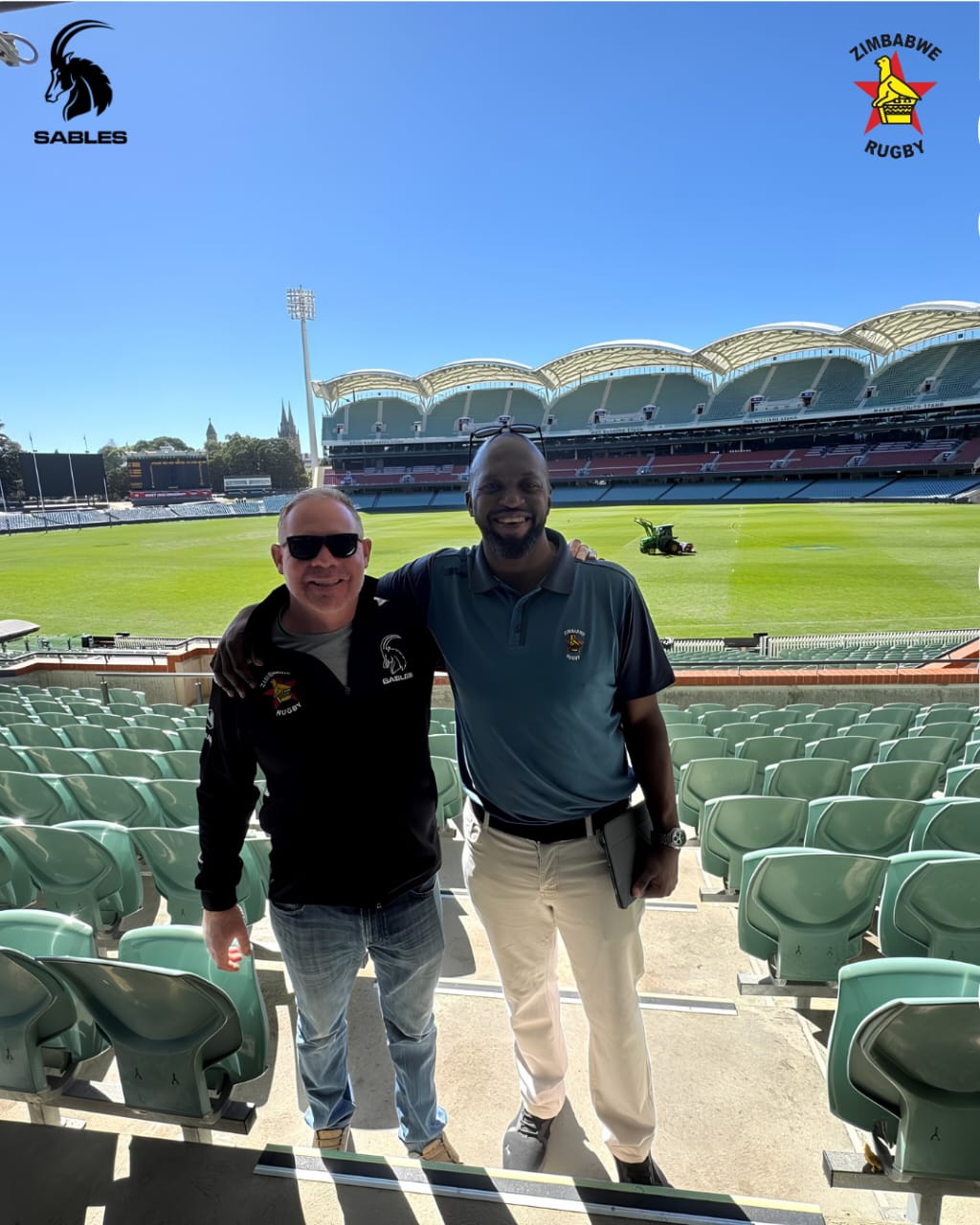
Tinashe Kusema
WITH the countdown to the 2027 Rugby World Cup in Australia gathering pace, Zimbabwe Rugby union has intensified its preparations, both on and off the field, as the Sables gear up for their biggest international assignment in decades.
Zimbabwe Rugby union Interim Management Committee (IMC) general manager Takunda “TJ” Chifokoyo is currently in Australia, where he is assessing facilities that could play a key role in the team’s World Cup campaign.
The visit, which is being undertaken at the invitation of Rugby World Cup Australia, includes inspections of stadiums, accommodation facilities and training venues expected to be used during the tournament.
“So we are here at the behest of Rugby World Cup Australia, which is the organising committee of the Rugby World Cup 2027. What we have been doing is touring the options available to us for hotels or accommodation, training venues, and, of course, touring the actual stadiums that we are going to be playing in.
“We have just completed Adelaide and have just moved over to Townsville, where we will look at the options and locations available there. In Adelaide, we had the pleasure of going to Adelaide Oval, where we will be playing, and it is a beautiful complex.
“That is where the Lions had their tour last year, and it was really good to get the chance to see the world-class facility that it is. We were truly impressed. There are some very impressive training facilities, and the accommodation options here are also world-class. Really, it is a matter of just getting the right combination of hotel and training venue that are going to complement what the boys are doing,” said Chifokoyo.
The timing of the visit coincides with the release of the November fixture block for the World Rugby Nations Cup, providing the Sables with another important opportunity to measure their progress ahead of the global showpiece.
The matches will be played between November 6 and 21 in Europe and Hong Kong.
Zimbabwe endured a challenging start to the competition, suffering defeats to Tonga (36-26), the United States (31-15) and Canada (23-19) during the July window.
The Sables will begin their November campaign against Samoa at the DIY Kitchens Stadium in Wakefield, England, on November 7.
They will then face Uruguay at Trailfinders Sports Ground in Ealing, England, on November 14.
As part of the November programme, Zimbabwe’s designated home fixtures will be played in England and France. Hong Kong China will also stage two of its three home matches in France before returning home to host Tonga at Kai Tak Youth Sports Ground on November 21.
The arrangements were agreed upon by the participating unions for the 2026 edition and reflect the wider European footprint of the November window while retaining key home-market engagements where possible.
The Sables will conclude their campaign against Chile at Stade Chanzy in Angoulême, France.
Chifokoyo said the November fixtures present another chance for Zimbabwe to prove that its recent performances were no accident.
“We are very excited about the November window coming up. It offers us an opportunity to show that our July results and performances were no fluke. This is an opportunity for us to grow as a team and to step up.
“It is not going to be easy at all. We are not expecting it to be, as it is different weather and conditions from what we are used to and what we faced in July. It’s starting to cool down, get wet, and cold. We are playing in a different environment, which is good for our players to be tested and for them to play under different conditions,” he said.
The return to France also carries added significance for the Sables, who suffered the disappointment of missing out on qualification for the previous World Cup campaign.
Reflecting on that experience, Chifokoyo said the team viewed the upcoming matches as an opportunity to make amends.
“it was a mixed bag of results for us back in 2022. Not qualifying for the Rugby World Cup then was devastating to the programme and the boys. However, we are quite excited about returning there, and it presents an opportunity for the team to redeem themselves. It is a great opportunity, and we are really excited about it.”
The Nations Cup brings together 12 unions that have qualified for the 2027 Rugby World Cup in a structured competition designed to enhance competitiveness and provide participating teams with meaningful annual fixtures and revenue-generating opportunities.
The competition has also been designed to provide greater certainty in international scheduling while balancing geographical considerations, player welfare, travel logistics and commercial interests.
The participating unions represent some of rugby’s fastest-growing markets, many of which have achieved significant progress through improved development pathways, increased investment and growing fan support.
For these emerging rugby nations, the Nations Cup offers an important annual platform to test themselves against comparable opposition, refine their systems and gain valuable experience ahead of Australia 2027.
Following the July fixtures, the United States and Georgia lead Pool A and Pool B respectively after recording three wins from three matches.
Zimbabwe and Uruguay remain the only teams yet to register a victory after three rounds in a competition that has already produced memorable moments, including the historic 42-42 draw between Canada and Spain, the highest-scoring draw in Test rugby history, as well as Hong Kong China’s victory over Uruguay.
The tournament is divided into two pools. Pool A, comprising the Americas and Pacific nations, features Canada, Chile, Samoa, Tonga, Uruguay and the United States.
Pool B, representing Europe, Asia and Africa, includes Georgia, Hong Kong China, Portugal, Romania, Spain and Zimbabwe.
Each team plays every side in the opposite pool in a full round-robin format spread across the July and November international windows.
The teams that finish at the top of their respective pools will be crowned the inaugural Nations Cup champions.
World Rugby chairman Brett Robinson said the competition had already delivered on its promise of providing meaningful and competitive rugby.
“The opening chapter of the World Rugby Nations Cup in the Americas delivered exactly what this competition was created to provide: compelling, competitive, and meaningful rugby, with high-scoring drama, historic moments, and nail-biting finishes that captured the imagination of fans around the world.
“November now promises a thrilling climax, with 18 fixtures across Europe and Hong Kong. There, 12 ambitious teams are chasing silverware, and two inaugural Nations Cup titles are on the line. For every union involved, this is more than a competition. It is an important step on the journey to the
Men’s Rugby World Cup 2027 in Australia, providing the intensity, certainty, and opportunity they need to grow, inspire, and perform on the world stage.
“We look forward to seeing which teams seize the moment and make history as the first World Rugby Nations Cup champions.”