Online Reporter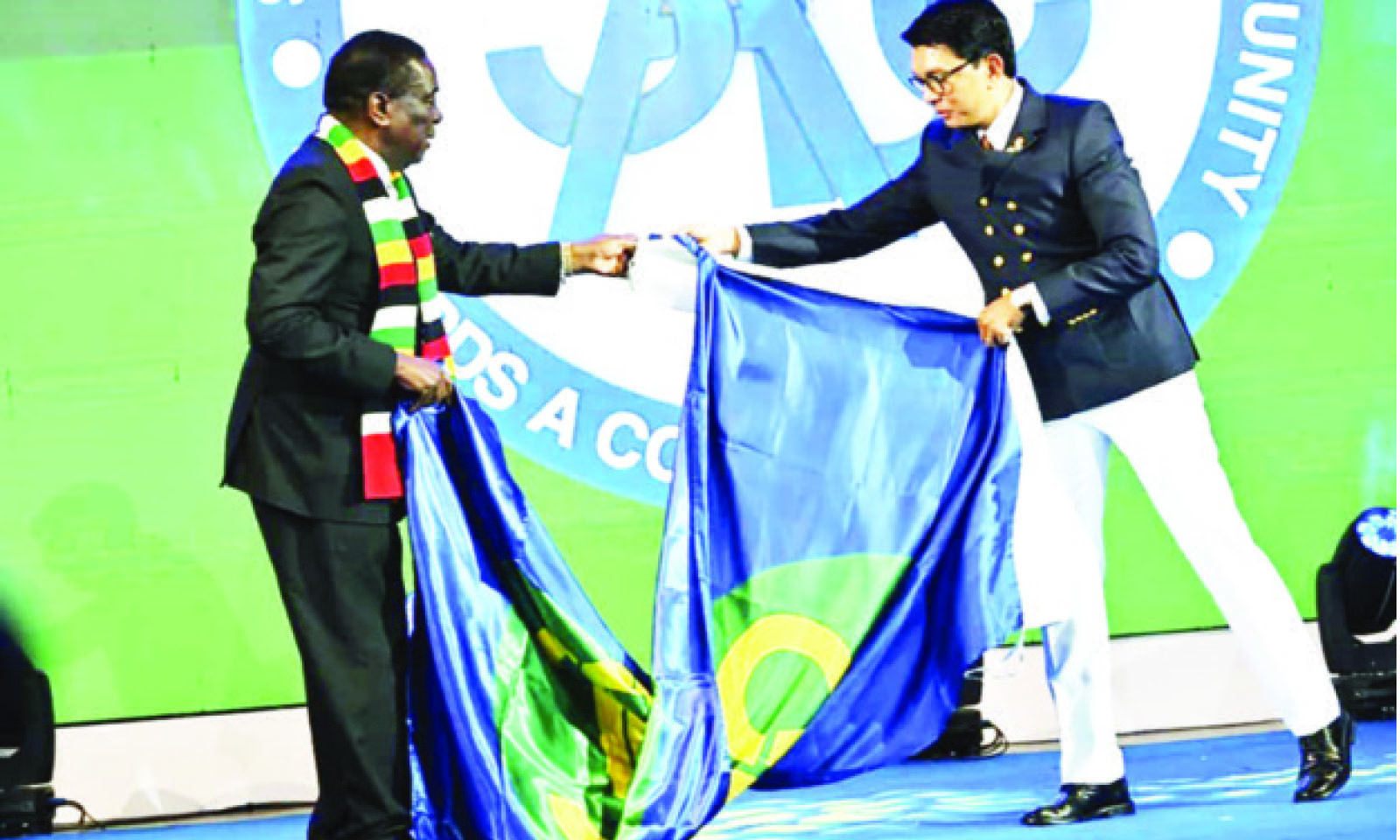
Richard Muponde
Zimpapers Politics Hub
PRESIDENT Mnangagwa’s handover of the SADC chairmanship to Madagascan leader Andry Rajoelina at the 45th Summit in Antananarivo was more than a ceremonial passage of leadership.
It was a pointed reminder of the unfinished business of regional economic integration, a call to action that SADC leaders cannot afford to ignore.
Speaking with the authority of a man whose political life stretches from Zimbabwe’s liberation struggle to the corridors of power and walked alongside the pioneering generation of African freedom fighters, President Mnangagwa’s message was not one of nostalgia but of urgency. His central thesis was unambiguous.
‘‘SADC must stop being a passive consumer of foreign goods and a supplier of raw materials, and instead harness its abundant resources and markets for the prosperity of its own people,” President Mnangagwa said.
“Regrettably, our exports continue to be driven by primary products, and intra-regional trade remains far less than our business with other regions.”
This frank admission reflects a structural weakness that has persisted for decades despite numerous declarations of intent. While SADC boasts some of Africa’s largest reserves of minerals, fertile land, and human capital, its member states remain trapped in an external dependency loop.
They sell unprocessed commodities such as copper, coal, lithium, platinum, and tobacco to the outside world, only to import finished products at high cost. The trade deficit within the bloc is stark, less than 20 percent of SADC trade happens between member states, compared to over 60 percent in the European union and around 50 percent in Asia.
SADC countries are effectively enriching external markets while depriving themselves of the multiplier effects of local value addition and regional trade.
This reality underpins President Mnangagwa’s insistence on stronger economic collaboration.
“Our prosperity is inevitably tied to the success of our neighbours and to that of our region as a whole,” he reminded fellow leaders.
His words resonate with both history and current economics. The founding fathers of SADC envisioned the bloc not just as a political solidarity platform but as an economic shield against global exploitation.
Founding leaders like Cdes Julius Nyerere, Samora Machel, Kenneth Kaunda, and Robert Mugabe understood that true liberation would only be achieved when African nations controlled their resources and markets. Today, as the President pointed out, these pioneers are mostly departed, but their vision remains an unfinished project.
The communiqué of the 45th Summit echoed President Mnangagwa’s sentiments, underscoring the theme of “Advancing Industrialisation, Agricultural Transformation and Energy Transition for a Resilient SADC.” It committed member states to scale up industrialisation, deepen agro value chains, and accelerate renewable energy development.
Communiques need to be matched by deliberate and coordinated action. One crucial area is the ratification and implementation of SADC protocols. President Mnangagwa was forthright.
“I am pleased to report that Zimbabwe has ratified the Protocol [on the Regional Development Fund. However, the number of ratifications remains far below the threshold required. The need to expedite internal processes . . . is essential to drive progress, ‘ President Mnangagwa said
This is a critical bottleneck. SADC protocols on trade, finance, industrialisation, and infrastructure, such as the SADC Protocol on Trade (1996), the Protocol on Finance and Investment (2006), and the Protocol on Industry (2019), are frameworks designed to harmonise policies and facilitate integration. But protocols mean little if they remain unratified or unimplemented.
For example, the SADC Free Trade Area launched in 2008 has yet to achieve its full potential because of overlapping tariffs, protectionist policies, and non-tariff barriers among member states. Meanwhile, external powers continue to flood the region with subsidised goods, undermining local industries.
The comparative lesson from other blocs is striking. The European union did not become the world’s largest single market by accident. It built institutions, the European Central Bank, the European Investment Bank, the European Court of Justice, while aligning fiscal, monetary, and trade policies.
ASEAN in Southeast Asia, despite political diversity, has achieved higher levels of intra-regional trade by harmonising standards and reducing tariffs. Even Latin America’s Mercosur has managed more structured collaboration than SADC in some respects.
President Mnangagwa’s call therefore is not radical but pragmatic, SADC must emulate these models by developing its own functional financial institutions, possibly even a regional currency, and by strengthening the SADC Development Fund to finance its own projects rather than depend on donors.
The risk of inaction is not theoretical. As global power dynamics shift, Africa is increasingly courted by competing powers seeking access to its resources. Without coordinated economic integration, SADC risks becoming a perpetual “dumping ground” for foreign goods, as the President cautioned, while losing control of its strategic industries.
For instance, while the region exports raw lithium to global battery producers, it imports expensive electric vehicles and batteries instead of building local value chains. Similarly, SADC’s agricultural potential is undermined by imports of cheap processed foods, even though it has the capacity to feed itself and export surpluses.
It is against this backdrop that President Mnangagwa’s long years of political and liberation struggle give his message extra weight. Having lived through colonial domination, sanctions, and post-independence turbulence, he embodies the continuity between past struggles for political freedom and the current struggle for economic sovereignty. His appeal was not cloaked in ideology but rooted in hard reality. Infrastructure corridors, one stop border posts, digital platforms, and the mobilisation of diaspora resources are not luxuries, they are necessities if the region is to achieve free movement of goods, people, and capital.
The trade deficit figures tell their own story. South Africa remains the largest trading partner within SADC, but even then, most member states import more from South Africa than they export, creating imbalances. Meanwhile, external trade dominates.
The European Union, China, India, and the United States account for the bulk of SADC’s external trade, often in finished goods. This imbalance perpetuates underdevelopment and stifles local industrialisation. By contrast, if SADC member states were to significantly increase trade among themselves by reducing barriers, investing in cross border infrastructure, and standardising regulations, they would create a self-sustaining market that protects against global shocks.
The communiqué’s recognition of industrialisation as central to resilience aligns with this vision. However, resilience cannot be built without political will. Ratifying all SADC protocols, especially those on trade facilitation, finance, and investment, is the first step.
Operationalising the SADC Development Fund would be another leap forward, ensuring that the bloc can fund its own infrastructure and industrial projects rather than relying excessively on foreign aid. Intra-SADC trade must not remain a theoretical aspiration; it must become the heartbeat of the bloc’s economic strategy.
President Mnangagwa’s parting words were both a reminder and a warning: “We all have the solemn duty to build a strong and more prosperous SADC. The SADC we want shall only be built by ourselves and no one else,’ President Mnangagwa said.
This encapsulates the ethos of self-reliance and regional solidarity that must guide the bloc into the next decade. For too long, SADC has paid lip service to integration while failing to confront the practical obstacles of protectionism, bureaucratic inertia, and political hesitation. The baton may have passed to Madagascar, but the responsibility rests on all member states. The wealth of the region, its minerals, its land, its people, is immense. But without integration, it will continue to serve outsiders more than its own citizens.
The President’s message was less about his own legacy and more about the unfinished task of economic liberation. If SADC leaders internalise his call, the bloc can transform itself from a fragmented collection of markets into one of the world’s most formidable economic regions.
If they fail, the region risks remaining a dumping ground for foreign goods and a conveyor belt of unprocessed raw materials. The choice, as he has clearly set out, lies squarely in the hands of SADC leaders themselves.


 Online Reporter