Chronicle Editor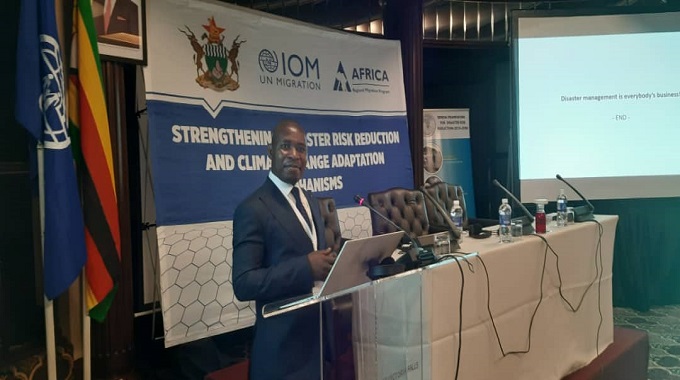
Online Reporter
THE International Organization for Migration (IOM) is conducting a workshop in Victoria Falls for disaster risk management practitioners from across Southern Africa to, among other objectives, capacitate member states to strengthen early warning systems through harmonised policies.
The workshop being attended by representatives of various ministries, agencies, climate change specialists, disaster management and emergency units and academia from Sadc member States as well as non-governmental organisation partners states, started Tuesday and will end on Friday.
The IOM, a United Nations (UN) migration agency, is funding the workshop through the Africa Regional Migration Programme in partnership with the Government of Zimbabwe. It has been noted that disasters can be tremendous setbacks for economic growth, stability and human development, and in the case of Zimbabwe may affect implementation of the National Development
Strategy 1 and attainment of a Middle-Income Society 2030. A majority of hazards in Southern Africa are hydro-meteorological, droughts and floods, landslides, cyclones, and wildfires.
The workshop therefore seeks to provide relevant stakeholders with knowledge and skills to strengthen disaster risk management, climate change adaptation and mitigation in communities for sustainable development in Southern Africa, increase knowledge of managing disasters, share best practices and lessons leant, identify gaps and challenges in disaster risk reduction and management and climate change adaptation and mitigation and develop comprehensive transnational nterventions in the region.
Discussions on the first day noted the need to align risk management to Global Compact for Migration which alludes to a wide and comprehensive understanding of the challenges linked with environment migration nexus, as migrants are prone to disasters.
IOM programme manager (ARMP Southern Africa) Mr Sylvester Deane commended Zimbabwe for taking a lead in coming up with a disaster action plan which includes setting up of mitigation committees across all governance levels.He said IOM is in support of every move and steps that involve coordination and partnership to manage disaster and prepare communities before disaster strikes.
“If you look around us you see that the effect of climate change is impinging lifestyles. Zimbabwe has made tremendous strides in management of disaster so it makes sense that we host this workshop here so that Zimbabwe demonstrates to sister member countries how they have been able after the 2019 Chimanimani episode to set up mechanism that has enabled them to manage disaster,” said Mr Deane. He called for coordination of countries to save lives in times of disaster.
IOM Zimbabwe protection specialist Mr Leonard Kamwendo said the workshop seeks to close gaps in disaster management systems. “IOM as a UN member state organisation is there to facilitate policy transformation and capacitate member states to increase their capacity and resilience towards disaster mitigation. IOM has been assisting disaster-affected countries to do displacement tracking for affected people and so the essence of this workshop is to close that gap.
“We realise that the region doesn’t have strong early warning systems although there is the new centre for emergency coordination which was formed in 2021 in Mozambique and that centre still needs to be capacitated.
“Member states’ early warning systems are still in a manner where there is no harmonised sharing of data and so we are trying to use this workshop to try and come up with strategies on how we can strengthen our data and evidence collection for formal response and policy practices,” he said.
Department of Civil Protection Chief Director Mr Nathan Nkomo said disaster risk reduction should not be taken as an end in itself but there should be focus on resilience building.
He challenged local government systems to improve especially by avoiding human activities on environmentally sensitive areas. Dr Albert Maipisi, a senior lecturer at Women’s University in Africa said climate change is a new threat that needs people to redefine disaster.
“As disaster practitioners we have to intervene where possible to avert disaster and we need to invest in preparedness,” he said.


 Online Reporter