Moffat Mungazi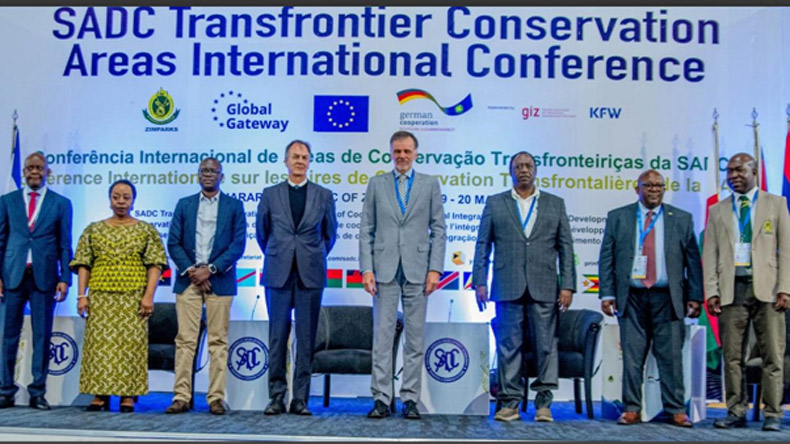
Lloyd Makonya
Correspondent
THE first-ever Southern African Development Community (SADC) Transfrontier Conservation Areas (TFCA) Conference will conclude on Thursday, paving the way for the inaugural SADC TFCA Summit of Heads of State and Government, scheduled for tomorrow.
The high-level Summit will be chaired by His Excellency, President Mnangagwa.
Held under the theme: “SADC TFCAs: 25 Years of Cooperation for Regional Integration and Sustainable Development”, the TFCA Conference marked a milestone in cross-border conservation, drawing over 500 delegates and 30 exhibitors from across the region and beyond.
These included senior officials from SADC Member States, traditional leaders, international partners, non-governmental organisations, academia, and wildlife experts.
Opening the conference yesterday, Permanent Secretary in the Ministry of Environment, Climate and Wildlife of Zimbabwe and chairperson of the SADC Committee of Senior Officials for Environment, Natural Resources and Tourism, Ambassador Tadeous Tafirenyika Chifamba, called for deepened cooperation among member states to secure the ecological and socio-economic future of TFCAs.
“As we celebrate 25 years of the SADC TFCA Programme, we must also focus on enhancing local community engagement and beneficiation. There can be no conservation without local communities who since time immemorial have lived and carefully conserved the natural resources that we so dearly enjoy today,” said Ambassador Chifamba.
Ambassador Chifamba further called for innovative financing frameworks and greater private sector involvement to ensure the longevity of the TFCA programme.
“We need to rope in the private sector and ensure TFCAs attract, not only grants, but also private capital,” he urged.
According to the director of Food, Agriculture and Natural Resources at the SADC Secretariat, Mr Domingos Gove, the TFCA concept has grown remarkably since its inception. From the first TFCA established in 1999, the Kgalagadi TFCA between Botswana and South Africa, the network has expanded to 13 TFCAs across the region, covering over 914 000 km².
Mr Gove highlighted the importance of this growth.
“This exponential increase may put the SADC region as one of the regions in the continent and eventually in the entire globe with the most active actions in terms of conservation efforts”.
He also acknowledged the growing need to manage human-wildlife conflict, and to adopt more human-centred conservation approaches.
“Our conservation work and gains will not be sustainable if we don’t adopt human-centred conservation approaches,” he emphasised.
Mr Gove called on member states to make greater use of regional instruments, such as the TFCA Financing Facility, LEAP Strategy (2022–2032), and the recently launched Toolbox on Community Engagement in TFCAs.
He advocated for the promotion of coastal and marine TFCAs and highlighted the economic importance of tourism, which contributes significantly to GDP and job creation across the region.
Head of Cooperation of the European Union Delegation to Zimbabwe, Mr Franck Port hailed the TFCAs as “one of the most promising and forward-thinking approaches to safeguarding our planet’s rich natural heritage while driving regional integration from below”.
Mr Porte spotlighted the EU’s NaturAfrica initiative, which supports TFCAs through three core pillars of; biodiversity conservation, green economy, and governance and partnerships.
“In Southern Africa, we have earmarked EUR 33 million to support the sustainable management of several TFCA fully aligned with the objectives of the SADC TFCA Programme,” he said.
He also announced that the EU intends to contribute directly to the SADC TFCA Financing Facility to support community-level green economy initiatives within the TFCA framework.
Country director of World Wide Fund for Nature (WWF) Zimbabwe, Mr Itai Chibaya, described TFCAs as “corridors of connectivity, linking nations, cultures, ecosystems, and economies.”
He added that “TFCAs exemplify regional integration in action not only in conference halls, but in the savannahs and forests where real people live, herd, farm, and thrive.”
Germany’s Ambassador to Zimbabwe, His Excellency Udo Volz, commended the region’s progress, noting that the development of TFCAs contributes to the “30 by 30” target under the Global Biodiversity Framework aiming to conserve 30 percent of the earth’s land and sea by 2030.The conference also underscored the urgent need for diversified and sustainable financing and proposed mechanisms include leveraging carbon markets, biodiversity offsets, payments for ecosystem services, and strengthening public-private partnerships.
As SADC Heads of State and Government convene today, the TFCA Summit represents the culmination of years of effort and coordination among regional players. It will reaffirm the political will to prioritise transboundary conservation and ensure that TFCAs remain at the heart of regional integration and sustainable development.
As Ambassador Chifamba noted: “We are at a pivotal moment where our collective actions can lead to transformative changes, benefiting not only our ecosystems but also the communities that depend on them”.
With such commitment and vision, SADC TFCAs are poised, not only to protect biodiversity, but to anchor a model of prosperity that is both green and inclusive.


 Online Reporter