

 Chronicle Editor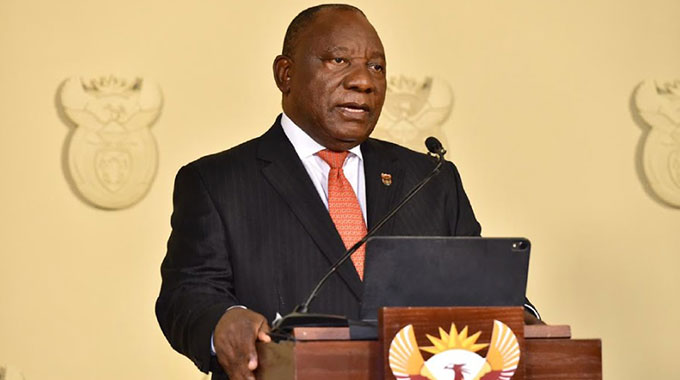
Mashudu Netsianda, Senior Reporter
AFRICAN Union (AU) chairman and South Africa’s President Cyril Ramaphosa has reiterated the call for the removal of illegal sanctions against Zimbabwe and Sudan to allow the two countries to adequately respond to the Covid-19 global pandemic.
President Ramaphosa made the call in a pre-recorded message delivered last Thursday to the virtual 31st United Nations (UN) General Assembly Special Session on the coronavirus (Covid-19) pandemic held at the level of Heads of State and Government in New York.
The meeting, the first-ever special session to address a pandemic, was held virtually in light of Covid-19.
President Ramaphosa made the call to the General Assembly in his capacity as the AU chairperson.
He also called on the international community to support the rollout of a comprehensive stimulus package for African countries.
“We reiterate our call for a comprehensive economic stimulus package for Africa, for a suspension of interest payments on Africa’s external and public debt, and for the lifting of all economic sanctions imposed on Zimbabwe and Sudan to allow them to adequately respond to the pandemic. It is only through multilateral cooperation that we can overcome this global emergency,” he said.
“In addition, an African Green Stimulus Programme is being developed to ensure our economic recovery takes place in a more sustainable manner. As African countries we will continue to need substantial support to recover from the pandemic.”
In the spirit of solidarity and cooperation, President Ramaphosa said, there was need for the international community to continue working together to overcome the prevailing global health crisis and build a better, safer, more equitable, peaceful and prosperous world.
The sanctions against Zimbabwe have been in existence for the past two decades following the historic land reform process embarked upon at the turn of the millennium.
The US sanctions were imposed through the misnamed Zimbabwe Democracy and Economic Recovery Act (ZIDERA) of 2001 while the EU introduced its own measures in 2002, although most of the embargoes have been lifted since 2004.
President Ramaphosa made a similar call in September during the 75th Session of the UN General Assembly
He also told the General Assembly that since the start of the pandemic there has been coordinated international action to ensure that all countries are able to respond effectively.
“This collaboration has been of particular benefit to developing economies, which continue to shoulder the burden of poverty, inequality and underdevelopment. As the African continent, we have driven a deliberate, targeted and coordinated response to Covid-19,” he said.
President Ramaphosa said through the AU, the continent established a Covid-19 Response Fund to contain the pandemic in member states and enable their economies to recover.
“To ensure that there is equitable access for all to an effective vaccine, we call on UN member States to work with the WHO on the Access to Covid-19 Tools Accelerator and the Covax Facility.
The AU appointed several special envoys to solicit concrete support for the continental effort as pledged by the G20, the European Union and international financial institutions.
“We launched the ground-breaking African Medical Supplies Platform to facilitate access for all African countries to critical equipment and supplies. We have also established a Covid-19 African Vaccine Acquisition Task Team to ensure that African countries are able to access and distribute affordable and effective vaccines without delay,” said President Ramaphosa.
Speaking during the same meeting, the President of the 75th Session of the United Nations General Assembly Volkan Bozkir said global extreme poverty is expected to rise for the first time in over 20 years with up to 115 million people at risk of being pushed into extreme poverty.
“We face the deepest global recession since the Great Depression and the broadest collapse in incomes since 1870.
The world economy has shrunk by 4,4 percent and foreign investments have been evaporating,” he said.
“Trade and travel restrictions; steep declines in export earnings, tourism and remittances, all put at risk the livelihoods of billions all around the world.”
Mr Bozkir said the pandemic has also highlighted the need for more investment in social and health services around the world.
“We need to develop projects for social inclusion of the most vulnerable groups. We must ensure universal health coverage,” he said.
“While tackling the immediate consequences of the pandemic, we must also work towards the 17 Sustainable
Development Goals (SDGs), uphold our pledge to leave no one behind and ensure that our recovery efforts spur on the SDGs.”-@mashnets


 Online Reporter