admin
admin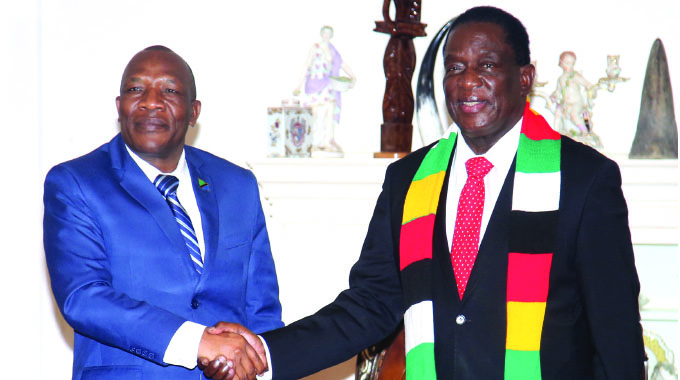
Joseph Madzimure Senior Reporter
ILLEGAL sanctions imposed by Western countries on Zimbabwe are not only affecting Zimbabweans, but the whole of SADC, and their removal will ensure regional economic growth, outgoing Tanzanian Ambassador to Zimbabwe Professor Emmanuel Mbennah said yesterday.
Speaking soon after bidding farewell to President Mnangagwa at State House in Harare, Professor Mbennah said sanctions imposed on Zimbabwe are illegal and have had adverse spill-over effects on the whole of SADC.
“I have said on numerous times, in media and on other platforms saying that with all fairness sanctions do not achieve anything, don’t help anyone, they cause unnecessary pain, they are illegal, they should be immediately removed unconditionally,” said Professor Mbennah.
He has served as ambassador to Zimbabwe for the past three years.
“I have the opportunity to call for the removal of sanctions using my status, my role and my responsibility as a diplomat to speak against sanctions.
“In my three years stay in here in Zimbabwe, I have had a very good and fruitful time. I have met friends. I have learnt the culture of the people of Zimbabwe. I am very happy about the zeal that the people of Zimbabwe have when it comes to work,” he said.
Under the leadership of the late Tanzanian President Dr John Pombe Joseph Magufuli, a bold decision was taken at the August 2019 SADC Summit in Tanzania which set October 25 as a regional day to show solidarity with Zimbabwe and call for unconditional lifting of the illegal sanctions.
On this day member states collectively voice their disapproval of the sanctions on Zimbabwe through different activities.
The United States and the European Union have been renewing sanctions despite the Second Republic’s drive for a new Zimbabwe cemented by economic and political reforms.
The First Republic is a closed chapter and kudos to the SADC leaders for the solidarity and joining Zimbabwe in its repeated call for the removal of sanctions. Professor Mbennah said Zimbabwe and Tanzania have strong political and historical ties and will enhance economic cooperation to improve the welfare of their citizens.
He said he was inspired by President Mnangagwa’s commitment to transform the livelihoods of people in line with Vision 2030.
“I have been more inspired by the sense of Vision 2030 by the leadership of the country especially His Excellency President Mnangagwa. He is mobilising everyone to focus on the future, to continue to build Zimbabwe in line with Vision 2030 which is a very good vision. The President is really inspiring everyone to pull towards Vision 2030,” said Professor Mbennah.
He further said the policies being vigorously pursued by President Mnangagwa under the Second Republic will see Zimbabwe attaining an upper middle income economy by 2030.
“I was also encouraged by trade between our two countries. There is an increased use of Port of Dar es Salaam. I am told last year alone there were four million cars going through the Port of Dar es Salaam, with half of the cars coming to Zimbabwe. Zimbabweans are using the port in a big way.
“We are now thinking of making it easier for Zimbabwean business people who want to use the port, by opening an office here in Harare, so that Zimbabweans can access some of the basic information they require. We have Zimbabweans doing business in Tanzania using the port and also buying merchandise from Dar es Salaam,” said the Ambassador.
“We managed to share and exchange notes with the Minister of Information, Publicity and Broadcasting Services Monica Mutsvangwa, who led a media team to Dar es Salaam to visit the former Liberation Movement sites to see their state, to document, to bring to life memories and training camps used by Zimbabweans and other SADC countries during the liberation struggle.
“That documentation is in place; it will continue to inform younger generations of what happened during the liberation struggle. It also encourages us to do something about the historical sites, in order to preserve the heritage sites. They will always inspire future generation, that the freedom and independence that the people of Zimbabwe are enjoying today did not come cheaply. It came with a cost and sacrifice. We are very grateful that Tanzania was among other countries that provided the support that was needed,” he said.
“Being a professor, I have had interaction with colleagues in universities to seek areas of cooperation. We even suggested the possibility of having a programme on Nyerere studies.
“How can we have training programmes at university level either history or political science that has a focus on Julius Nyerere, his life and philosophy and his contribution to the liberation struggle of Southern Africa including Zimbabwe?” he said.
The two counties will be following up on the five agreements signed under the Zimbabwe-Tanzania Joint Permanent Commission Cooperation in 2019.
The MoUs are on: diplomatic and political consultation; cooperation on economic, industrial and trade relations; tourism development; promotion of small and medium enterprises development; and cooperation towards the promotion and empowerment of women.



 Online Reporter