

 admin
admin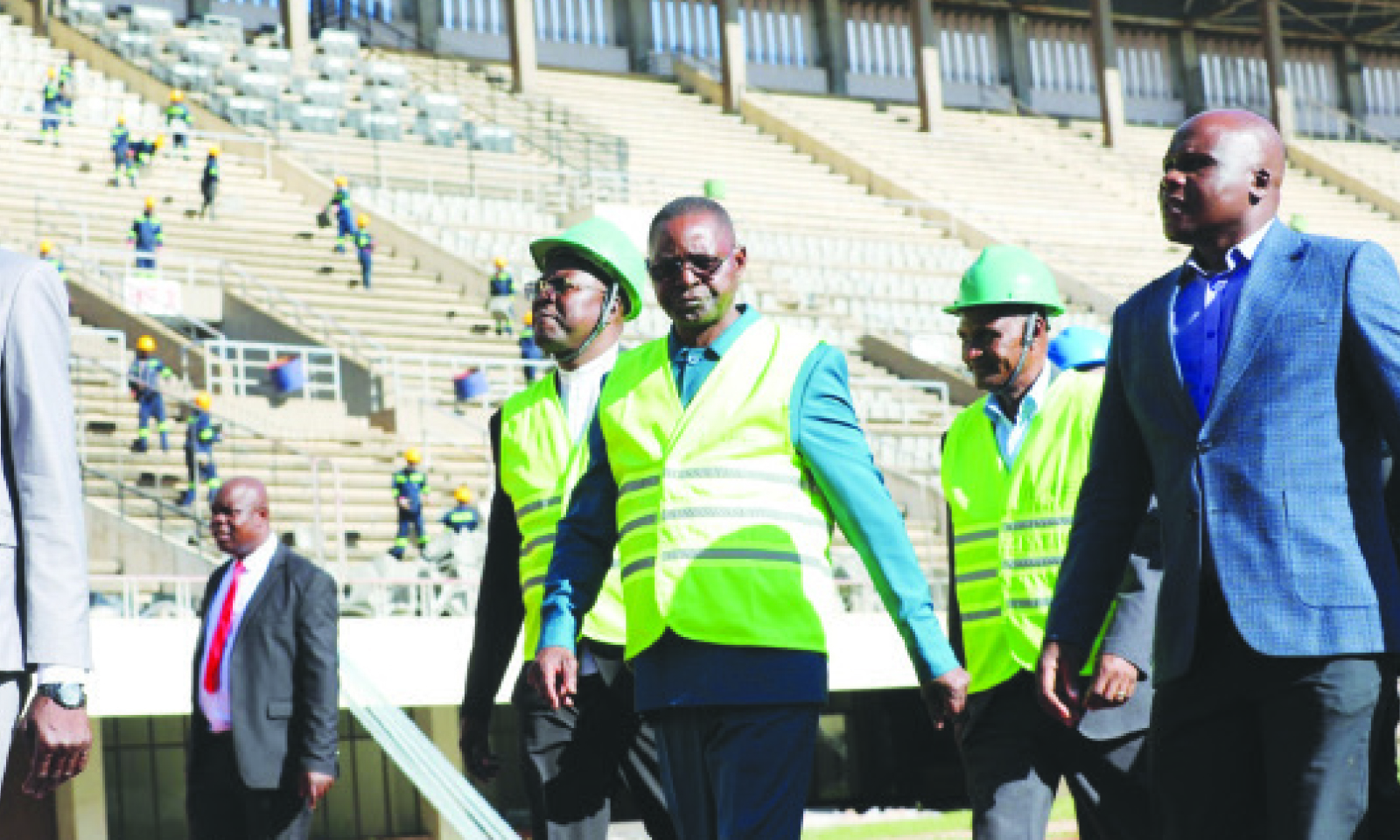
Eddie Chikamhi
Zimpapers Sports Hub
Newly appointed Minister of Sport, Recreation, Arts and Culture, Anselem Sanyatwe, yesterday got a first-hand appreciation of the extensive progress being made in the refurbishment of the National Sports Stadium — a critical step in Zimbabwe’s bid to return to hosting international football on home soil.
With the local football fraternity anxiously hoping for the stadium’s recertification by CAF and FIFA, Minister Sanyatwe and his entourage toured the facility, guided by a team that included Permanent Secretary Nicholas Moyo, Sports and Recreation Commission Director General Eltah Nengomasha, and representatives from the contracted firms.
Although Minister Sanyatwe declined to offer a detailed comment during his first official visit to the venue, he expressed general satisfaction with what he observed.
“I’m a man of action,” he said. “I believe in less talking and more delivering. I will only issue a progress report when the renovation work has reached around 95 percent completion.”
The minister inspected several key areas, including the newly installed electronic turnstiles, changing rooms, playing pitch, gym, anti-doping rooms, and the media centre.
He was particularly impressed by the installation of bucket seats, with contractors visibly hard at work on the terraces during the tour.
The upgrades have gathered momentum in the past three weeks. The installation of electronic turnstiles is now complete, and around 60 percent of the bucket seats have been mounted.
Bays 16 to 31 and the VIP tribune are now ready for occupation, and there are plans to extend the terraces down to the pitch perimeter — a design already visible in Bay 1 and the VIP section. Once complete, the revamped stadium is expected to have a seating capacity of 42 000.
Additional seating is currently stocked in the venue’s storerooms, with another consignment expected from China.
Besides the bucket seats, the renovation scope includes the electronic turnstile system, water reticulation upgrades, and locker replacements in the changing rooms. The current metal lockers are corroding and will be replaced with modern alternatives.
Work is also ongoing on the pitch and ablution blocks, with the broader goal of meeting CAF and FIFA standards — potentially in time to host international fixtures before year-end.
The National Sports Stadium was closed for renovations in 2023, two years after it had been condemned by CAF and FIFA for falling short of international requirements. The ongoing upgrades aim to bring the facility up to scratch and end Zimbabwe’s reliance on foreign venues for home matches.
The Warriors are hopeful that renovations will be completed in time for their remaining FIFA 2026 World Cup qualifiers against Rwanda and South Africa, scheduled for September and October.
As a national project, the refurbishment received an allocation of ZiG 884 million from Treasury, and the Government has also partnered with private contractors to expedite progress.
Minister Sanyatwe also called for the restoration of the players’ tunnel, which had been abandoned following concerns raised by CAF over potential injury risks.
He emphasised the importance of a comprehensive renovation, pointing out that the tartan track used for athletics must also be revitalized.
“No aspect of the stadium should be left behind. Every part must be in top-notch condition,” he said.
Originally, the bucket seat installation and other upgrades were expected to be completed by December 2024, but the timeline has since been extended.


 Online Reporter