

 dyton mupawaenda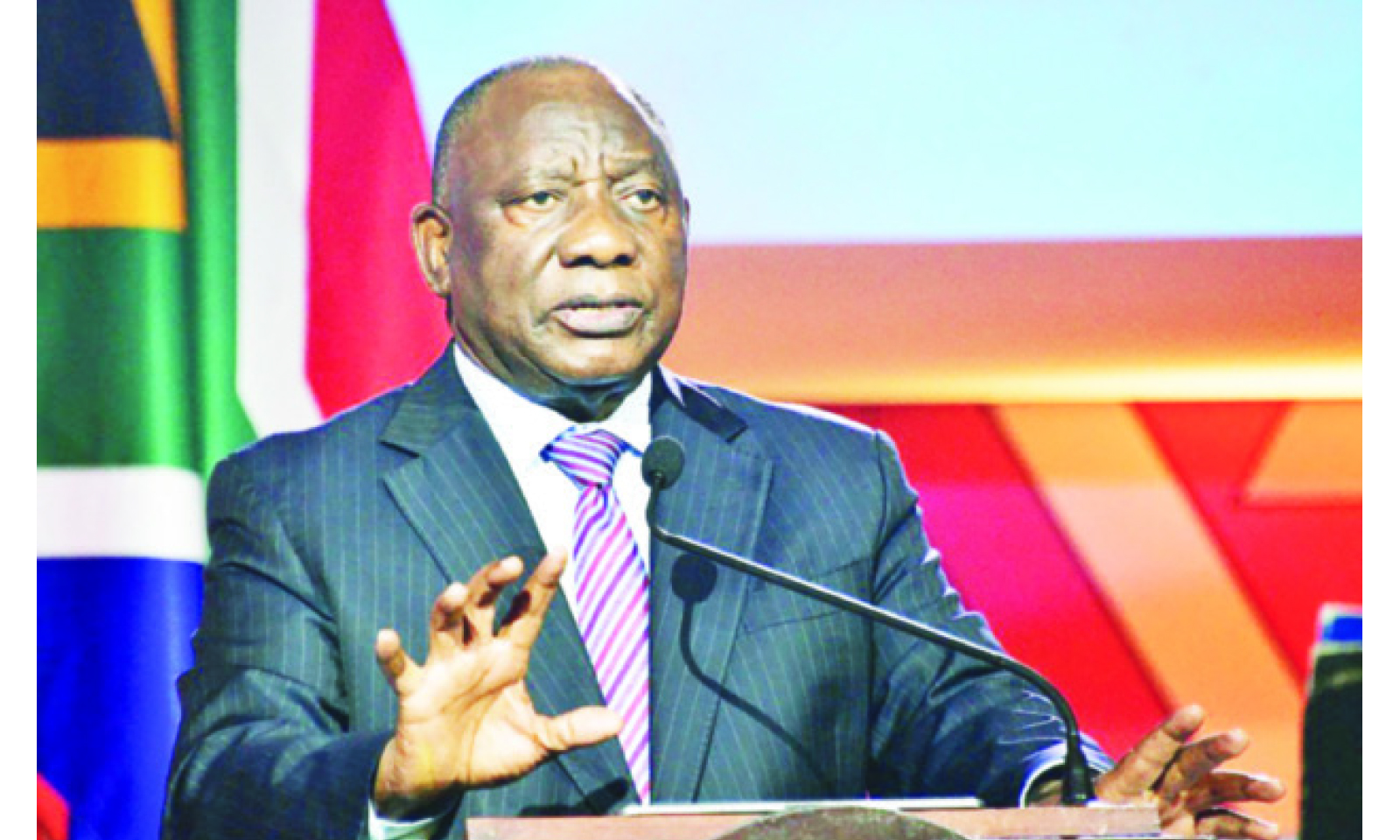
Langton Makuwerere Dube-Herald Correspondent
The growing diplomatic spat between South Africa and the United States, allegedly over the passing of the Land Expropriation Bill, continues to inundate media spaces.
Interestingly, it has generated competing interpretations within South Africa and across the continent.
Along the continuum, proponents view the Bill as the overdue remedy for the residual effects of colonialism.
At the same time, protagonists (primarily whites) see no iota of affirmative action in the policy but, instead, a race-based instrument designed to support or justify a pogrom on the white population.
The protagonists’ argument dominates this piece’s primary submission.
A section of White South Africans, led by the AfriForum and the solidarity organisations, is growing resistant to land redistribution.
Therefore, as a starting point, I focus on the origins, metaphysics, and dynamics of this white fear, its prejudices, hubris, and white claims of entitlement and belonging, which they have unconsciously projected over the years.
White entitlement emanates from a deeply held belief in exceptionalism, one that makes them fail to recognise any civilisation other than theirs.
In their collective psyche, the colonialists never robbed or displaced anyone from their lands; to them, that part of history is not relevant. Their warped belief that they discovered Africa vast and empty strengthens their sense of entitlement.
Instead, they perch on colonial aesthetics and the ‘white man’s burden’.
In their prejudiced colonial worldview, natives were invisible munts who could not pass the master; being oblivious to longitude and latitude, they were just a wandering bundle of drives, energies, and spirits.
Therefore, they continue to ignorantly believe that Africans should be grateful because, had it not been for white ingenuity, maverick frontiersmanship, reflective energy, and collective thrift, modern-day South Africa would have never been realised.
The combination of land ownership and entrenched values of exceptionalism buttressed by language and culture laid the foundations for what is now known as Afrikaner Nationalism. Throughout the colonial years, onomastic practices solidified their claims of belonging.
As a result, the narrative that South Africa belongs to all tribes and races that migrated from elsewhere is incorrigible on their part.
Hence, they question black South Africans’ claims of indigeneity.
On their part, Whites argue that they are not birds of passage. Unfortunately, such a monolithic memory that debases native agency while clinging to colonial aesthetics has not only made them cogitate less about black suffering, but has also created a delusion of grandeur.
As a corollary, such an obstinate refusal by a section of white South Africans to decentre, de-authorise, and divest themselves of privilege has regrettably sustained and entrenched colonial settler values, pushing the country along the road toward an eventuality that they so dread.
The negotiated settlement at independence in 1994 and the Truth and Reconciliation Commission did nothing to change their attitudes and prejudices.
Left to their enlightened self-interest to walk the extra mile, they stubbornly retreated into their enclave mentalities.
As a result, a cavalier form of independence and reconciliation was bequeathed to the new nation.
Preserving the status quo, it created a rainbow nation in which whites remained economically Alpha.
Fast-track to the contemporary. Still trapped in their ossified racial proclivities, the AfriForum, Solidarity, and other like-minded organisations that may be subterranean for now are victims of their colonial amnesia.
These associations are platforms where Afrikaner nationalists ignorantly commiserate with each other as victims while lobbying the Empire for international support, hoping to circumscribe the inertia of affirmative action.
Hoist by their own petard, they are trapped in their delusional enclave society, characterised by a complex web of fear of loss and privilege.
In their cocoon, they reinforce a nostalgic colonial memory that sanitises their excesses.
Their fear of land redistribution stems from their guilty conscience from past excesses.
Because they refused to walk the extra mile to shed their nauseating sense of entitlement and exceptionalism, they fear retribution.
Hence, they equate land redistribution with words like reverse racism, genocide, pogrom, and all kinds of nomenclature.
They may posture themselves as victims, but that is pure bluffing.
The narrative that whites are systematically being targeted and maimed and that the government intends to grab land from white farmers wantonly is pure mischief, devoid of substance.
Besides, land redistribution is not an avant-garde policy in South Africa; it also has precedence in many countries as a solution to the limitations of post-colonial wealth distribution.
These parochial Afrikaner nationalists are afraid of a wholesale land expropriation without compensation.
However, the government has maintained that redistribution will be undertaken within the confines of the Act and Section 25 of the South African Constitution.
South Africa has a liberal democratic system and culture that many can only admire and dream of, but these white goons have been ducking behind it. But that can only go so far because the situation in South Africa is untenable; it is a ticking time bomb.
As expected, the Empire is fighting back in myriad ways; everyone can smell it from afar.
What is happening in South Africa is a regrouping of the Empire and its local surrogates, interlocutors, or appendages. The aim is to resist affirmative action policies and besmirch them as pure chicanery.
Just as the script was read in Zimbabwe, nothing comes as a surprise anymore. They can label the bill as resource nationalism, a race-based tool of white segregation, or anything else. However, the fact is that the overbearing nature of the Empire, the asymmetries of global capitalism, and the racial affluence disposition in South Africa feed and sustain the need for land redistribution.
In his State of the Nation Address in February, South Africa’s President Cyril Ramaphosa stated that such imperialist and egotistic tendencies will not bully South Africa.
While the Empire clutches at straws as its influence wanes across the continent, what is baffling is that it has learned nothing over the years.
Its tendency to employ a crudely hectoring approach when dealing with matters like these has only pushed target countries to dig in and rally around the flag.
Whether the US is trying to undercut the BRICS forum or make South Africa pay for its stance against Israel on the Palestinian cause, such scare-mongering tactics are always self-defeating. In fact, such an approach, reminiscent of the Empire’s perfidious Albion, has always worked in favour of countries like China and Russia.
To those obstinate white South Africans drowning in their colonial morbidities, whether now or in the not-so-distant future, a time is coming when lines will be drawn, and the National Democratic Revolution will be fulfilled.
The land issue in Southern Africa is not a colonial obsession by the black population; it is modern history. It is only a matter of time before the chickens come home to roost.
Dr Langton Makuwerere Dube is a postdoctoral research fellow in the Centre for Africa-China Studies (CACS) at the University of Johannesburg’s Confucius Institute (UJCI)


 Online Reporter