admin
admin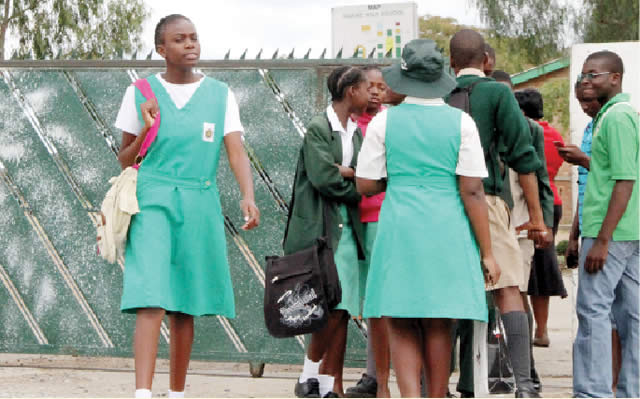

Yoliswa Dube Features Reporter
SOME congested schools around Zimbabwe still use the hot seating system. It is estimated that 1,500 schools require rehabilitation and the country needs 2,000 more schools to close the teacher-pupil ratio that stands at 1:70 at some schools instead of 1:30, which the Ministry of Primary and Secondary Education recommends.
A significant number of pupils have to walk close to 24km to the nearest school while others attend lessons in tobacco barns and under trees.
Maybe this is the reason why the ministry’s boss, Lazarus Dokora has announced that government would start levying school suppliers in a bid to raise funds for developing infrastructure in schools.
Dokora said there are over 1,600 service providers working with schools and would all be levied to help the government raise money to build new schools.
But the decision has not been popular among parents who feel they would indirectly pay the cost of the levy.
Zimbabweans are heavily taxed and have to pay income tax, sales tax, property tax and excise duty among many others.
The new levy would add to the financial burden carried by the end user, the parent.
“The school my daughter attends has with effect from this term hiked fees by about 40 percent. Where do they think we’ll get the money from if fees are going to come to about $800 for a child in primary school? I’m angry because this is really a lot of money. Now, the introduction of this levy would mean my child’s fees will increase even more,” said a frustrated Michael Muchechetere.
In his logic, Muchechetere believes the moment suppliers pay a levy to the ministry, they would also increase the prices of their goods and consequently schools would increase school fees to meet the demand.
“This is just ridiculous. We honestly just can’t keep up with all these requirements. Of course, we want our children to get the best education but at what cost really? This has just gone too far.”
Various service providers supply schools with stationery, computers, sports equipment, science and technological equipment among other equipment.
Dokora said at the moment, all these suppliers do not pay anything to his ministry; they merely get money from schools and walk away. But parents are livid.
“Our education system has been on a rollercoaster ride for a long time now. The minister (Dokora) keeps introducing new things which either disadvantage us as parents or affect our children negatively,” said Portia Dongo, another parent.
She said it did not make business sense why the ministry would need remittance from school suppliers.
“How are suppliers obliged to pay the ministry any money. It doesn’t make sense to me. All these years, no one saw it necessary for suppliers to go via the ministry to do business, why now? This system will be abused extensively I tell you,” said Dongo.
The proposal would be prone to manipulation, she added.
“I’m certain this is going to create more problems and it’ll become extremely difficult to regulate. I anticipate that corruption will also be rife as suppliers try to override the system,” said Dongo.
The levy should be viewed as a means of regulating business in schools and simultaneously raise funds but instead, the decision has opened a can of worms.
Some experts believe the proposal is too soft and agree it is prone to manipulation while others insist there is a bigger picture to focus on.
“Everyone in the chain will be affected. It’s not an individual who becomes victim but everyone is affected. There’ll be direct and indirect costs contributing to the huge bearing levying school suppliers will have, regardless of which part of the chain one is. By the time the cost gets to the parent, it’s very heavy,” said economist, Davison Gomo.
The end user would become the depositor, a burden which is heavier at consumption level, he said.
“When we have narrow fiscal space, every system must find means to survive. The government can’t meet that cost that’s why it needs to find other means of raising that money. There is need to get our economy to work more effectively, this is where the answer to all these problems lies,” said Gomo.
If hurdles are removed and businesses take off, more people are absorbed into the employment system which would mean more corporate tax and tax from individuals.
“All the fundamentals can be sorted out to create room for growth. The country is very hospitable, Zim-Asset is very clear so there is a glimmer of hope, the roadmap for recovery is there. Our attention should be in ensuring the economy works everywhere because the impact of its failure is on the ordinary person,” said the economist.
The move to introduce supplier’s levies comes at a time when the country is set to adopt a new school curriculum.
The ministry has completed a draft Curriculum Framework that will see Agriculture being examined at primary school level while Chinese, French, Swahili and Portuguese will be compulsory subjects in all government schools.
According to the draft, the first Grade 7 General Paper Examination with the agriculture component will be written in 2016.
The draft becomes effective once it is approved by Cabinet.
Dokora has been accused of causing confusion in schools through a raft of policy changes he has made since taking over the portfolio in 2013.
Various stakeholders have said Dokora’s policy pronouncements since assuming office were negatively affecting schools, while accusing him of failing to consult.
The proposed salary adjustments for heads according to qualification, skills, experience and type of the school headed as well as the ban on incentives, holiday and extra lessons proved to be unpopular with teachers.
The directive for schools to seek legal recourse against parents who default in paying levies and tuition fees, instead of sending pupils home, as well as the banning of Form 1 entrance tests continue to generate debate.
Now, there is a proposal to introduce industrial attachment for O-Level pupils, which has also been met with controversy.
Dokora said he did not expect the organisations to cry foul, adding that the introduction of the levy was long overdue.
“No one should cry foul when we say we need to levy all those who do business with our schools. That has to be soon, probably before the end of May. My colleagues in Cabinet have been asking me questions on the other avenues in terms of revenue inflows. They gave me authority to start infrastructure development,” said Dokora.
He said devious service providers who were not interested in paying the levy risked losing business with schools.
“If you pass the cost to the schools it means your product will be more expensive and then we’ll help the schools avoid your expensive tools,” said Dokora.
He said the levy would be used to develop infrastructure, which will in turn create more demand for service providers’ products.


 Online Reporter