Online Reporter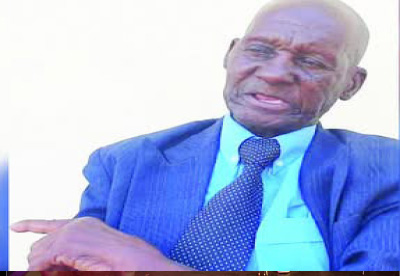
Lovemore Dube, Zimpapers Sports Hub
HE was fast, fearless and rarely missed the net. Nevison “Scorer” Masunda, one of Zimbabwe’s earliest football stars and a former teammate of the late Vice-President Joseph Msika at Mashonaland United (later to change to Zimbabwe Saints), has died in Bulawayo at the age of 101.
Masunda passed away early Thursday morning in Bulawayo. He had been in good health until Tuesday and had been caring for his ailing wife, Moud (nee Musonza), when he suddenly fell ill.
His eldest son, Robson, confirmed the death.
“He was sick for just two days. Our mother is the one who had actually been unwell. He died at a city surgery in the morning,” said Robson.
Believed to be the oldest surviving Zimbabwe Saints player, Masunda turned 101 in March.
A funeral service will be held at Nyaradzo Funerals in Bulawayo at 3 pm on Friday. The body will then be taken to Chawatama Village in Buhera for burial on Saturday morning.
In a wide ranging interview at his Chawatama home earlier this year, Masunda, born on March 25, 1924, shared memories from a remarkable life on and off the pitch.
Originally from Chivhu, he said his family relocated to Buhera early in his childhood when white settlers claimed the more fertile land. From there, they moved to Mvuma, where he began school and played football with boys from Chirumanzu.
At 20, like many young men of his generation, he moved to Bulawayo in search of work. He joined Mashonaland United in 1944, 13 years after the club’s formation, and started his career as a right back before switching to a forward position.
Known for his speed, ball control and powerful shot, Masunda said he met Joseph Msika at the club, where they played together, Msika as a centre back and Masunda leading the attack.
“Msika was tall and imposing. He played right back when I was now a striker,” Masunda recalled. “He always spoke about politics.”
Masunda said clubs in those days often formed along ethnic lines.
“Even across town, the English, Irish, Hellenic, Italians, Jewish, and Portuguese had their own clubs, like Queens, BAC, Parkview, Municipals, Postals and others,” he explained. “There were also clubs like Gaza, which had players from Chipinge; Africa United from Chirumanzu; and Mashonaland United, which drew from a broader base.”
Another team he admired was United Africa, a strong side with ties to Mashonaland United.
He also pursued further education and credited old friends from Mvuma for convincing him to join the club.
His skill in front of goal earned him the nickname “Scorer.” At the height of his career, he was repeatedly called up to the Southern Rhodesia national select side, which played international matches against Malawi, South Africa, and what’s now the Democratic Republic of Congo.
“Those were great times. We’d be flown out and paid three pounds for the cup. That was a lot of money then, you could buy quite a few things with it,” he said.
Masunda’s contemporaries included players like Scholar, Jambok, Dutchie, Chester and Gibson Makanda, Matthew “303” Maruma and Jeffrey “Dusty King” Gotora, the one handed dribbling maestro.
He retired from football in 1953 to focus on work and start a family. He married the daughter of Mr. Musonza, a Saints official at the time.
Masunda remained a loyal Zimbabwe Saints supporter and watched the club evolve, especially after 1975 when Joshua Nkomo encouraged Mashonaland United and Highlanders to drop tribal identifiers from their names.
He said even during World War II, football continued to be played widely across the country.
Masunda credited Msika with drawing him into political activism.
He is survived by his wife Moud, three sons, a daughter, 25 grandchildren and 20 great-grandchildren.