Joseph Madzimure and Remember Deketeke
THE Second Republic, in partnership with private sector players, is stepping up efforts to improve access to clean and safe water as part of broader initiatives to enhance public health, restore essential infrastructure and improve the livelihoods of communities across Zimbabwe.
The rehabilitation of ageing water infrastructure, including the replacement of old pipes and the expansion of water distribution networks, is expected to improve the availability of potable water to households in towns struggling to meet growing demand.
Under Zimbabwean law, water resources are vested in the State through the President, while local authorities are legally responsible for supplying water and maintaining water infrastructure within their areas of jurisdiction.
Section 3 of the Water Act (Chapter 20:24) provides that, “Subject to this Act, all water is vested in the President.”
Section 183 of the Urban Councils Act (Chapter 29:15) also empowers councils to provide and maintain water supplies within or outside their areas, including constructing the necessary infrastructure and entering into agreements relating to water supply.
The legal framework therefore provides for the President’s vesting of water resources alongside the role of local authorities in delivering water services to communities.
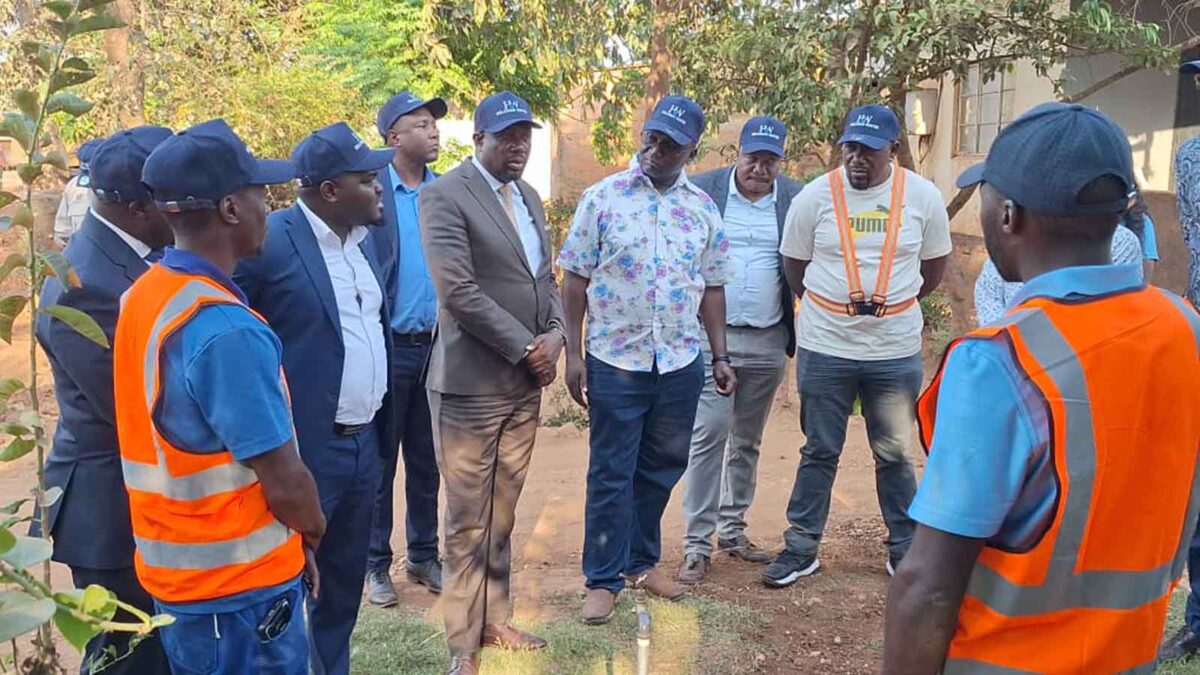
Helcraw Water chairman Mr Farai Jere said the ongoing water infrastructure rehabilitation programme was aimed at addressing challenges across the entire water supply chain, rather than focusing solely on the introduction of prepaid water meters.
In an interview Mr Jere said the programme was designed to increase water production capacity while ensuring that more of the water being pumped reached consumers.
“It is the entire water infrastructure rehabilitation which is happening. I know people always call it a prepaid water system because that is the end of the value chain. But what we are doing is increasing the capacity of water for Chinhoyi,” he said.
Mr Jere said Chinhoyi town was currently pumping 22 megalitres of water per day against an estimated daily requirement of 75 megalitres, highlighting the gap between supply and demand.
He said the town’s projected growth would push its future water requirements to 84 megalitres per day, making investment in production and distribution infrastructure essential.
“Chinhoyi is currently at 22 megalitres per day. That is the water we are pumping, against a requirement of 75 megalitres per day,” he said.
“Because of the expansion of the town, we intend to grow to 84 megalitres per day. So, this is the scope which we are doing.”
However, Jere said the challenge was not limited to insufficient production, as some of the water being pumped was failing to reach residents because of problems within the distribution network.
“To start with, the 22 megalitres which we have, we are having a problem because it is not all that water that is reaching our people,” he said.
As part of the rehabilitation programme, old asbestos and steel pipes are being replaced with polyvinyl chloride (PVC) pipes to improve the distribution network and address deterioration in the ageing infrastructure.
Mr Jere said the replacement of the old pipes was a critical component of efforts to ensure that residents received clean and safe drinking water.
“That is why I find this project we are starting is the entire value chain. We are starting from the replacement of the asbestos pipes with the PVC pipes,” he said.
He said some of the existing pipes were susceptible to corrosion, having been installed when the towns were first established.
“The whole idea is for our people to get clean water. Every Zimbabwe for our people to get potable water,” he said.
The programme is also being implemented in other urban centres, including Harare, Kwekwe, Hwange and Bulawayo, as the authorities and their partners seek to improve water delivery and rehabilitate ageing infrastructure.
He said work in each area could reveal further interventions required to improve water production and distribution, resulting in changes to the original project scope.
“As you can see, we find that something needs to be done, and a lot of more money is going to be put in,” he said.
“It was very difficult for us to scope, like for Harare when we started with a certain budget, but a lot of things started coming up. So this is where we are,” said Mr Jere.