Chronicle Editor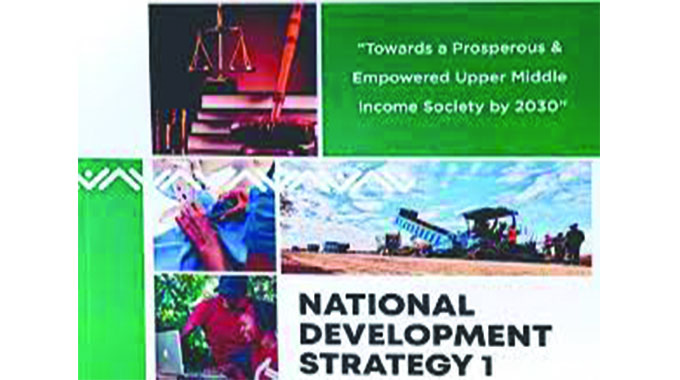
THE National Development Strategy 1 (NDS1) was launched upon the realisation that Zimbabwe had in the past implemented several economic blueprints aimed at promoting sustainable economic growth, employment and new wealth creation, national development and poverty alleviation whose results were however, insufficient to spur the economy to expected levels of sustainable economic development.
As a result, Vision 2030 was launched in September 2018 to chart Zimbabwe’s new development trajectory to achieve an Upper Middle-Income Society by 2030, for an empowered and prosperous country. The Vision reflects the collective aspirations and determination of the people of Zimbabwe to achieve and sustain economic growth, broad-based transformation, while conferring equal opportunities for all.
It is because of that new approach and the economic blueprint that the Government has achieved a lot of success in projects implemented to better the lives of ordinary people and spur the economy. A total of 6 869 projects were implemented and out of these, 4 984 were completed while 1885 were ongoing as at December 2022. According to a Government report, the Infrastructure and Utilities Thematic Area had the highest number of 2 343 projects, comprising 1 866 completed and 477 ongoing. President Mnangagwa has acknowledged the tremendous strikes taken to develop the country.
“The Second Republic has for the past five years, 2018-2022, remained resolute in its determination to uplift the livelihoods of the people of Zimbabwe. The transformative agenda has hugely steered industry and commerce into production across all sectors of the economy, which include agriculture, mining, construction, transport, communication, manufacturing and social services, among others. Notwithstanding the Covid-19 pandemic induced lockdowns, illegal economic sanctions, climate change-induced disasters and negative geo-political factors, the country has tenaciously continued to chart its developmental trajectory with significant milestones being registered on delivering people-centric programmes and projects,” he said in his foreword to the Compendium of Government projects released recently.
The development projects were implemented across the country and the thrust was anchored on national development strategies under the Transitional Stabilisation Programme (TSP), (2018-2020) and the National Development Strategy 1 (NDS1), (2021- 2025). The President noted that programmes and projects implementation was buttressed by the involvement of grassroots levels in the countryside’s development juggernaut, premised on the Devolution and Decentralisation Policy, in line with Section 264 of the Constitution.
“This increased citizen participation in the planning, execution, monitoring and evaluation of programmes and projects within their localities. This all-inclusive approach to socio-economic development positively impacted on communities and people’s livelihoods thereby uplifting people from poverty, particularly in the previously marginalised communities in line with the Second Republic’s mantra of leaving no one and no place behind. The Second Republic has distinguished itself by adopting a deliberate policy to utilise local expertise and the country’s natural resource endowments, thereby breaking from the donor dependency syndrome for technical skills and funding. Since the coming in of the Second Republic, most of the infrastructural programmes and projects were locally funded through the Inter-Governmental Fiscal Transfer system (Devolution) and the Public Sector Investment Programme (PSIP) among other funding vehicles. Local companies were contracted to provide goods and services in line with the adage ‘Nyika Inovakwa Nevene Vayo/ Ilizwe Lakhiwa Ngabanikazi Balo’. Going forward, together as a sovereign and unitary nation, let us continue building our country ‘Brick by Brick and Stone upon Stone’ as we gravitate ‘Towards a Prosperous and Empowered Upper Middle-Income Society by 2030’.’’


 derick.khumalo