admin
admin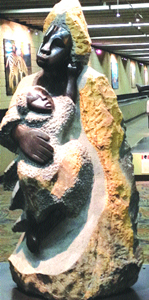
Prior to a visit, it is important to know what a gallery is. Collectively a gallery is an organised display institution, essentially educational or aesthetic in purpose with tangible objects, it cares for them and exhibits them to the public on some regular schedule. A gallery is also more accessible, more fluid and responsive to movements, shifting identities, socio-political environments and actively defines tastes adding value to important artworks.
Although nowadays many people visit museums dedicated to different areas of knowledge, our service at the National Gallery of Zimbabwe is uniquely about art.
What is art? One can say that a work of art is as close as one can come to the idea of creation. The work of art in the gallery forces you to stop, ponder its form and possible meaning and hopefully this process encourages you to experience the absolute world of the work.
The National Gallery of Zimbabwe is a hub for the visual arts in the country. It organises well designed and conceptually exciting exhibitions every month of the year. Exhibitions range from high- profile international exhibitions to prominent local shows.
The National Gallery in Bulawayo and the National Gallery in Mutare are also part of the National Gallery of Zimbabwe network. The National Gallery of Zimbabwe in Harare situated at 20 Julius Nyerere Way has over 2 000 sq cm of fluidly functional exhibition space.
The exhibition space consists of the airy and spacious Courtauld Gallery on the ground floor then the West Corridor, the North, South, East and P. G. Galleries on the first floor.
A picturesque Sculpture Garden flanks the Gallery carrying dozens of sculptures by Zimbabwe’s established and acclaimed first and second generation sculptors.
A visit to the gallery is a complete experience to which every aspect contributes something. Thousands of visitors come through the National Gallery of Zimbabwe doors every year and this is proof of the art centre’s continued eminence.
As you enter into the spacious gallery through the main doors you will enjoy an inviting view of the sales shop and a scenic view of the sculpture garden. Attendants at the admissions desk will be waiting at your service to assist with information on exhibitions or activities taking place inside the building.
Your luggage should not be a burden to your anticipation as a cloakroom area is available for visitors. The calm and receptive atmosphere of the Courtauld Gallery grants access to some of the grand exhibitions that are held at the Gallery. Works on display are usually labelled with the name of the artist, the title and the medium of work.
Optionally, a visitor can circulate an exhibition in the direction in which they view the show either from left to right or right to left depending on the design of the space.
An important basic fact about art is that you, the viewer, decide how much time you’re going to spend on each art work. You can choose whether to look at a painting for 10 seconds or 10 minutes which is at least a good measure of how intrigued you are by it.
A word of caution though is that visitors are not allowed to touch the works so as to preserve them for generations to come. Time given for observation of works also allows for the patrons to increasingly achieve a greater degree of involvement and participation in gallery activities.
A more fascinating and modified feature in the Courtauld Gallery is a ramp which has been specifically built for wheelchair access. The ramp connects the Courtauld Gallery to the West Corridor, the North, South, East and P. G. Galleries upstairs.
Most commonly, the change in floors usually marks a new exhibition, which also prepares the visitor for a change in mood by its different content. As you proceed to other galleries the design or display of the works should awaken and keep the visitor’s interest. Currently, the gallery has five different shows which if properly engaged may take up to 30 minutes each to explore.
Thankfully, the visitor has become an active, selecting, rationalising individual seeking to impose sense and meaning on the exhibition, meanings couched necessarily in his own terms and stemming from past experience and prior understanding as well as present circumstances.
Children are also welcome in the gallery because most galleries offer young and mature visitors activities that keep them engaged.
Activity boxes, puzzles, questionnaires, competitions are offered to visitors. Different categories of membership are available under the Friends of the Gallery.
Children can visit in formal school groups and these are usually booked in advance. The children are taken on a tour of all or some of the shows and provided with interactive exercises to complete.
A variety of benefits are proffered and these will keep you updated on the developments of the art scene, the changing shows and conversations, as well the cocktail official openings that enable like-minded people to mingle against the backdrop of art.
In a gallery rules are not made to be broken but to maintain a high level of alertness and security. On top of the list are three vital requirements that should be adhered to and these are; no taking of pictures in order to protect the physical artworks and avoid plagiarism. Cellphones are prohibited for security measures and
no smoking is permitted in the exhibition space to avoid fires as most works are inflammable.
Having worked your feet up and down the six galleries, you can visit the sales shop which offers a wide range of traditional and modern art works, literature and crafts at reasonable prices to ensure that you can prolong the feel good experiences that will stir your sense of wonder.
To complete the visit along the sales shop is an internet café and a restaurant which offer you a place to refresh and relax.
A visit to the National Gallery is never a dull moment. You can learn more about the world through artists’ eyes.



 Online Reporter