Chronicle Editor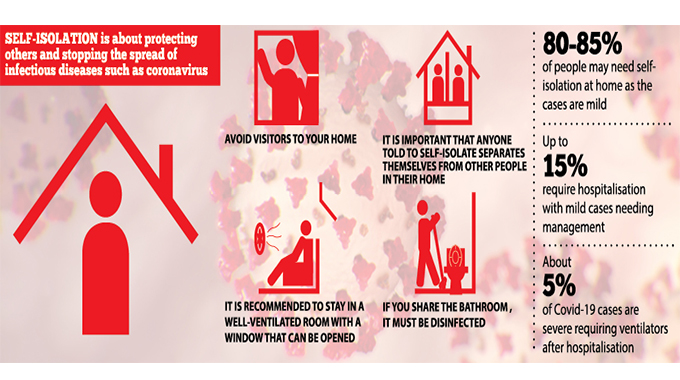
Nqobile Tshili, Chronicle Reporter
GOVERNMENT is in the process of reviewing home self-isolation measures to fit the local context as some household conditions can further expose families and the public to Covid-19.
When Government introduced the self-isolation measures on Covid-19 patients and those at high risk of contracting the virus, little consideration on the home conditions of the affected individuals was taken into account.
As the number of cases in the country continues to rise, health authorities are coming to terms with local realities to learn about the virus and devising new strategies to mitigate its spread.
The public has previously raised concern that those ordered to self-isolate, may violate the procedures exposing many to the global pandemic.
In cases where those told to self-quarantine adhere to laid down procedures, their family members who might not be under surveillance could go out exposing the others to the virus.
According to Government, 80 to 85 percent of the Covid-19 cases are mild where a patient does not need to be hospitalised hence the need for self-isolation at home.
About 15 percent of the cases are moderate to severe and need to be admitted to a hospital for management, while 5 percent need to be managed in the Intensive Care Unit, most needing ventilators.
In an interview, Bulawayo City Council health services director Dr Edwin Sibanda said after the local rapid response teams observed challenges in implementing the self-isolation measures, recommendations were made to the Ministry of Health and Child Care, which in consultation with health partners is set to come up with new self-quarantine regulations.
“There have been some questions over how effective is our local self-isolation measures as a country and how to improve on it. We have started looking at how we should implement the self-isolation, because one can be told to self-isolate at home but that person might be living with four other family members in one room. As a result, the Ministry is coming up with new guidelines for self-isolation, guided by a World Health Organisation (WHO) expert,” said Dr Sibanda.
He said if a patient is told to self-isolate, they are not supposed to be in contact with even those they stay with at home to prevent the virus from spreading.
“The person is expected to stay at home, stay in your room don’t interact with anyone in the house, use sanitisers, don’t share anything with anyone. In case you have to share for instance after using a bath, the person has to disinfect the place,” he said.
Dr Sibanda said after considering the living conditions of most citizens who do not stay in spacious houses with many rooms, more isolation centres need to be opened.
“This is where we have come up with a plan B where we are saying self-quarantine or self-isolation might not be possible. We have since looked at institutions like Elangeni Training Centre and Hillside Teachers’ College as options for such people.
“We are looking at the logistics of how they can be kept there entertained and fed and catered for in every way. Unfortunately, some of the places may be taken over by these returnees from Botswana and other countries. This means we have to identify more isolation centres for people depending on their status,” said Dr Sibanda.
Health and Child Care Ministry Permanent Secretary Dr Agnes Mahomva said Government has modelled the self-isolation to be patient specific.
She said rapid response teams in their daily surveillance programme assess whether a patient is living in a home that is convenient for self-isolation.
If not, new measures are put in place to secure them or their families.
“Those are the things that they assess if you are in a one-roomed place and there are eight of you staying there and one is positive then quite clearly the recommendation is specific. That is why we are saying we are following up to ensure that you are staying in a safe place. In case you are staying in your eight-bedroomed house you really shouldn’t be coming to a hospital. You should just self-isolate in a corner of your bedroom,” said Dr Mahomva.
She said Government will not be admitting every Covid-19 to hospitals as those with mild cases do not require hospitalisation.-@nqotshili



 Online Reporter