

 admin
admin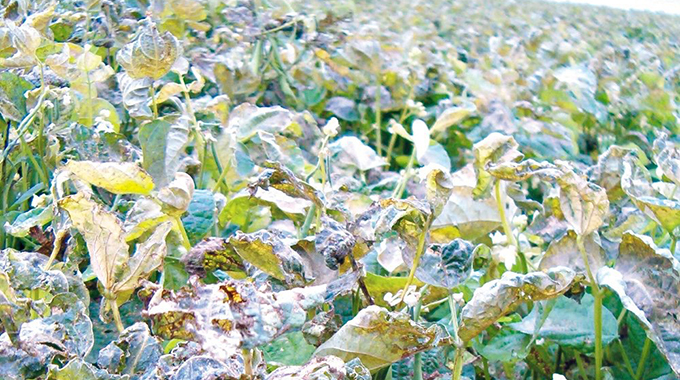
The Rhodesia Herald,
June 15, 1972
REPORTS of severe damage to crops, gardens, and plantations, caused by almost unprecedented bitter frosts and high winds on Thursday night, poured into Salisbury yesterday.
The damage to vegetables and flowers and even to water pipes, frozen solid by the cold has not yet been calculated.
Late last night an equally icy spell was feared. No part of Southern Africa seems to have escaped the cold.
One of the worst-hit areas in Salisbury was Rolfe Valley, in Borrowdale. There, the frost froze the sap in trees, a Meteorological office spokesperson said yesterday.
Reports came from Selous and Inyanga of an “almost unbelievable” minimum of between four- and five-degrees Fahrenheit – nearly 28 degrees of frost.
One Salisbury nursery man yesterday described the damage as “fantastic”. Despite taking every precaution, he had lost about 20 000 flowering plants.
Species which normally withstood frost had died within hours, and others given normal season protection showed blackening.
Another grower estimated his losses at more than 500 pounds. Growers cannot insure against damage of this kind.
Some places recorded, record low temperatures. Bulawayo had its coldest morning on record Thursday when the minimum temperature was 25,2 degrees Fahrenheit.
Frost scared the trees and destroyed flowers and vegetables gardens. Water froze in the taps in some parts of the city.
At the Goetz Observatory the ground temperature was down to 15,9 degrees Fahrenheit and the minimum temperature was 25,4 degrees C.
The previous lowest figure was in June 1964 when 29 degrees C was registered. In the Matopos (21 degrees C) and at West Nicholson (25 degrees C) there was bitter cold.
The effects of the frost in Bulawayo were evident from the shortage of vegetables at the markets. Prices of cabbages, beans, peas, and tomatoes soared. There was a big demand for coal and wood.
Weather stations in the north and east of Rhodesia all recorded lowest ground minimum temperatures.
Several established new record “lows”. The ground temperatures at Mount Darwin and Rusape were 19 degrees Fahrenheit, at Enkeldoorn 16 degrees, and Sipolilo and Chisengu 25 degrees.
Even the Hot Springs felt the grip of winter, a temperature of 38 degrees was registered there early yesterday morning.
“The swimming baths were the only warm place,” said one visitor.
LESSONS FOR TODAY
- There is need for people to always plan adequately for seasons such as winter, which can be very disruptive because of the low temperatures.
- Farmers need to ensure that they grow crops that are resistant to frost and low temperatures, or alternatively make use of greenhouses during the winter period.
- The Meteorological Department needs to ensure that its forecast is on point, and that it advises people of adverse weather conditions well on time for them to prepare adequately. For instance, the Met Department did well to warn people that this winter season will be much colder than previous seasons.
- ZESA should ensure that it increases power supply at this time and minimise load shedding to assist in the reduction of deforestation due to huge demand of firewood and charcoal during this period.



 Online Reporter