admin
admin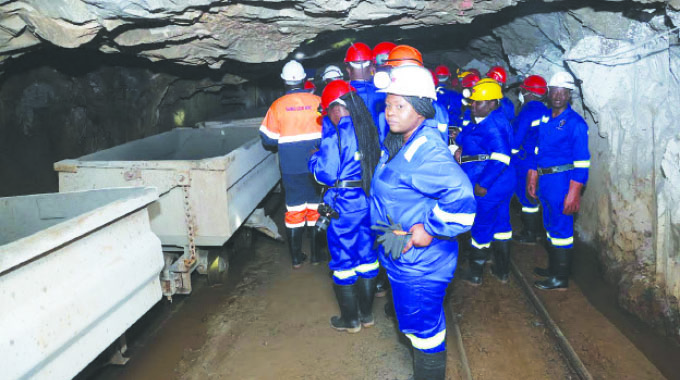
Oliver Kazunga Senior Business Reporter
SHAMVA Gold Mine says it will adopt a multi-skilling approach for its workers to contain costs associated with the harmonisation of underground operations and planned open-cast mining.
The multi-skilling approach will entail equipping existing underground workers with the requisite skills to carry out open-cast operations, meaning the company will not need to hire new extra labour.
Subsequently, this will see the mine that presently employs 1 035 workers, cutting down employment costs associated with hiring additional workforce for open cast mining.
The gold mine, which is situated about 90 kilometres north-east of Harare in Mashonaland Central province is owned by Kuvimba Mining House (KMH) which is Zimbabwe’s largest gold producer.
In an interview after a media tour of the mine last week, Shamva Gold Mine general manager Engineer Gift Mapakame said while the existing underground operations will not be discontinued when the planned open pit operations at Shamva Hill start, multi-tasking the existing workforce would be prioritised as part of a broader strategy to contain costs.
“We are going to be harmonising the current underground operations and the Shamva Hill open pit project.
“The employment figures right now because of our mining method, which is conventional, are standing at 1 035.
“But as we transition into the open pit, our strategy as the open pit is ramping up is to multi-skill the current complement that we have so that much of them can actually be able to transition into roles and responsibilities that are presented in the open pit and this will assist us in cutting cost,” he said.
The gold miner aims to reduce operating costs to between US$1 350 and US$1 450 per ounce from about US$1 600.
Eng Mapakame said depending on the outcomes of the mine’s down-deep potential, it is expected to a certain extent that as opencast operations at the hill begin in the next two years, the mine would also reduce the underground footprint while picking up the open pit operations.
“So, at 200 000 tonnes of ore per month on the open pit operation, we don’t expect the employment figure to be over 1 200 but at the same time most of the employees that we have here in the underground operation and as far as reasonably practicable, should be multi-skilled into roles in the open pit operation,” he said.
Mining at the Shamva Hill open pit project is expected to extend for 16 years and at present the mine is undertaking extensive exploration work on the surface moving from the east to the west and also underground moving deeper.
“The two approaches (underground and open pit) are supposed to overlap at some point, this is two years from now when we are expecting the development and construction of the open pit project to have reached a stage where we can start production from the surface,” he said.
The mine, which is also one of the country’s oldest gold assets, was discovered in the pre-colonial era around 1865 before exploitation commenced in 1893 by a company that was called Goldfields of Rhodesia.
Given its extensive history, the mine has gone through several ownerships and in 1968 the asset was owned by Independence Gold prior to acquisition acquired by Metallon Gold in 2002.
At the hands of Metallon, an entity owned by a South African business tycoon Mr Mzi Khumalo, Shamva was negatively impacted by undercapitalisation and underdevelopment.
In 2019, Metallon put Shamva Gold Mine under care and maintenance prior to acquisition by KMH, which immediately placed the operation under business rescue to protect the mine’s assets from confiscation by creditors as well as resolve legacy concerns that arose before the takeover.
The mine in 2020 received a US$15 million boost from KMH for revamping operations and the capital outlay was allocated towards the refurbishment of infrastructure, shafts, haulages, and offices and also procurement of new equipment for drilling, and materials handling, among others.
Since 2021, the mining concern has been having an annualised stay in the business capital of US$4 million per annum.
Following its acquisition by KMH in April, Shamva Mine has improved annual production to nearly 700kg.
Presently, it is producing 45 000 tonnes of ore per month, a feat that was last achieved in 1910.
In the financial year that began in April 2023, the mine targets to raise annual gold production to 770kg and this would be on the back of an increased average grade of 1,83 grammes per tonne from about 1,8g/tonne.
The optimism in improved production is also hinged on the capital activities (exploration, drilling and evaluating) that the gold operation is implementing to create more options with the ore body.



 Online Reporter