Online Reporter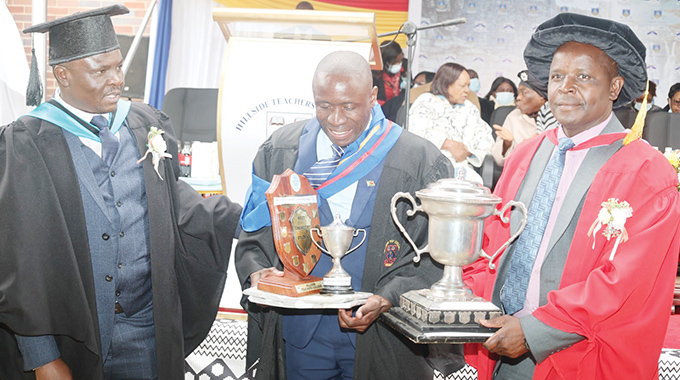
Peter Matika, [email protected]
NEWLY qualified teachers have been challenged to become frontline fighters of drug and substance abuse while embracing emerging technologies such as Artificial Intelligence (AI) to prepare learners for a rapidly changing world.
The call was made yesterday by Higher and Tertiary Education, Innovation, Science and Technology Development Deputy Minister Simelisizwe Sibanda during the 68th graduation ceremony of Hillside Teachers’ College in Bulawayo where 441 teachers graduated.
The graduates, comprising 149 men and 292 women, were urged to view their graduation not as the end of their training but as the beginning of a greater responsibility to shape the country’s future.
The event was held under the theme, “Building a Sustainable Future Through Heritage-Based Education.”
Deputy Minister Sibanda said teachers had a critical role to play in confronting social challenges affecting young people, particularly drug and substance abuse.
“Today is a day of triumph, but equally a day of responsibility to be the torchbearers of shunning drugs to safeguard our future generation,” he said.
Deputy Minister Sibanda challenged the graduates to lead by example, serve with integrity and continuously upgrade their skills to remain relevant in an increasingly technology-driven education sector.
“Graduation does not mark the conclusion of learning; it signifies the beginning of a higher calling to service,” he said.
Deputy Minister Sibanda said the changing education landscape required teachers who could combine academic knowledge with innovation, technology, cultural values and practical skills.
He said 48,4 percent of the graduating class had completed their studies in Science, Technology, Engineering and Mathematics (STEM), describing the figure as evidence of the institution’s growing contribution to the country’s innovation and technological development agenda.
Deputy Minister Sibanda also challenged the college and other tertiary institutions to harness emerging technologies such as AI while ensuring that innovation remained anchored in Ubuntu/Unhu/Vumunhu.
AI, he said, could improve personalised learning, access to information, research and administration, but its adoption should ultimately serve humanity and promote inclusive development.
Deputy Minister Sibanda cited Hillside Teachers’ College’s embrace of E-Sport as one of the initiatives helping teachers acquire skills to use technology responsibly.
The institution is also increasingly placing heritage-based education at the centre of its training programmes.
Deputy Minister Sibanda said heritage should not simply be viewed as a link to the past, but as a resource that could drive economic transformation and national development.
He commended the college for introducing ChiNambya to the six indigenous languages already offered in its curriculum.
Government has also approved a special dispensation, effective from the first semester of 2026, exempting students specialising in minority languages from the mathematics prerequisite for admission into secondary teacher training.
The measure is intended to promote minority languages, with students and lecturers already producing literature and teaching materials to support the teaching of indigenous-languages.
Deputy Minister Sibanda said the institution’s commitment to inclusivity extended to students with disabilities, with 21 students currently benefiting from its support systems.
The Work for Fees Programme has also expanded, with beneficiaries increasing from 38 last year to 63 this year, representing a 65,8 percent increase.
Beyond classroom training, the college is strengthening the link between education and production through a number of practical projects.
Deputy Minister Sibanda cited the college’s garment production unit, bakery project and Government-funded Madhumbe crisps factory as examples of initiatives translating academic knowledge into practical products and services.
The crisps factory is expected to provide practical training for students studying agriculture, food science, entrepreneurship and related disciplines while supporting community-based industrialisation and agro-processing.
Building Technology and Design students are also being trained to graduate as qualified teachers while acquiring practical trade skills, with students on course to become registered builders after completing the theoretical component of their trade tests.
The college’s investment in sport is also expanding, with Phase One of its multi-purpose sports complex completed and operational while Phase Two is under construction.
Deputy Minister Sibanda said the investment was already producing results, with Team Zimbabwe finishing second out of eight countries at the CUCSA SADC Games in Gaborone, Botswana.
Zimbabwe returned with 35 medals, behind hosts and eventual winners South Africa, who collected 46.
Deputy Minister Sibanda said the achievement demonstrated that sport, like education, had a role to play in developing discipline, character, national pride and international goodwill.
The college is also expanding its international partnerships, having hosted JICA volunteers and the Joint Translational Conference in Nyanga in June, which brought together representatives from nine teachers’ colleges.
Deputy Minister Sibanda urged the institution to continue building such partnerships to strengthen research, innovation and cross-cultural exchange. He challenged the graduates to carry their training into classrooms with a strong sense of responsibility and patriotism.
“You are now the vanguards of transformation, the custodians of culture, and the architects of national development,” he said.
He invoked President Mnangagwa’s philosophy: “Nyika inovakwa, inotongwa, inonamatirwa nevene vayo.”