admin
admin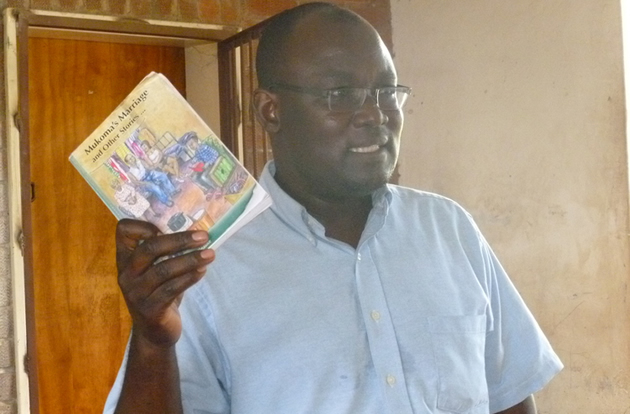
Beaven Tapureta Bookshelf
Emmanuel Sigauke is obviously a happy writer after successfully launching his dream workshop known as Chisiya Writer’s Workshop in his home area of Mazvihwa a few months ago.
He is also riding on double joy as his English short story collection ‘‘Mukoma’s Marriage and Other Stories’’ cannot be mentioned without prefixing to it the phrase ‘‘the NAMA-nominated’’. The collection got the accolade this year in February at the National Arts Merit Awards.
When one closely look at it, “Mukoma’s Marriage and Other Stories’’ seem to have surpassed all of Sigauke’s earlier works and Sigauke himself seems also to have naturally adopted the collection as a ‘‘sweetheart’’ because he chose his favourite text from this collection when he was asked to read at the ZIBF literary evening this year. Again, at a function organised by Writers International Network Zimbabwe and held at Glen View 2 High earlier this year, Sigauke talked at length about ‘‘Mukoma’s Marriage and Other Stories’’ and went on to read a story from the book!
At the Chisiya Writers’ Workshop writer Memory Chirere, who also took part, was seen reading his published work to the workshop participants as they were gathered on top of the Chisiya Hill. The retreat was part of the workshop. About Chisiya Hill, Sigauke once told Bookshelf that the hill had a profound effect on him as he was growing up in Mototi. “It’s my childhood hill in my backyard. I used to read perched on its summit when I was in secondary school. It was my natural library,” he said. How memorable then the Workshop will forever be for Sigauke and the participants who had a feel of this poetical retreat to the hill that gave birth to a poet’s undying love for his country.
However, no matter how much we have come to know Sigauke, there is a book that is mentioned incidentally when describing Sigauke’s brief biography. It is titled “Forever Let Me Go”, an earlier collection of his English poems published by PublishAmerica in 2008.
While in this poetry collection the reader may note what has become to be known as Sigauke’s passionate attachment to the famous Chisiya Hill as felt in his other works published elsewhere in different anthologies, there is a different timbre that runs through the poems in “Forever Let Me Go”. That poems sing differently when collected together is really true. Broken patches or the emotions which the poet artistically unweaves or weaves with words can echo a different meaning when they are put close to other ‘‘broken patches’’.
The collected poems in “Forever Let Me Go” sing a different tune, a tune of going and returning, of not going and not returning. It resonates with the agony of search and yet not finding. It echoes the words of renowned author Chimamanda Adichie who said, “I think you travel to search and come back home to find yourself there.”
The going and returning in Sigauke’s poetry is physical, spiritual and intellectual. The three parts in which the anthology is broken are chained together by memories of ‘‘home’’, the restlessness moments as a university student and as ‘‘hunter’’ of a certain fulfilment in a foreign land, and the consequences of this journey into self and other lands.
The poem from which the anthology borrows its title “Forever Let Me Go” carries a dreamer’s celebration of having finally decided to go to “. . . lands/never walked before/places inside and outside the heart/strange cities/familiar cities”.
Having lived in Zimbabwe as well as America, Sigauke’s poems retain feelings and expectations of someone so observant of every little movement either away from home or towards home or just the stasis or middle of the transition.
In other words, poems in “Forever Let Me Go” are literally stones upon which the persona treads as he/she contemplates going away and the eventual return to home. Whether or not the journey is fulfilled remains the poetry’s magic of suspense. Yet all the reader can deduce is that the return seems very important.
At a writers’ meeting in Harare a few months ago renowned poet Chirikure Chirikure spoke about how Zimbabweans in the diaspora connect with their cultural roots through local artists performing abroad. The ambiance of an event in the diaspora where a local artist is performing is echoed in Sigauke’s poem “Hurry, Tuku in Concert!”. In this poem the great Zimbabwean musician Oliver ‘‘Tuku’’ Mtukudzi is said to have “a voice that rouses the dead/ a consciousness that slaps/one from the sleep of forgetfulness”.
The reader can imagine this concert and the impact it has upon the persona who enjoys one of Tuku’s songs about “going away and coming back/especially coming back”. It is also likely that Sigauke believes in the shared power of music and poetry in inspiring the ‘‘forever-let-me-go’’ spirit in a dreamer or dreamers like in his poems “The Shaba Days” and “Celebration”.
“Celebration” fuses Bob Marley’s music with essence of freedom, capturing the moment when Zimbabwe celebrated its independence from colonial rule in 1980 at Rufaro Stadium.
Anyone who has stayed away from home for too long has such profound longing to once again belong, to be welcomed by the singing grass of one’s motherland, to stop and whisper to it:
“Sing the new Zimbabwe song
Sing grass, sing
So I can move beyond the shadow of dream”. (Upon my Return)
There is then a negative feeling that grips you when the persona in another poem returns home and finds no fun there. Children fill homes with fun and to returnees, children have an impartial hospitality. When the persona in the poem “These Bushes Know” returns home, he/she bewails:
“Only if someone had spared the children
Only if someone had allowed them to wait
Wait for my arrival, they would smile about my return
And fill the void. Now the void sings
Its vile chorus of war.”
The absence of children as little lords of joy and gifted welcomers is felt in another poem about ‘‘return’’ titled “The Native Returns”. In this poem, upon returning, the persona admires the welcoming beauty of nature but is disappointed when
“Now the ungloved fists of time
Squash the tomato of memory
Plucking the collard greens of experience
Until drained, anticipation crumbles:
Where on earth are the children
Who should celebrate my return?”
The poem “Imagined Return” adds to the idea of diminishing joy upon returning to a home where there are no children. The ‘‘children’’ in the poems above, if one further questions, may come to be metaphors for a longing, a desire for a certain something no longer there but something that one had been working to perhaps appease in some way.
University days in Zimbabwe must also have had an impact on the budding poet as illustrated in autobiographical poems such as “Budding Writer In the Park”, “UZ, 1994”, “The Shaba Days” and “Promises and Prophecies”.
It is fair to say that Sigauke’s poetry anthology cannot be isolated from his short story collection as the two books pose like ‘‘question and answer’’. One asks, the other answers and vice versa.



 Online Reporter