malvernmugadzikwa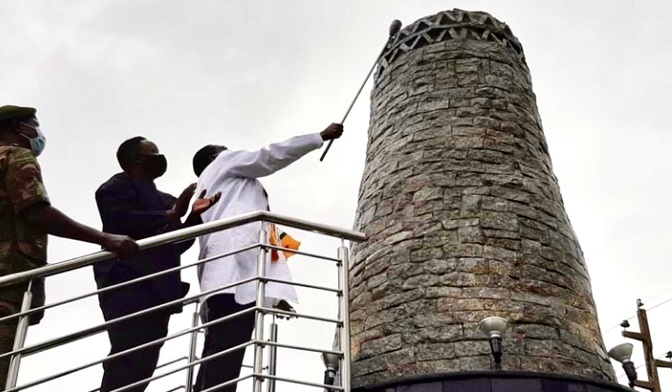
Charles Mavhunga
IN tourism branding, the exhibition of the Zimbabwe Defence Forces (ZDF) heritage monument at the Museum of African Liberation in Harare magnifies Zimbabwe’s past in a manner that projects the country’s future identity.
The monument was launched on December 21, 2021 by President Mnangagwa.
Globally, monuments are testimonials that immortalise society’s political, social, cultural and historical values.
In tourism branding, monuments play an important role in establishing heritage values that shape behaviour and drive society to become focused, innovative and futuristic.
Monuments help people to confront the past, the present and the future.
They represent the society’s cultural epitome of the past, the present and the future.
The ZDF heritage monument was constructed from granite to symbolise the Madzimbabwe spirit of Ubuntu from Great Zimbabwe’s Munhumutapa state, as well as showcase the country’s struggles from the First Chimurenga to the current period and future.
It represents the country’s national integration, international understanding, unity in diversity, appreciation of cultural values, the deep Madzimbabwe spirit of Ubuntu’s ideological framework of co-existence, positive solidarity, human dignity and respect for peace and security.
The monument inspires reflection on Zimbabwe’s experiences in the following:
The First Chimurenga (1896-1897)
The First Chimurenga was a Ndebele and Shona revolt against British settlers, who had come to the country as explorers, traders and missionaries, but ultimately became colonisers.
The war was waged by liberation/freedom fighters wielding spears, shields and axes.
They, however, lost to gun-wielding British settlers.
Notable heroes were Mbuya Nehanda, Sekuru Kaguvi, King Lobengula, Chief Chingaira, Chief Chinengundu, Chief Mashayamombe and Chief Mapondera, among others.
Some of them, like Mbuya Nehanda, were hanged.
But before she was executed, she warned the settlers that her bones would rise (mapfupa angu achamuka) to fight back.
The settlers plundered the country’s gold, diamonds, rich fertile soils, cattle and other precious minerals to develop Europe.
The Second Chimurenga (1966-1979)
After 50 years of white domination, the Second Chimurenga erupted and ultimately culminated in independence in 1980.
The war was waged between the white minority government and black nationalist movements of ZANU and ZAPU.
The Battle of Chinhoyi involving a small unit of the Zimbabwe African National Liberation Army (ZANLA) and the Rhodesians on April 28, 1966 marked the beginning of the revolution.
The ZANLA fighters — David Guzuzu, Arthur Maramba, Christopher Chatambudza, Simon Chingozha Nyandoro, Godfrey Manyerenyere, Godwin Dub and Chubby Savanhu — engaged the Rhodesians but were outgunned and killed.
This prompted both ZANLA and ZIPRA to regroup and restrategise to engage in full-scale guerrilla war.
As the war escalated, a desperate Ian Smith resorted to crude tactics such as dropping bombs in camps that had been established in neighbouring Mozambique and Zambia.
Among the worst atrocities was the bombing of Nyadzonia and Chimoio, among others.
The liberation fighters, however, eventually prevailed.
Third Chimurenga
After independence, attention naturally shifted to reclaiming the land.
During colonial occupation, the Land Apportionment Act (1930) was used to forcibly move blacks from fertile land to poor and reserved areas.
It reduced blacks to paupers, who were paid slave wages as labourers on farms owned by whites.
In 2000, the Government decided to redistribute the land to its rightful owners under the Fast-Track Land Reform Programme, which was part of the Third Chimurenga.
The conical tower at the monument has a flame that was lit by President Mnangagwa to honour departed souls that fought in the liberation struggle.
The flame reminds Zimbabweans to honour the fallen heroes, who fought for peace, tranquillity, human rights and dignity.
Two statues — on either side of the monument — represent the men and women who fought gallantly for the country’s freedom and independence.
The ZDF heritage monument, therefore, depicts the sacrifice made by Zimbabweans to liberate themselves from oppression.
It encapsulates continental values embodied in Africa’s Agenda 2063 for sustainable development of Africa in terms of Article 4: Peaceful and secure Africa; Article 5: Africa with strong cultural identity, common heritage, values and ethics; Article 7: An Africa as a strong, united, resilient and influential global player and partner.
In terms of branding perspectives in the Second Republic, the monument is modelled around the knowledge economy, where the country is now focused on skills development in entrepreneurship, innovation and industrialisation (Education 5.0).
The monument generates memories of the realities of Zimbabwe to defend its identity and to envision the future strategically.
Charles Mavhunga co-authored textbooks in business enterprising skills and is currently studying for a PhD in Management at Bindura University of Science Education. He can be contacted at: [email protected]/ Cell: +0772989816



 Online Reporter