Lovemore Dube BRILLIANT!”
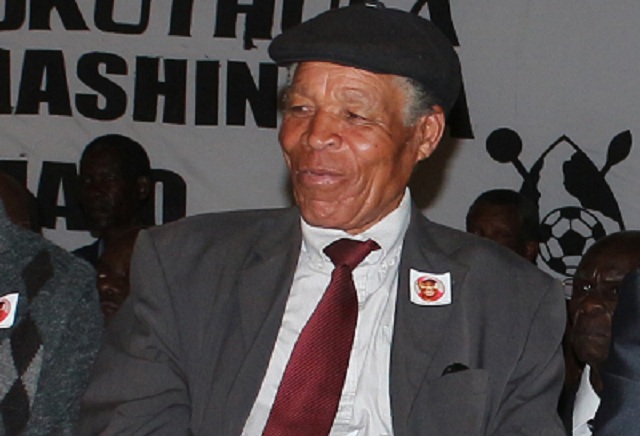
That is how Highlanders legend Lawrence Phiri describes former Bosso player, manager and chairman Silas Ndlovu, whose contribution to the club’s transformation has left an enduring legacy.
As Highlanders celebrate 100 years of existence and service to the community, Phiri and fellow club legend Josiah Nxumalo have paid tribute to Ndlovu, crediting his football intelligence, leadership and tactical ideas for helping turn Bosso into a household name.
In an interview on Friday, Phiri said Ndlovu’s contribution deserved to be written in bold letters in the club’s history.
Ndlovu’s association with Highlanders began in the late 1950s when he was a student at Dadaya
Mission in Zvishavane. Such was his importance to the team that Bosso elders would travel to Zvishavane to collect him for crucial fixtures.
After retiring as a player in 1972, he turned to management and helped transform Highlanders into a football powerhouse.
Phiri recalled that Highlanders initially resisted joining the Rhodesia National Football League in 1963, opting to remain in the Bulawayo Amateur Football Association (BAFA). The club eventually joined association football in 1969, securing promotion to the elite division at the end of 1970.
However, Bosso’s first top-flight campaign ended disastrously, with the club collecting just seven points in 1971.
Phiri joined Highlanders in 1972 and initially played as a goalkeeper before an injury to right-back
Nehemiah Dube in 1973 saw him move into the outfield, beginning an 18-year career in which his versatility allowed him to feature in almost every position.
His career spanned three generations, including the side that won the 1973 Chibuku Trophy, three consecutive regional titles and the 1974 national league championship, as well as the post-
Independence team featuring stars such as Madinda Ndlovu, Peter Nkomo and Douglas Mloyi.
Ndlovu’s arrival in the management set-up marked a turning point. He took charge of the team’s management and doubled as coach without an assistant, introducing changes to the club’s administrative structure.
Phiri said players wielded considerable influence at the time and had pushed for a leaner executive, arguing that having assistants for every position was causing problems.
“Players in those days were very powerful. We dictated what had to be done and we suggested as players that we do away with the 15-member executive. Each post had an assistant and that was causing problems in favour of a leaner structure, adherence to a constitution, and a manager who is a coach like in Britain, that proved a masterstroke,” said Phiri.
He described Ndlovu as a man of character whose football intelligence and leadership transformed Highlanders.
“He had a big impact on the Highlanders we have today. It is his first year in charge, 1973, when
Highlanders became a household name after the Chibuku Trophy win over Mhangura. He had great tactical ideas and man-management skills that were second to none, and he carried his executive along,” said Phiri.
Phiri later followed in Ndlovu’s footsteps, becoming a successful club manager after retiring as a player. Between 1983 and 1992, he helped Highlanders win several major trophies.
Nxumalo, another member of the celebrated 1973 side, also praised Ndlovu, who brought him from Sables to Highlanders.
The former top-scoring forward was part of the team that won three regional titles, reached three
Chibuku Trophy finals — winning two — and clinched the 1974 league championship.
“He was a genius in football, very intelligent. He brought his education into the game and ran Bosso in an enlightened way, far different from other clubs, and as a result we were successful. He was a kingpin, a bold character, very organised and articulate in his views, it is no surprise he did so much for Highlanders and even brought South African clubs to Zimbabwe because of his charismatic character and tact,” said Nxumalo.
Ndlovu’s influence extended beyond Highlanders. After the club withdrew from the Rhodesia
National Football League at the end of 1976, he masterminded the formation of the South Zone
Soccer League and was unanimously appointed its general manager.
He returned to Bosso in 1989, and the following year the club won the league and cup double.
Before his appointment as manager at the end of 1971, Ndlovu had beaten Chris Mhlanga in a vote
for the coaching job. At the time, Highlanders’ successes had largely been confined to BAFA
competitions and the annual Stanley and Livingstone Trophy, contested against Hwange and
Zambian clubs across the Victoria Falls Bridge.
Ndlovu’s leadership helped lay the foundations for the success and stature Highlanders enjoys
today, as the club marks its centenary and reflects on the figures who shaped its history.