Chronicle Editor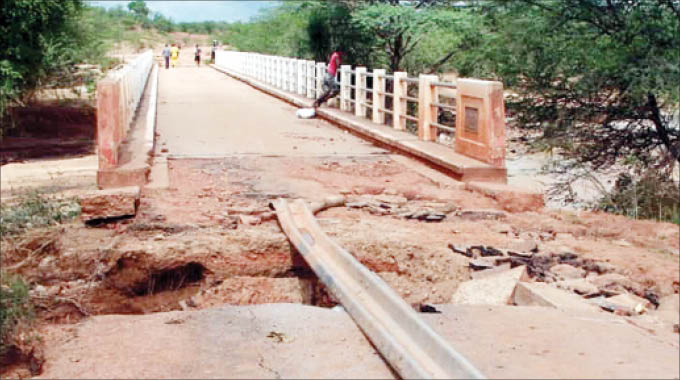
Leonard Ncube, Victoria Falls Reporter
THE floods that hit Binga in February may have left a trail of destruction but also came as a blessing in disguise for Nsungwaale Primary School. The school, which is an annex of Chininga Primary about seven kilometres away, is located right at the epicentre of the flood-hit area where an elderly man died and 181 homesteads were damaged. The floods also affected 37 families and damaged roads and bridges across Nsungwaale and Chininga rivers in Chief Sinakoma’s area.
The victims were villagers that had relocated from various areas around the community and settled on a floodplain along Sungwaale and Chininga rivers and other streams with the intention to farm there as there are rich soils compared to the surrounding areas.
Unfortunately, the rains that fell on February 11 left homesteads and crops destroyed and damaged Chininga Bridge connecting Binga and Siabuwa.
The road on both sides of the river was badly damaged together with the road that links Nsungwaale to the Binga-Siabuwa main road.
Some of the 37 families have finally moved to a campsite established for them by Government and occupied about 60 tents.
The affected families had been staying with relatives as they initially didn’t want to move into the tents on alternative land identified for them by Government saying they wanted to be resettled in Chijalila Game Reserve, about 30km away.
Government insisted the families move to the tents pending a time when they will start building their new homesteads.
Before the Covid-19 induced lockdown was effected, the District Development Fund (DDF) and Binga Rural District Council had started clearing an alternative road by-passing Nsungwaale River to connect to the Binga-Siabuwa Road, through the alternative land for new homesteads in the same area.
Matabeleland North Provincial Affairs and Devolution Minister Richard Moyo said the affected families are now housed at the campsite.
“They have moved to their tents while they have also been allocated new land to build permanent homesteads. Initially, they were reluctant to take up the tents because they wanted to be resettled in Chijalila Game Reserve but they ended up agreeing and moving to the campsite,” he said.
While rescue efforts by the Civil Protection Unit and its partners focused on the affected villagers and area, the state of the local Nsungwaale Primary School also caught the attention of development partners who immediately chipped in. The pole and dagga school has 286 pupils, 129 of whom are girls and 137 boys.
There were two pole and dagga classroom blocks shared by pupils, while five teaching staff, comprising three females and two males, shared a single cottage.
A brick classroom block which parents had been constructing with the help from Schools Improvement Grants (SIG) funds was left at roof level after the funding partners pulled out citing lack of resources.
During the rainy season, pupils would not attend classes because a majority of them are from villages across Nsungwaale River and also due to the fact that the classrooms had no roof, making it difficult to conduct lessons while it rained.
The only secure structure is a makeshift administration office also used as a storeroom for school property.
Save the Children, Action Aid, Caritas Zimbabwe, Girl Child Friendly, Net One, Emmanuel TV and Days of Girls have literally taken over the school where they have split responsibilities to upgrade it.
While most of the work has been stalled by the ongoing Covid-19 induced lockdown, a recent visit to the institution showed that construction of a classroom block and some toilets was underway with members of the community providing labour and some building materials.
Save the Children adopted the incomplete block and had started plastering it while efforts are being made to roof it.
Action Aid is constructing a new block and a cottage while Caritas is building toilets for pupils and staff members.
A feeding scheme had also been launched by Action Aid giving porridge to pupils to complement Government schools’ feeding programme.
The school head Ms Jackie Bulongo Muleya said, “Pupils were not at the school when the floods hit us. It could have been tragic because the whole school was flooded. We had started constructing one block using SIG funds but they pulled out at roof level citing economic challenges and we were left grounded again.
Our community has been very cooperative as they provided pit sand, bricks, gravel and labour. We would buy cement and give each village 10 bags to mould bricks for the block.
“Action Aid is constructing a new block and have also brought in porridge for pupils’ meals and we started the feeding programme early March. We were getting maize and beans from GMB for school feeding and now our feeding programme has been boosted by this as we now have a kitchen where the pupils are fed. Caritas is building toilets for both pupils and staff. Save the Children, Emmanuel TV, Net One, Girl Child Friendly and Days of Girls have donated stationery, sanitary wear and cleaning equipment especially for toilets.”
Save the Children has also donated building material comprising 120 bags of cement, roofing material, paint, door and window frames all worth US$14 998.
The school head said they had minimal challenges with learning materials after they received a consignment of textbooks through SIG but still need new curriculum material for Grades Six and Seven.
The school has a trained Early Childhood Development teacher but has no classroom for the kindergarten class and uses a makeshift play centre.
One big challenge for the school is a low fees payment rate by parents, which has made it difficult to buy furniture hence it remains with a few chairs and small desks.
Said Ms Muleya:
“Our challenge is the way people pay school fees because a majority don’t pay but wait for help through the Government Basic Education Assistance Module (Beam), Capernaum Trust and Higher Life Foundation to pay for them.”
Ms Muleya implored mobile network providers to ensure the area has network coverage for rapid response to disaster as the nearest Sinakoma Clinic is 13km away.
She said while efforts are being made to construct an alternative road by-passing the river to Binga, the school will remain affected as a majority of pupils come from across Nsungwaale River.
“We have written to the District Development Coordinator’s office about the bridge that was destroyed because most of the pupils come from the villages across the river,” she said.
Twelve villages namely Chinomba 2, Chinomba 3, Chinomba 4, Maneta 1, Maneta 3, Maneta 4, Maneta 5, Maneta 6, Maneta 8, Maneta 10 and Maneta 11 and Simelembo 9 make up the school’s catchment area.
Chinomba 2 headman Mr Petros Sakanenge Kembo under whose area the school falls concurred saying, “At least if we can have a bridge across the river for children to cross as they go to school.”
The District Development Fund has also drilled a borehole to complement the only one that used to supply the school and community while Save the Children has installed solar panels to the existing borehole and now there is piped water for Nsungwaale Primary School and the campsite which are about 300 metres apart.
A Jojo water tank was also mounted at the campsite.
During a visit to Binga in March, Vice President Kembo Mohadi said Government will assist the affected community until the villagers can sustain themselves.
He said Government will continuously work with cooperating partners for development of communities.
Binga acting DDC Mr Farai Marinyame said the Covid-19 induced lockdown affected work on both the campsite and school as focus shifted to interventions against the coronavirus.
He said six water taps have been put, two to supply the school, three the campsite and one supplying the community, drawing from the solar-powered borehole.
The United Nations Population Fund (UNFPA) in partnership with the International Organisation for Migration (IOM) Zimbabwe has also donated sanitary wear for affected women and girls, clothing and chlorine to purify water to make sure boreholes were not contaminated in times of floods. – @ncubeleon


 Online Reporter