Vusumuzi Dube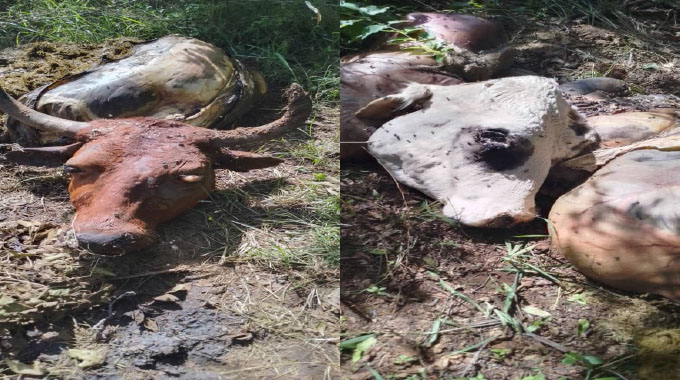
Nothando Zondo, [email protected]
FEAR and anger have gripped Shangani in Insiza District as farmers reel from a series of brutal livestock thefts that have left cattle slaughtered, deboned and dumped along roadsides. Since November last year, cattle rustlers have struck repeatedly, leaving behind skinned carcasses and severed heads while families lose their main source of livelihood.
The attacks have intensified in recent weeks, particularly around Shangani Mine, Shangani Turn and neighbouring plots.
Farmers say the thieves follow a consistent pattern: cattle are taken from grazing lands or kraals, slaughtered, and the meat deboned close to roads for quick collection and transport. The heads are deliberately left behind to allow owners to identify their animals.
Among the latest victims is Mr Kelvin Ndlovu, who lost two cattle while he was briefly away from home.
“I left my farm for some business on Thursday and returned on Friday evening. On Saturday, I noticed that two of my cattle were missing. I searched for them and on Sunday found their carcasses dumped near Shangani Turn, with the heads and offal left behind. I reported the matter to the police base in Shangani,” said Mr Ndlovu.
Farmers who have lost cattle have been able to identify them through the heads intentionally left at the scene.
“Just yesterday, my neighbour found two of his cattle deboned close to the road at Shangani Mine,” said Mr Ishmael Manjera, who lost 10 cattle to thieves late last year.
Farmers suspect the stolen cattle are being sold in Gweru and to local butchers. Mr Stanley Dube, who lost five cattle in December, said the thefts had left his family struggling.
“I rely on my cattle to cultivate my farm. This time it was tough since three of my strong bulls were taken. I had to use some funds earmarked for other things to ensure my family had enough food,” he said.
Local leaders admitted that justice has been slow despite numerous reports being filed. Ward 23 Councillor Nomusa Ndlovu said a significant number of farmers in Shangani have suffered devastating losses to cattle rustling.
“These cases started last year around November with one of the farmers, Ishmael Manjera; 10 of his cattle went missing and they were never found.
The next big number was that of another farmer who lost nine of his cattle in January. The theft continues; just last week, three more were lost and found deboned near Shangani station,” said Clr Ndlovu.
Cattle rustling poses a major threat to livelihoods in Matabeleland South, undermining food security, income streams and agricultural productivity. Livestock losses deprive farmers of draught power, affecting crop production and worsening poverty.
The crime is often driven by organised syndicates, sometimes operating across borders, and cheap meat is suspected to be sold to local butcheries.
Rural poverty, weak policing capacity and porous borders continue to fuel the crisis, with Gwanda identified as a hotspot for organised, armed groups. Acting Matabeleland South police spokesperson Assistant Inspector Stanford Mguni urged farmers to report all cattle theft cases.
“We have received reports from farmers who have lost cattle to thieves. We urge the community to report to Fort Rixon and Umzingwane police bases. If they don’t find assistance, they are welcome to proceed to the provincial office,” said Assistant Inspector Mguni.
He said police were making efforts to assist the affected communities.
“We’re not sitting on our hands doing nothing. As from 23 February, we started doing stop-and-search operations, raids, road blocks and checking if butcheries are slaughtering and selling legal meat. We are also working hand in hand with veterinary meat inspectors and health officials,” said Assistant Inspector Mguni.
He added that thieves were transporting the stolen meat in buckets, containers and taxis, hence the increased security operations.
“We encourage councillors and community members to report all missing cattle for better follow-ups.
Farmers should brand and re-brand their livestock clearly for better identification. Also, report stray animals because these also fall victim to thieves,” said Assistant Inspector Mguni.
He urged farmers to thoroughly vet their farm workers, warning that some were colluding with criminal syndicates.
Assistant Inspector Mguni appealed to community members to tip off the police about any suspicious movements or provide information that could lead to arrests.
Despite hundreds of arrests being made nationwide each year, many cases go unreported. Zimbabwean law classifies cattle rustling as a serious economic crime, punishable by a minimum of nine years in prison without the option of a fine, to protect farmers and agricultural livelihoods.



 Online Reporter