admin
admin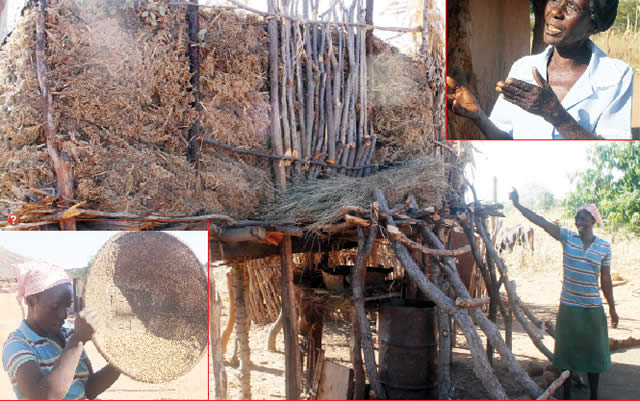

Yoliswa Dube
GROWING drought-tolerant crops is paying dividends for Hwange villagers who continue raking in bumper harvests of millet (amabele/rukweza) and sorghum (mapfunde/inyawuthi). The grains have sustained them and their families over the years to the point where they have stopped worrying about poor maize yields. “God gave us hands so that we work. He always blesses those that work hard,” said Gogo Rebecca Dube of Jabulisa Village.
She could not emphasise enough the importance of hard work.
The grandmother of six orphans said despite living in a semi-arid region, God had been faithful to his word of blessing the hands that work, as her family had reaped plentiful millet and sorghum.
She will not have to worry about food all year round as her ingalami (grain stack) is full to the brim after a successful farming season.
Villagers in this part of the country have resorted to cultivating drought resistant crops such as millet and sorghum, which produce good results.
They, however, still plant maize as per tradition, although it does not do very well.
“I’ve six orphans to take care of. Five of my daughters have since died, I’m left with a daughter and a son, which really pains me. It was because of these orphans that we decided to work hard to ensure that they would not have to struggle for food,” said Gogo Dube.
Very little rain falls in the province. There has been even less rain in recent years and the farming seasons have become unpredictable.
Gogo Dube is one of the villagers in the area to make the switch to drought tolerant crops in order to reduce the impact of poor harvests caused by climate change.
Farming these crops has almost instantly transformed the agricultural complexion in the area.
Gogo Dube’s daughter-in-law, Nonziwa, who was winnowing millet when a Chronicle news crew visited the homestead, said their harvest of grains would sustain the family all year round.
“We started planting at the start of the normal growing season in November last year. We cultivate maize but it never does well so we concentrate more on sorghum and millet. Out of the millet, we make isitshwalasadza and porridge.
“We keep a vegetable garden to supplement our millet. Okra and spinach are also part of our daily diet. We only start buying mealie-meal when what we have has run out, which is a long way from now. What we have can last us all year, it will last till the next farming season,” she said.
Nonziwa said the family of 11 relied on one man’s salary for other basics such as school fees.
“The only struggle is paying school fees. There are six children to take to school here so that is the major challenge. My husband is the only one who works and makes it a bit difficult for us,” said the Nambya speaking mother of two.
She demonstrated how to winnow on the traditional rubuwa, a circular floor cemented by cow dung.
An art which a novice cannot immediately pick up, winnowing is done to sieve the millet and separate the good grain from the chaff.
“We have goats, chickens and cows which we slaughter once in a while for meat. Our farming is solely subsistent so we don’t worry about selling the surplus. We enjoy all of it.
“Last year, we filled 11 drums with our millet harvest. We’re expecting much more this year because we harvested more,” said Nonziwa.
After the millet is winnowed, it is stored and later ground. It can be washed and dried in the sun before it is taken to the grinding mill.
“We’ve no other means of survival aside from farming. It doesn’t even cost much to take our produce to the grinding mill, a five-litre bucket of millet settles the debt,” she said.
Sorghum has traditionally been used for making porridge and beverages, but it is also used for making bread, pancakes, dumplings and isitshwala. It can be combined with wheat to make bread, added to other grains to make wholesome porridge or eaten as cooked porridge by itself. Whole-grain, unrefined sorghum is one of the healthiest breakfast cereal alternatives to the sugary, refined instant cereals that are popular nowadays.
The whole sorghum grain consists largely of carbohydrates, but it also boasts of plenty good protein, vitamins and minerals, very little fat and a miniscule amount of bad, saturated fat, with little sodium and zero cholesterol. The rest of the grain is fibre.
It is good for energy, for building and maintaining healthy living cells, and for fighting off diseases such as heart disease, cancer, diabetes, obesity and intestinal disorders.
Millet is a grain that should be included on one’s list of heart-healthy choices because of its status as a good source of magnesium.
Magnesium has been shown to reduce the severity of asthma and to reduce the frequency of migraine attacks, high blood pressure and reduce the risk of heart attack, especially in people with heart disease.
The phosphorus provided by millet plays a role in the structure of every cell in the body.
Eating foods high in insoluble fibre, such as millet, can also help women prevent gallstones.
Matabeleland North Minister for Provincial Affairs Cain Mathema said farmers in the area had done significantly well but a paradigm shift was needed to move from subsistence to commercial farming.
“People have always grown sorghum and millet, it’s their staple food. I’m happy about the harvests in the area, which are also in line with the ZimAsset (Zimbabwe Agenda for Sustainable Socio-Economic Transformation) cluster of Food Security and Nutrition but these farmers should also produce enough for sale. We need to make communal farmers commercial farmers.
“We’ve embarked on a project with Zinwa (Zimbabwe National Water Authority) so that these farmers have metered water. As it is, each farmer has a garden. Once they are connected it means they can irrigate from January to January. “You don’t need a large piece of land to practise commercial farming. More needs to happen. These farmers will also need money — loans from banks so that they’re able to buy farming implements,” said Ambassador Mathema.
Zimbabwean farmers have suffered a succession of poor harvests with yields far below what the country needs.
Farmers and their unions blame the cyclical uncertainties of their sector not only on a lack of up-to-date farming technology, but also on their inability to obtain seed varieties that can survive low rainfall caused by climatic shifts.



 Online Reporter