Online Reporter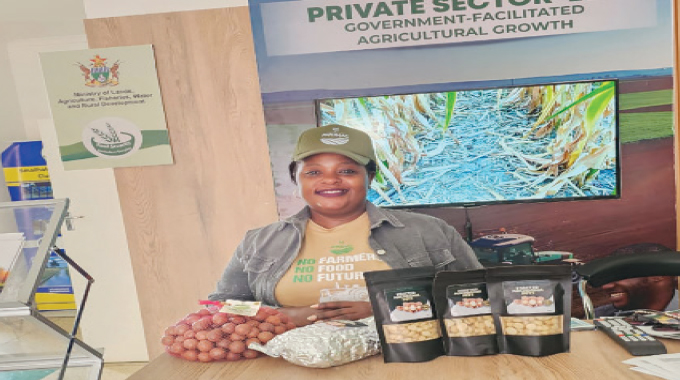
Theseus Shambare, [email protected]
IMAGINE losing 20 tonnes of avocados in a single shipment — everything gone, no compensation, no recovery, no second chance.
For Dephine Mbanje, a macadamia youthful female farmer, that moment still lingers like a dream she wishes she could wake up from.
But it is not a dream. It is a lived reality —one that defined her entry into the brutal world of agricultural exports.
“I recall a time when we lost 20 tonnes of avocados,” she told delegates during a Zimbabwe International Trade Fair (ZITF) side event under the Zimbabwe-Mozambique Agriculture Value Chain and Trade Development Project (Zim-Moza ATDP).
“We had shipped to the United Arab Emirates, but there were delays at the airport. When it finally reached, the buyer raised quality issues and said it would be destroyed. We never recovered anything.”
The silence that followed her words in the room was heavy, not because her story was unique, but because it was familiar.
Across southern Africa, smallholder farmers are being pulled into global markets faster than the systems meant to protect them.
A project built on reality
The Zim–Moza ATDP, formally known as GCP/SFS/008/ITA, is a 36-month initiative with a budget of 3,5 million euros, implemented by Food and Agriculture Organisation (FAO) in partnership with the governments of Zimbabwe and Mozambique and the Italian Agency for Development Co-operation.
Project co-ordinator, James Mugombi, set the tone clearly.
“The objective is to accelerate agrifood transformation between Zimbabwe and Mozambique, enabling smallholder farmers to participate in global value chains while improving trade policy implementation and facilitating sustainable economic growth,” he said.
He added that the project focuses on Manicaland in Zimbabwe and Manica Province in Mozambique, strategically linked through the Beira Corridor to regional and international markets.
But Mugombi was also candid about the structural barriers.
“Low volumes, high informality, high transaction costs, weak integration of smallholder farmers, and inadequate infrastructure remain major obstacles,” he said.
Learning the hard way
For Dephine, those “obstacles” are not policy language, but they are lived experience.
“It was our first time exporting,” she said. “We didn’t know whether to follow the shipment or just accept the loss. It was disheartening.”
She described a second wound just as painful as the UAE rejection — losing containers to unscrupulous buyers, with payments still outstanding after three to four years.
“It is tough,” she admitted. “But we have adapted.”
That adaptation has reshaped her farming model. At Abomak Farm in Chipinge, she invested in a modern drying facility with 16 dryers capable of processing 300 tonnes in seven days and 3 000 tonnes in four months.
“We realised that without compliance, we cannot meet market standards,” she said. “Now we hold a GACC certificate for China and we are targeting new markets.”
Her journey reflects a broader shift: agriculture is no longer just production. It is compliance, certification, and systems thinking.
Mozambique: Sesame reality enters the same system
If Dephine’s story is about losing entry into global markets, then across the border a different struggle unfolds — not entry, but survival within production itself.
Speaking through the same regional lens, Anderson Chiremba of Kugutakurima Cooperative in Mozambique, who is a-lso a farmer, placed a different but connected pressure point on the system.
“We produce black sesame and white sesame,” he said. “But there are few buyers and no competitive prices.”
In 2023, his cooperative produced 13 500 tonnes. By 2024, output had fallen to 9 000 tonnes due to excessive rains.
But for Chiremba, climate is only part of the equation.
He points to structural weaknesses that sit at the foundation of production.
“The shortage of extension services is affecting output per unit area,” he said. “We also lack mechanisation to reduce labour costs in harvesting and post-harvest preparation.”
His reality reflects what FAO describes as “weak institutional capacity and limited production support systems”; a constraint that begins at farm level long before exports are even considered.
In other words, while Dephine is fighting to meet global standards, Chiremba is still fighting to stabilise local production systems.
Yet both are now being pulled into the same regional framework under the Zim–Moza Agriculture Value Chain and Trade Development Project.
Policy architecture behind the shift
For FAO assistant representative for programmes, Tendai Munyokoveri, this tension between production and market readiness is exactly why the project exists.
“This project aims to ensure structured, competitive and compliant cross-border agricultural trade,” she said.
She emphasised that macadamia, sesame and tomatoes were selected as “flagship value chains with strong potential for export diversification and rural livelihoods.”
“A key strength is that this project is evidence-based. We conducted baseline assessments and value chain analysis to understand trade flows, SPS bottlenecks and investment gaps,” Munyokoveri said.
Her message frames both Dephine and Chiremba’s realities within one system: a value chain that is being redesigned from farm to export.
Mozambique’s coordinated push
Mozambique’s national project coordinator, Maria Cabaral, described how multiple institutions are being mobilised to bridge those gaps.
She listed the Mozambican Tax Authority, Plant Health Department, Institute for Promotion of SMEs and the Cotton and Oilseeds Institute as key actors in implementation.
“These institutions are essential to our progress,” she said.
She outlined an emerging structure where macadamia is export-driven through the Beira Corridor. Sesame is a high-growth but climate-sensitive crop, and tomatoes are sustaining active cross-border trade with Zimbabwe.
Investments such as the Manica Agro-Processing Centre, supported by the Italian Development Agency, are intended to anchor farmers into formal value chains.
“These areas were selected because of their production potential and proximity to border posts,” she said.
ZITF: Where two realities collide
For FAO, the Zimbabwe International Trade Fair is more than an exhibition space. It is where these uneven realities meet.
“It is at trade fairs like this where policy meets production and markets,” said Ms Munyokoveri.
“This is not just dialogue — it is a launchpad for action.”
Dephine agrees. Standing beside her neatly packaged macadamia products, she reflects not only on loss, but on rebuilding.
“At Abomak, we are proud to be part of the ZimTrade SheExporter programme,” she said.
“We are being capacitated to meet global standards. That support has changed everything.”
She added, “Capacity building is very crucial. This is what compliance looks like.”
Two sides of the same transition
What emerges from Chipinge to Manica is not two separate stories, but one fragmented system.
One farmer is trying to survive production shocks. Another is trying to survive export rejection.
Both are being drawn into the same global market architecture. But the transition is uneven.
Farmers still lose shipments, buyers still default, and weather still destroys harvests, while logistics still fail.
Yet the direction is clear.
As Mugombi noted: “The intended impact is to boost inclusive and sustainable agricultural-driven economies by strengthening bilateral and regional trade.”
A revolution still in motion
For Chiremba, Dephine and thousands like them across the borderlands, the revolution is not abstract—it is lived in real time.
It is the memory of lost containers, the frustration of unpaid invoices, and the struggle of weak extension systems. It is the burden of certification, the hope of new markets, and the reality of climate shocks.
“I am a young woman,” Dephine said. “I had to prove myself again and again, but I learnt to build alliances.”
From border farms to global markets, the Zimbabwe–Mozambique agricultural trade story is no longer about potential. It is about transformation already underway — fragile, uneven, but irreversible.