Online Reporter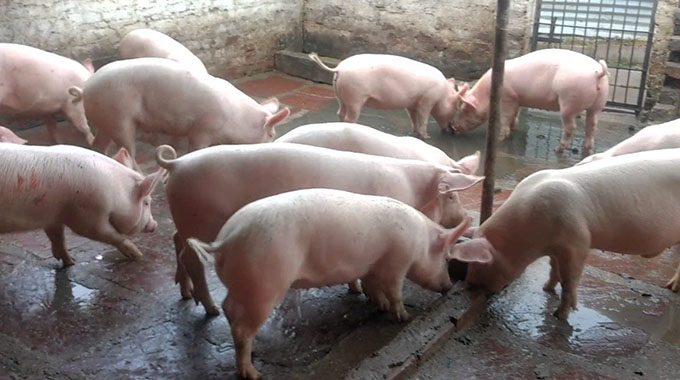
Edgar Vhera
Specialist Writer – Agribusiness
SMALLHOLDER pig producers have scored a major production breakthrough, increasing pigs sold per sow per cycle by 50 percent from the traditional 10 to 15, with commercial pig slaughter reaching 264,952.
This came out through a message of appreciation by a smallholder pork producers’ cooperative with members in all Mashonaland provinces, Midlands, Bulawayo and Manicaland – Premier Agriculture Cooperative (PAC).
PAC chairperson, Mr Tapiwa Evans Takawira, thanked the Government for facilitating access to prolific genetics that are yielding impressive results.
Mr Takawira said the genetic improvement programme, which started in 2025, had enabled over 100 farmers to import in excess of 700 gilts and boars.
“Pig farmers are selling an average of 30 porkers and baconers per sow per year, up from 20 and the age to slaughter has reduced to 137 days from 183, with a minimum cold dressed mass per pig of 62 kilogrammes.
“This is due to improved feed conversion efficiency and the impact of grandparent terminal sires, which possess excellent carcass traits,” he said.
Mr Takawira said this further lowered feed consumed by pigs, lowered the cost of producing a kg and enhanced the competitiveness of small-scale producers at the market.
The group also appreciated the Pig Industry Board (PIB) for providing farmers with quarantine facilities and the Department of Veterinary Services (GVS) for helping with import protocols, biosecurity set ups and, animal health inspections and farmer trainings.
“We believe the Government may assist in setting up accredited pig breeding centres in partnership with leading pig breeders.
“There is a need to decentralise abattoirs across the country so that farmers slaughter through hygienic facilities,” he said.
The farmers also want abattoirs to lower slaughter fees and collaborate with tertiary institutions to enhance continuous research on problematic areas affecting the industry.
Mr Takawira said their future target was for one productive pig to produce two tonnes of pork per year, bolstering the push to reduce imports of pork and pork products.
The second round Crops, Livestock and Fisheries Assessment 2025/26 (CLAFA 2) revealed that commercial pig slaughter at registered abattoirs had increased by 9, 6 percent to 264, 952 from 178, 668 in 2020.
“Pig slaughter by grades indicates that porkers accounted for 32 percent and baconers second with 31 percent. These two made up the largest share of pig slaughter, followed by general purpose pigs at 27 percent, manufacturing at seven percent and under-mass pigs on three,” read CLAFA 2.
The Stockfeed Manufacturers Association 2025 annual report revealed that pig feeds accounted for nine percent (95 119 tonnes) of total livestock feeds valued at US$44 million.
This marks a 13 percent increase from the 2024 volumes.
The Agriculture Food Systems and Rural Transformation Strategy 2026-30 (AFSRTS 2) underscored that the pig industry in Zimbabwe had immense potential for growth.
“With good genetics from three primary sources, a well-established research and development centre, a new production, processing and marketing model must be sought to ensure the expansion of the smallholder sector.
“Already lessons from aggregation and cooperative lessons on piggery are beginning to show some positive trends,” read AFSRTS 2.
The new agriculture blueprint noted that feed represented the largest input cost in pig production, representing up to 60 and 70 percent of the costs, so viability and sustainability should focus on localisation of feed production.
Beyond food production, the pork value chain contributes significantly to employment, income generation and the supply of much-needed animal protein.
“Pork production is estimated at 25,000 tonnes in 2025/2026 and is projected to increase to 36,000 tonnes by 2030/2031. The sow population is expected to increase from 153,773 in 2026 to 256,406 by 2030.
“The pig value chain will contribute US$85 million in the 2025/26 season and US$104 million in the 2030/31 season,” continued AFSRTS 2.
The new blueprint will advocate better financing for smallholder production, focus on cost-effective feed production, farmer capacitation, heightened vigilance to diseases, and better biosecurity measures.
“Furthermore, a review of the costs of compliance for abattoir operations will be undertaken. The strategy will promote the establishment of pig multiplication and artificial insemination centres to improve access to high-quality genetics for small-scale farmers,” read AFSRTS 2.