admin
admin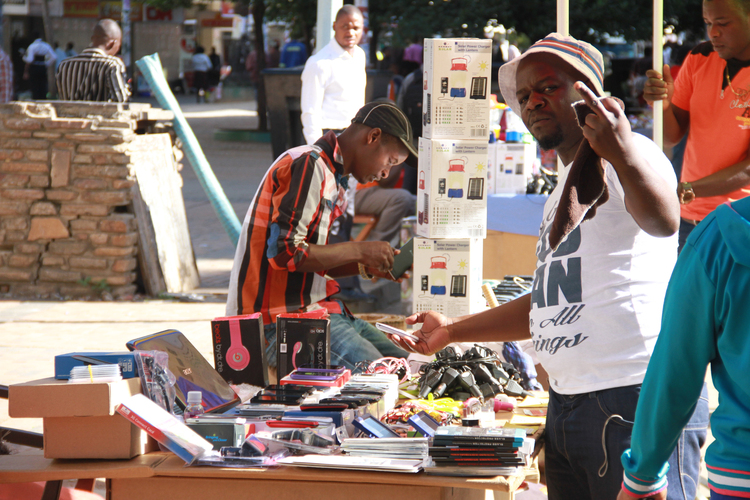

Darlington Musarurwa and Africa Moyo
IT is impossible for one to hit his/her stride on the pavements of Harare’s central business district.
It is not uncommon to move crab-like throughout the length of the city’s sidewalk as detours – stalls improvised from cardboard boxes conveniently assembled to hold all manner of wares – continue to distract human traffic.
Vendors are now threatening to overrun the city.
Even though there is a substantial number of fruit and vegetable paddlers in the wave of vendors flooding the city, it is mobile phone and accessories sellers who have become the dominant species.
Statistics from industry regulator the Postal and Telecommunications Regulatory Authority of Zimbabwe seem to explain why.
Since the licensing of the first mobile phone company in Zimbabwe in 1998, there has been an exponential growth in the use of mobile phones, especially after 2009 when Government scrapped duty on ICT gadgets. Potraz recent stats show that the number of mobile subscribers had risen to 11,8 million at the end of March this year from 11,4 million recorded as at December 31, 2014.
The mobile penetration rate, which measures the rate of uptake of SIM cards in a population, now stands at 90,3 percent.
So popular have mobile phones become, particularly in Africa, that scholars are now describing the phenomenon as the mobile miracle.
A young population, which is widely regarded as a haven for the new generation of “digital natives” (a generation that is intimately familiar with ICT), is also helping drive consumption of ICT products.
The United Nations Population Fund says more than 30 percent of the population in Africa is between the age of 10 and 24, while in Zimbabwe youths make up about 60 percent of the population.
And it is the mobile phone that has become the gateway to the world wide web or the internet.
In the wake of the burgeoning demand for the gadgets from youths, the bulk of whom are unemployed and hence cannot afford high-end mobile phones, informal businesses have naturally moved in. Also, the inherent bureaucratic strictures of brick-and-mortar shops that have to contend with statutory payments to Government and utility and operational costs make formal shops unable to ably compete with the small-time briefcase entrepreneurs.
Imitations storm market
Mr Gideon Chiunda (30), who sells mobile phone handsets along Harare’s First Street near the Econet Shop, said last week most buyers are now price sensitive and would rather opt for counterfeit products that are coming from China than buying a brand new phone from a formal retail shop.
Though buying phones from the street comes with its fair share of risk, consumers seem to see it as a safe bet.
The allure of social media platforms is drawing more and more people towards smartphones, most of which are expensive. Most of the Chinese smartphones, be they counterfeit products or brand new originals, are imported through South Africa and the UAE.
Mr Chiunda said the Chinese phones come into the country mainly from South Africa and Dubai.
“Many people want phones but prices determine as to what type of phone they buy. We bring original phones from time to time but the uptake is very low and, more importantly, profit margins are also very low.
“This means we are now focusing on Chinese phones which are affordable and some buyers say there is no major difference between original and Chinese phones; after all, some just want a phone.”
He noted that sales of low-end monochrome mobile phones is usually brisk mid-month, while demand for counterfeit smartphones soars at month-ends.
Integrity
Apparently, public sector employees, especially members of the police force, have become one of the biggest clients for the small businesses.
“Police officers have become our biggest customers and without them we could be in trouble. No group of civil servants supports us more than the ZRP; they make money circulate among us.”
Prices have also proved to be a major drawcard for pavement vendors.
Original, brand new phones range from US$10 to US$400.
Shops around the new NSSA car park, where Ximex Mall used to stand – along Angwa Street – and the pavements around the Gulf Market near Market Square have become the hotbed of mobile phone trade.
Far from the notion that some of the phones are stolen, vendors believe that integrity is the key to sustainable business and growth.
Most clients are actually referred by satisfied customers.



 Online Reporter