Online Reporter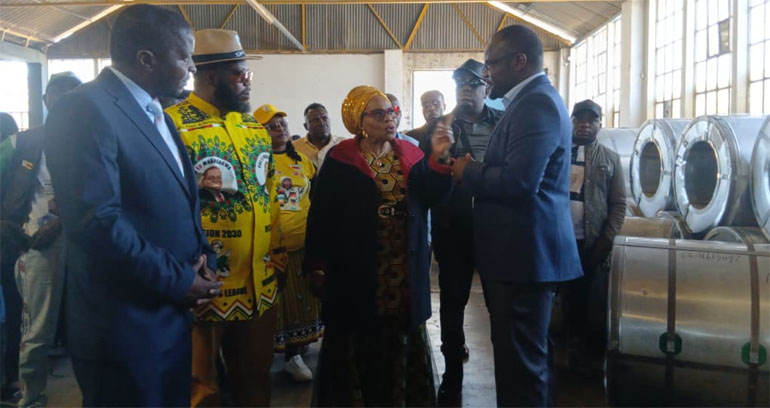
Tendai Gukutikwa
Post Reporter
THE transformation of Small and Medium Enterprises (SMEs) from traders into manufacturers is critical to Zimbabwe’s industrialisation ambitions and the attainment of Vision 2030, Women Affairs, Community, Small and Medium Enterprises Development Minister, Senator Monica Mutsvangwa has said.
Speaking during a tour of Mutare-based manufacturer, Invictus Steel Africa early this week, Minister Mutsvangwa, said the future of the country’s SME sector lies in value addition, production and job creation.
The minister was visiting the company ahead of a graduation ceremony for 764 women and youths who completed entrepreneurship and life-skills training programmes in Manicaland Province.
She described Invictus Steel Africa as a prime example of the kind of SME growth the Government seeks to promote, saying the company has successfully evolved into a manufacturing enterprise that is creating jobs, adopting technology and contributing to economic development.
“Invictus Steel Africa represents the transformation we want to see in the SME sector. They have moved beyond trading into manufacturing, creating value, generating employment and contributing to industrial growth. This is the direction we want our SMEs to take as we build an industrialised economy,” said Minister Mutsvangwa.
The company, which has been operating for eight years, manufactures a range of steel products, including door frames, lintels, embossments and other construction materials used in housing and infrastructure development.
Minister Mutsvangwa commended the company for embracing modern technology to enhance productivity and product quality.
“What impressed us is the level of technology that has been introduced into the production process. Modern equipment improves efficiency, product quality and profitability, all of which are essential for sustainable business growth,” she said.
She said the Government remains committed to creating an environment that enables indigenous businesses to invest, expand and participate in national development.
She also underscored the importance of strengthening local supply chains to reduce dependence on imported raw materials.
“Our vision is to see more inputs being produced locally. This will lower production costs, increase manufacturing output and create additional employment opportunities for Zimbabweans,” she said.
Minister Mutsvangwa applauded the company’s expansion into export markets, describing exports as an important source of foreign currency earnings and a reflection of confidence in locally manufactured products.
“It is encouraging that the company has begun exporting its products. Export growth strengthens the economy while showcasing the quality and competitiveness of Zimbabwean goods,” she said.
She noted that SMEs have become a major pillar of the economy and should no longer be viewed solely as informal businesses.
“The SME sector is now one of the largest contributors to economic activity in Zimbabwe. Companies such as Invictus Steel Africa are creating jobs, paying taxes, supplying local industries and increasingly competing in regional markets,” she said.
Minister of State for Manicaland Provincial Affairs and Devolution, Advocate Misheck Mugadza, said the growth of local manufacturers was complementing the province’s infrastructure development programme.
“Manicaland is experiencing increased construction activity, particularly in Mutare, where commercial and residential developments continue to expand. This growth is creating demand for locally produced building materials, and companies such as Invictus Steel Africa are helping meet that demand while creating jobs,” he said.
Invictus Steel Africa director, Mr Munyaradzi Shadaya, said the company’s growth was driven by sustained investment and a conducive operating environment.
“For the past eight years, we have been steadily expanding our operations and improving our production capacity. Government infrastructure projects have also contributed to increased demand for our products,” he said.
Mr Shadaya said the company currently employs 30 workers and plans to recruit more as it expands.
“As production increases, so does our need for additional workers. Manufacturing growth naturally leads to employment growth,” he said.
He added that the company remains focused on investing in technology, improving product quality and expanding its export footprint.
“We believe Zimbabwean manufacturers can compete regionally if they continue investing in innovation, skills development and quality production,” said Mr Shadaya.
Minister Mutsvangwa later officiated at the graduation of 764 women and youths from across Manicaland who completed entrepreneurship and community life-skills training programmes designed to equip participants with practical business and income-generating skills.
Women constituted 80 percent of the graduates, while men accounted for 20 percent.
The minister said empowering citizens with productive and marketable skills remains central to the country’s development agenda.
“Sustainable development can only be achieved when citizens are equipped with practical skills that enable them to participate meaningfully in the economy. Skills development is the foundation of entrepreneurship, innovation and economic transformation,” she said.
She said empowering women and young people strengthens families, communities and the national economy, making skills development an essential component of achieving Vision 2030 and the objectives of the National Development Strategy (NDS2).