Remember Deketeke recently in Murehwa
For generations, the women of Manomano and Guveya villages in Murehwa West have woken before dawn — not to prepare their children for school, tend their gardens or open their small businesses, but to walk. Sometimes for kilometres. Sometimes through the dark. All in search of a resource that most of the world takes for granted: clean, safe water.
That daily pilgrimage, which has shaped and constrained the lives of women and girls across this corner of Mashonaland East, is now coming to an end.
The commissioning of the Murehwa Water, Sanitation and Hygiene (WASH) Project has brought six solar-powered boreholes, storage tanks, a reticulation system and strategically positioned tap points to communities that have long borne the brunt of water scarcity.
But beyond the pipes, tanks and panels lies a transformation that is deeply personal for the women who have carried the burden of water collection for years.
“We want to thank the Government and the Rotary Club for remembering our community and bringing this development to us. Water has always been a major challenge, but this intervention has made life much easier,” said Ms Monica Maniwi of Guveya Village.
“We are now able to prepare meals on time, clean our homes and attend to other household chores without spending much of our time in search of water. It is a huge relief, especially for women who used to wake up early and spend several hours fetching water.” Perhaps nowhere is the impact more profound than at Chemhondoro High School, where the absence of reliable water and proper sanitation facilities had long forced some girls to miss school during their menstrual periods — a silent crisis that undermined their education and dignity.
State Minister for Provincial Affairs and Devolution for Mashonaland East, Advocate Itai Ndudzo, captured the significance of the development during the commissioning ceremony on Tuesday.
“Today is not simply about taps, pipes and tanks. It is about dignity. It is about health. It is about giving every child at Chemhondoro High School, beyond and every family in this community, a fair chance to learn, to grow and to prosper,” he said.
“No girl should ever have to choose between her dignity and her education. With running water, clean toilets and proper handwashing facilities now in place here at Chemhondoro, our daughters can attend school every day of the month.”
For the women of Murehwa West, the availability of water within their communities represents more than convenience — it is a reclaiming of time itself.
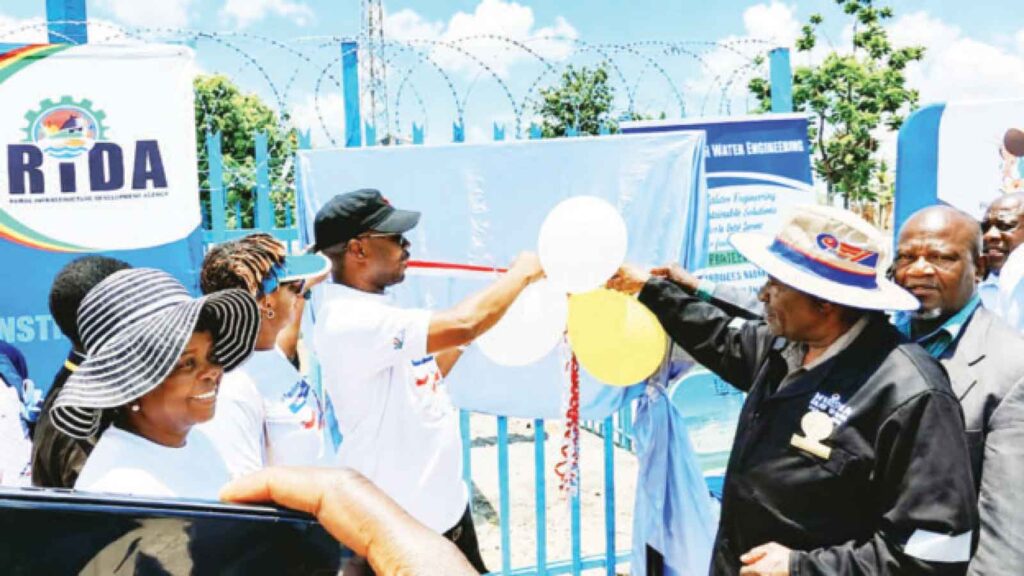
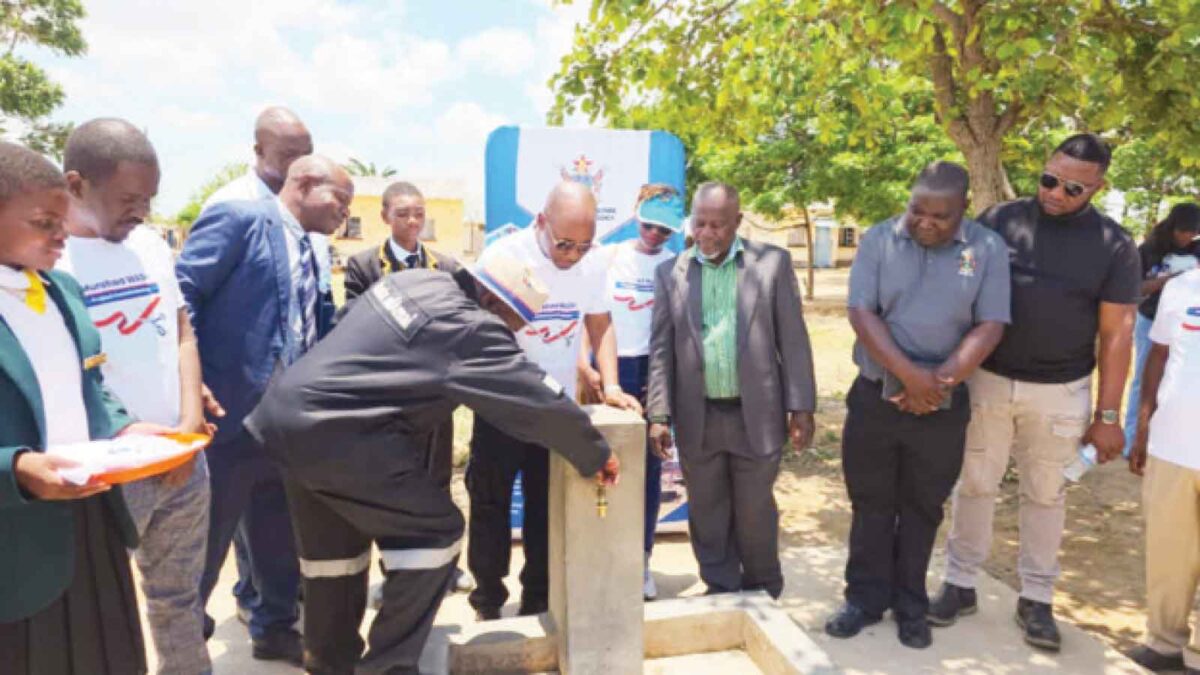
Minister of State for Provincial Affairs and Devolution for Mashonaland East Minister Itai Ndudzo (in white), commissions a solar powered borehole together with Murewa Chief, Chief Mangwende (Morgan Gatsi) at Chemhondoro High School in Mrewa on Tuesday. —Picture: by Remember Deketeke.
Time that can now be spent on education, income-generating activities and the countless responsibilities that had previously been squeezed into the margins of the day.
Ward 12 Councillor Idah Jaravaza said the initiative had come as a lifeline to residents, particularly women and girls who were bearing the brunt of water shortages. She noted that the lack of reliable water supplies had exposed young girls to various social challenges, including teenage pregnancies, as they travelled long distances in search of the precious liquid.
“Water is life, and these boreholes have come at the right time to save lives and address some of the challenges our communities have been facing because of water shortages,” she said.
“When water is not readily available, women and young girls are forced to walk long distances in search of it, exposing themselves to various risks.
The availability of water within our communities will go a long way in protecting our children and ensuring that they have more time to concentrate on their education.”
The scale of the benefit is substantial. Ward 12 has been allocated three boreholes, strategically located to serve a significant number of households and institutions.
One borehole at Chemapango High School benefits approximately 1 600 pupils, while Manomano Village serves about 450 households and Guveya Village about 480 households.
“This means that thousands of people are set to benefit directly from improved access to water, which is essential for their daily activities, hygiene and general well-being,” Cllr Jaravaza said.
Crucially, taps have been positioned approximately every 300 metres to minimise the distances people have to travel in search of water. “We want to make sure that water is accessible to everyone, particularly women, children and elderly people,” she said.
At the household level, the relief is tangible. Village Head Manomano said the development had eased household chores and triggered other income-generating activities.
“The drilling of these boreholes has made a tremendous difference in our village. Previously, people would spend a lot of time looking for water, but now they can easily access it within their communities,” he said.
“Women can now attend to other household responsibilities, while those involved in different business activities can concentrate on their work instead of spending hours searching for water. We are grateful for this development because water is central to everything we do. It has brought convenience and relief to our people.”
The project will also support agricultural education through school gardens and demonstration plots, enabling learners to practise climate-smart farming techniques.
Minister Ndudzo urged the school to use the facility to equip learners with practical agricultural skills.
“Let it become a centre of excellence where young people discover that farming is a business, a science, and a path to prosperity,” he said.
The initiative is being supported by the Rotary Club of Harare CBD, in partnership with the Rotary Club of St Helena in California, USA, with The Courage of H.O.P.E. Foundation also contributing. It represents a model of partnership that places communities — and especially their women — at the centre of development.
Yet Minister Ndudzo sounded a note of caution, urging the school and surrounding community to safeguard the infrastructure and establish mechanisms for its maintenance.
“Commissioning a project is the easy part. The real test is whether it still serves this community five, 10 and 20 years from now,” he said.
For the women of Murehwa West, that future begins now. With every tap that flows within reach of their homes, with every girl who can attend school without interruption, with every hour reclaimed from the search for water, the WASH project is doing more than delivering a basic service — it is restoring dignity, protecting health and unlocking the potential of a generation.
Water may be life, but for the women of Murehwa, it is also time, safety, and opportunity — and it has finally arrived.