Online Reporter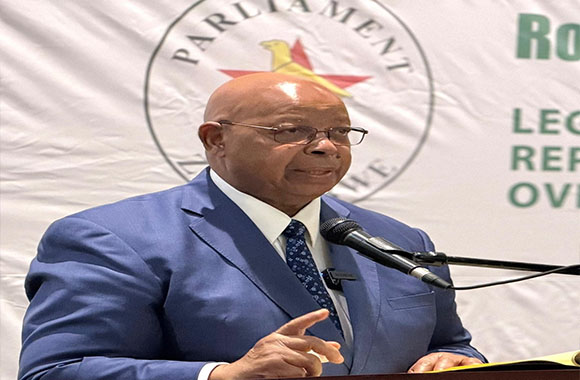
Sikhulekelani Moyo [email protected]
Speaker of Parliament Advocate Jacob Mudenda has called on Parliamentary Portfolio Committees to strictly enforce the timely submission of monthly, quarterly and annual financial reports by Government ministries and public entities, saying consistent reporting is the cornerstone of credible budget analysis and effective public accountability.
Officially opening a two-day Capacity Building Workshop on Budget Analysis in Bulawayo on Saturday, Adv Mudenda said the Public Finance Management Act (PFMA) [Chapter 22:19] provides Parliament with the legal instruments needed to transform oversight from a theoretical exercise into an enforceable constitutional obligation.
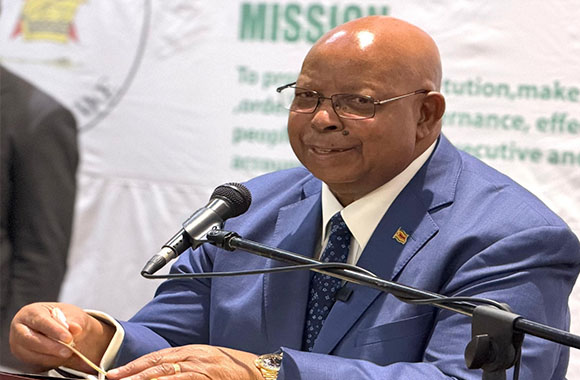
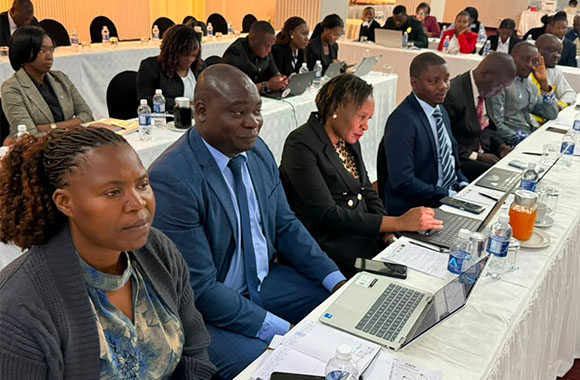
Addressing Members of Parliament serving on the Portfolio Committees on Energy and Power Development, Environment, Climate and Wildlife, ICT, Postal and Courier Services, and Media, Information and Broadcasting Services, he stressed that financial reporting under the PFMA follows a structured chain that committees must vigilantly monitor.
“Chief among these is the discipline of reporting which Sections 32 to 35 establish as a graduated framework flowing directly to your Committees,” he said.
Adv Mudenda outlined the statutory reporting timelines provided under the Act, noting that Section 34(2) requires monthly financial statements and reports to be submitted within 30 days of the end of each month, Section 33(2) requires quarterly reports within 60 days after the end of each quarter, while Section 35(9) stipulates that unaudited annual financial statements must be submitted within 90 days of the end of the financial year.
“These sequential reporting obligations — monthly, quarterly and annually — create a continuous accountability chain that enables your Committees to monitor fiscal performance in real time rather than retrospectively,” he said.
The Speaker criticised the growing tendency by some Government ministries, departments and agencies to bypass monthly reporting and submit only quarterly reports, describing the practice as a violation of the principles underpinning public financial management.
Responding to concerns raised by committee members that they had not been receiving monthly reports from ministries, Adv Mudenda said quarterly reports could not be credible without the monthly financial records on which they are based.
“The monthly report is the springboard for the production of the quarterly submission and the annual statement is no more than the faithful aggregate of the four quarters’ reports preceding it,” he said.
He urged committees to adopt a proactive approach by demanding reports before statutory deadlines instead of waiting for ministries to submit them.
Demand the monthly report in the third week and the quarterly report within thirty-five to forty-five days of the close of the preceding quarter,” he said.
Adv Mudenda also called for strict adherence to International Public Sector Accounting Standards (IPSAS), saying standards that are not enforced become meaningless.
Grounding his remarks in the Constitution, the Speaker reminded legislators that oversight of public expenditure is a constitutional duty rather than a discretionary function.
“The Constitution does not merely permit you to scrutinise public expenditure as a courtesy. It commands you to do so because you must ensure that public resources are deployed on programmes designed to advance the livelihoods of the citizenry with the greatest attainable equity, efficiency and developmental impact,” he said.
He cited Section 119(3), which makes Government accountable to Parliament, Section 298 on the principles of public financial management, and Section 299, which mandates Parliament to monitor State expenditure.
Where ministries fail to comply with reporting requirements, Adv Mudenda urged committees to invoke the disciplinary provisions contained in Sections 85, 86, 87 and 88 of the PFMA.
He said the same reporting obligations apply to State-owned enterprises and public entities under Sections 45 to 48 of the Act, which require them to submit annual budgets, corporate plans and other information requested by Parliament.
“Together, these provisions place a regular stream of financial statements before your Committees and your budget analysis must interrogate every figure the stream contains,” he said.
Adv Mudenda challenged legislators to ensure that every budget allocation they scrutinise translates into tangible improvements in citizens’ lives.
He urged MPs to assess budget proposals against four key tests — adequacy, priority, equity and effectiveness — while embracing data analytics and artificial intelligence to strengthen parliamentary oversight.
Quoting the African proverb, “Until the lion learns to write, every story will glorify the hunter,” Adv Mudenda encouraged legislators to strengthen their capacity in budget analysis.
“Today, you begin the ennobling journey of becoming the lion that writes its own story through the disciplined mastery of rigorous Budget Analysis,” he said.
The workshop is aimed at enhancing the budget analysis and oversight capabilities of members of the four Portfolio Committees as Parliament seeks to strengthen accountability and improve public financial management.