happiness Chikwanha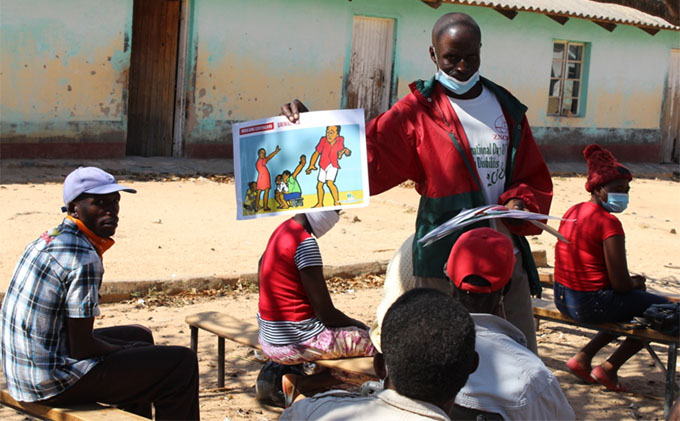
BY DEBORAH NCUBE
Senkwasi village is located in Ward 9, Zhombe East Constituency. It is a hard to reach area characterized by very bad roads.
This limits the level of interaction between the inhabitants of the Senkwasi community with the outside world as there are erratic mobile network systems for communication and little to no transport system.
According to the Councilor of the Ward,Mr Sibanda, the BMZ project was the first project to programme in the area specifically targeting persons and parents of children with disabilities. Children with disabilities in the Ward have over the years been marginalized.
It is unfortunate that they lack knowledge and assistance on issues that affect them. Due to myths and misconceptions on the causes of disability, parents of children with disabilities have been isolated and suffer from various forms of discrimination in the community.
Intervention
In 2019, the BMZ project facilitated the identification and training of parents of children with disabilities through collaborations with the District Social Welfare andMinistry of Health and Child Care (MoHCC) Rehabilitation department.
A total of 30 parents were trained on parenting skills, basicphysiotherapy, rights of children with disabilities, as stipulated in the United Nations Convention on the Rights of Persons with Disabilities (UNCRPD), and the 2013 Constitution of Zimbabwe.
Thetraining took place at Rio Tinto High School in Zhombe and was jointly facilitated by theMoHCC Rehabilitation Department and the project team [(Zimbabwe Parents of Handicapped Children Association (ZPHCA),Zimbabwe National Council for the Welfare of Children (ZNCWC) and PLAN International Zimbabwe)].Parents were encouraged to form parent-to-parent support groups in their communities so as to offer each other moral support and engage in livelihood projects to cater for their children’s needs.
Change
Soon after the intervention started, where parents of children with disabilities received training, they instantly formed a support group called St Paul’s Support Group. Initially, the group comprised of only 8 members.
They selected their committee members and drew up a constitution upon which they agreed to meet once every month and each member to contribute RTGS$2 for starting livelihood projects.
Currently, their membership consists of 18 members.As parents who had been made aware of the rights of children with disabilities, members of the group began community-based awareness campaigns to sensitize communities on the need for inclusion of persons with disabilities in issues that had a development focus and agenda.
3 committee members were tasked with visiting schools in the Ward and conducting meetings with School Development Committees (SDC) encouraging them to construct disability-friendly infrastructure that included ramps and toilets.
The group managed to collect demographic data on the number of children with disabilities and the various forms of disabilities which fed into the MoHCC’s database.
According to the chairperson of the group, Mr. Nicholas Musakatizi, members of the group with children of school-going age have managed to take turns to accompany their children to school, a scenario that has promoted the children’saccess to their right to education.
The support group collaborated with Zhombe Mission Hospital and organized outreach sessions on physiotherapy at the 3 clinics in the Ward which witnessed most children being given home programs.
This has resulted in 3 children in the Ward who were wheelchair bound being able to walk with limited assistance. According to Councillor Sibanda, who has also been acting as a mentor for the group and also has a disability, “the parents are doing very well and are making strides in making sure that discrimination of persons with disabilities becomes a thing of the past. Even parents with able bodied children want to join the support group because of the projects they are doing.”
The group has a poultry project and once the chickens are ready for selling, each member is tasked with selling a certain number of chickens. The group also has a catering component where they provide catering services during awareness meetings.
A member of the group, Ms Rhoda Ncube, indicated that the income generated from these projects is used to pay school fees for some of their children, purchase medicines for children with epilepsy and the money can also be borrowed by members if they have an urgent need for the money.
Those who borrow the money return it with a 10 percent interest and she cited that, “we always try to make sure the money from our projects is used to benefit our children with disabilities.”
Most parents of children with disabilities in this Ward were also selected to become Community-Based Rehabilitation Volunteers in line with the District Social Welfare and MoHCC guidelines. According to the Councillor, “this is because the community recognized them as doing important work in uplifting the lives of children with disabilities in their Ward.” The group continues to encourage other parents of children with disabilities to form support groups. Their efforts have seen parents forming 3 other separate support groups in the Ward namely, Bhamala Support Group, Toshinga Support Group and Bambanani Support Group.
Challenges
Despite making all these positive strides, the parents continue to face a lot of challenges which are a drawback in fostering inclusion of children with disabilities.
As described by MrMusakatizi,one of the major challenges is the shortage of qualified teachers who were trained to teach children with special needs in schools. This results in either parents being reluctant to send their children to school or some of the children with disabilities going to school to spend the whole term playing.
The current economic climate is impacting negatively on livelihood projects as earnings tend to lose value.
There is also a serious shortage of medication for epilepsy in the local clinics which has resulted in some children with disabilities defaulting on treatment. It is also difficult for some of the children to access assistive devices, including wheelchairs, which hinders their mobility especially for those with affected limbs.
Recommendations
Cllr Sibanda recommended that the project and all stakeholders should ensure that all children with disabilities have access to assistive devices. In his remarks, “it is pointless for organizations to come here and talk about inclusion of children with disabilities when there are no wheelchairs to make it possible for the same children to move around.”
MsNcube cited that government has to make deliberate efforts to ensure that at least one teacher should be available to teach learners with special needs at every school. A Senior Teacher at St Paul’s primary school, on the other hand, said parents should enroll their children in school and leave MoPSE to figure out how they are going to learn. In her remarks, “the district can only send special teachers if the school has children with learning challenges, therefore, I urge you parents to send all your children to school regardless of their disabilities and let us worry about getting special teachers.”



 Online Reporter