Chronicle Editor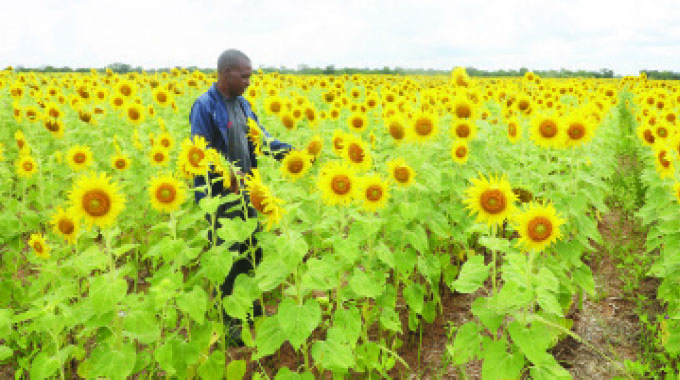
Flora Fadzai Sibanda, Business Reporter
BUBI-Lupane Irrigation Scheme in Matabeleland North province is not just a farming place for food production but a sustainable industrial zone that gives locals regular stable incomes.
From producing good wheat harvest in the last winter season, farmers in the area have planted maize and sunflower under summer cropping from which they expect to reap big earnings.
The 90 members of the scheme are confident their sunflower crop, grown in a 120-hectare piece of land, would deliver more than four tonnes per hectare.
From their projections, the farmers expect to get more than US$400 each from the harvest, which is in addition to the wages they earn every month for the work they do at the irrigation.

Irrigation scheme chairperson, Mr Gerald Khumalo, said following the successful wheat harvest they have decided to venture into sunflower production. This follows wide consultation with the respective experts in soil sciences.
He said after consultation they were advised to grow the crop on zero tillage because the area has sandy soil. Zero tillage refers to the arable land on which no tillage is applied between the harvest and sowing. Instead, the crop is sown directly into the soil that is not tilled.
One of the major benefits is that it increases soil biological activity and increases soil organic composition.
Mr Khumalo said when they were planting the sunflower, they used a chemical called glyphosate, which kills weeds down to the roots to avoid growth.
He said this chemical has helped to ensure weeds do not grow and disturb the growth of the sunflower crop.
“Growing sunflower is not hard. You just need to plant it properly and monitor the weeds then all becomes set.
“Right now, we water it after every two days using our irrigation, that is if it has not rained,” said Mr Khumalo. “To make sure that our crop is not affected by weeds and insects we spray a chemical using the fumigation tank after every three weeks.”
He said they were going to be harvesting in August and each farmer was going to get more than US$400 from the harvest.
“We would be getting more. However, since it was the first time we were trying sunflower we have costs that we need to put aside and some pay debts.
“The crop is promising as you can see how it is growing and how healthy it looks. After harvesting, we are going to sell the sunflower to the Grain Marketing Board,” said Mr Khumalo.
He said the irrigation scheme continues to improve their livelihood by creating jobs and affording them a chance to make their own money.
The farmers are confident the money they will get from the sunflower harvest will go a long way in supporting livelihoods for the 90 households.
Another farmer at the irrigation scheme Mrs Siphathisiwe Makhuwe said they were grateful to the Government for the continued support they are getting.
She said if it was not a Government initiative the money from the sale would not be shared among the farmers and they would only be getting the dividends.
“The Government has shown that it is possible for people even in our region to be given a chance to make their own money,” she said.
“When I first heard about this initiative I was skeptical because it seemed to be too good to be true. However, now I can safely say the Government has kept its word and has supported us throughout,” said Mrs Makhuwe.
Bubi-Lupane Irrigation was established in 2021 as a pilot project for an integrated business model to be replicated by 450 irrigation schemes across the country. The model is part of the Second Republic’s accelerated rural development and industrialisation drive.
Through Government support, the project has helped transform subsistence agriculture at household level into commercial agriculture as part of rural development and industrialisation in line with Vision 2030, which is anchored on driving the country’s economy into an upper middle-income one.
President Mnangagwa launched the Arda Vision 2030 accelerator model programme at Bubi-Lupane Irrigation Scheme to stimulate rural industrialisation through agricultural development.
In 2021 the villagers who participated in the Bubi Lupane Irrigation Scheme were paid a dividend of nearly US$1 000 and $600 000 each after delivering 900 tonnes of maize to the Grain Marketing Board.
Also, the villagers are paid monthly salaries of $25 000, which assists with their upkeep. — @flora_sibanda


 Online Reporter