admin
admin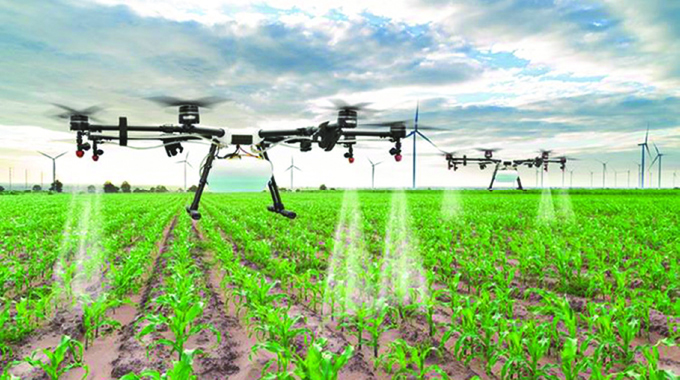
Business Reporter
THE Government, development partners and stakeholders in the agriculture sector are expected to come up with solutions on how the sector can leverage technology to boost production across its value chains.
Agriculture is the backbone of the economy accounting for almost three-quarters of the raw materials needed in manufacturing while employing over half of the employable population.
The sector is also seen playing a critical role in helping the country achieve the upper middle-income economy by 2030 as espoused in the Government’s Vision 2030. Experts have said employing smart farming techniques such as those practised in India and Israel will see the country more than double output.
Smart farming is an emerging concept that refers to managing farms using technologies like Internet of Things (IOT), robotics, drones and Artificial Intelligence (AI) to increase the quantity and quality of products while optimizing the human labour required by production.
The introduction of smart farming enables increased yield through more efficient use of natural resources and inputs, and improved land and environmental management, Zimbabwe can attain its breadbasket status again.
In line with this Minister of Lands, Agriculture, Fisheries Water and Rural Resettlement Dr Anxious Masuka is expected to headline a Smart Farming Indaba in the resort town of Victoria Falls from December 8 to 10, 2022.
He will be joined by other speakers such as African Development Bank (AfDB) executive director Dr Judith Kateera, Zimbabwe Farmers Union executive director Mr Paul Zakaria, Indian Ambassador to Zimbabwe Mr Vijay Khanduja and among others will share ideas on adopting smart farming principles.
The indaba, hosted by alternative investment firm Global Renaissance Investments (GRI), will create a platform for stakeholders to determine the country’s readiness to adopt the revolutionary concept.
GRI chief executive officer (CEO) Mr Ngoni Dzirutwe said more than half of working Zimbabweans have jobs in agriculture, but poor infrastructure, traditional farming techniques, inadequate tools and a lack of investment have left the country’s mostly small-scale farms struggling to feed a growing population, something that can be addressed embracing smart farming.
“Smart farming helps both contractors and small-scale farmers to better understand the important factors such as water, topography, aspect, vegetation and soil types. This allows farmers to determine the best uses of scarce resources within their production environment and manage these in an environmentally and economically sustainable manner.
“It also enables farmers to monitor the quantity and quality of their products in a timely manner and to adjust their production techniques, when necessary,” he said.
According to various forecasts, the world’s population will grow by 34 percent by 2050, therefore smart farming will highly become the norm in order to increase yields. This makes the use of smart farming technologies a necessity.
Recently, President Mnangagwa called on Africans to focus their attention and responsibility towards shaping pathways and solutions to the challenges that confront the continent by building resilient agricultural food systems.
“Despite the challenges we face as a continent, solutions abound on the horizon. Climate-proofing agriculture is an immediate solution to address the challenges of climate change. This can be achieved through the adoption of climate-smart agriculture practices such as conservation agriculture and irrigation development that help build adaptive capacity, enhance resilience, and increase agriculture production and productivity,” said President Mnangagwa while opening the Plenary Session of the African Green Revolution Forum in Kigali, Rwanda.
Mr Dzirutwe said the use of technology in farming means farmers can reduce costs, time and waste which translates to greater profit margins and more efficient resource use.
“Technology can be used even in dryland farming systems, as operators gain a better understanding of the soil moisture profile to assist decision making particularly with respect to sowing, yield potential and the application of fertilizer,” said Mr Dzirutwe.
The world over, drones are being used to assess crop health, predict yields, spray plants, count plants, measure moisture and plant seeds.
This in return reduces costs and time spent on the process while limiting human contact with fertilisers, pesticides and other harmful chemicals.
In some countries sensors are installed in fields for soil, water, light, humidity and temperature monitoring.



 Online Reporter