


 Chronicle Editor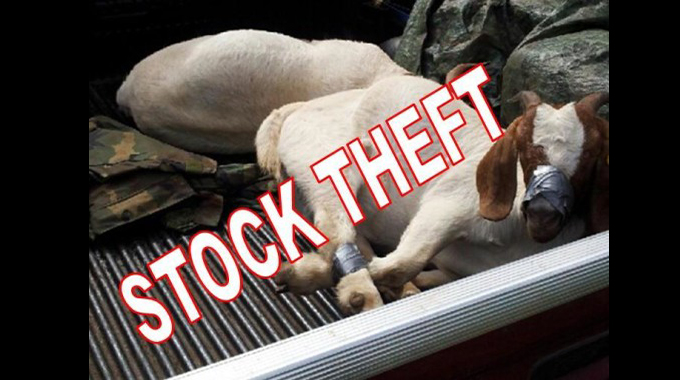
THERE are at least three serious challenges that face a livestock farmer today, namely stock theft, livestock diseases and drought.
We have seen the migration of the deadly Theileriosis (January disease) from regions in the north of the country to the southern side and farmers have been counting losses since then.
As I write farmers in Insiza, Umzingwane and Bulilima districts are being ravaged by this disease.
You then add, the current drought to the already burdened farmers and you have a perfect definition of a calamity.
These farmers are struggling with the deadly disease and they have been battling to save their herds since the arrival of the disease.
Now, they must add feed and water challenge to the matrix, there is no worse headache than that. Then, you have the perennial problem of stock theft, which has also been growing and evolving over time.
Readers will agree with me that over the years, stock theft has evolved from being an occupation of rascal bottom feeders ,to the involvement and participation of businesspeople and other well to do people.
The thieves have become more connected and increasingly untouchable, making it difficult for justice to be dispensed.
Even the modus operandi of stock thieves has evolved from simple illegal possession and sell of a few animals, to a wholesale looting of an entire herd and sophisticated concealment of the theft.
We have now seen de-boning of slaughtered animals and transportation of up to five carcasses in smaller vehicles, like the infamous Honda Fit.
The point of this article, is to shine a light of the evolution of stock theft as a petty vice from low key members of our society to a sophisticated enterprise comprised of a matrix of connected powerful persons.
As such, the means of the farmer and the law enforcement agencies that still care for protection of private investment and the course of justice must evolve and keep up or at least be ahead of the thieves.
It is in that view that I wish to celebrate the efforts of an individual whose identity I am yet to establish. This is a guy whose signature statement is “when duty calls”. This man’s voice has been doing rounds especially on WhatsApp platform, as his audios are shared among groups, especially those with an inclination towards livestock issues.
The man has been very active in exposing stock theft and the alleged thieves especially in areas of Matobo and Mangwe districts.
I would like to believe that many farmers have recovered their lost animals and some stock theft efforts thwarted through the effort of this anonymous man.
His level of commitment to the protection of livestock from theft is currently unmatched and the lengths to which he goes to investigate, track and expose the evil is unimaginable.
This man deserves a Bells! My point, however, is to highlight the importance of evolving our methods to match or even surpass those of thieves.
We need to embrace the use of technology, to shoot videos and photos of any animals being moved and share the details widely so that the thieves are easily identified.
A small improvement is needed though on these messages, audios, or videos and this is to do with such things as the date, geographical location and the identity as well as the contact details of the person sending the message, so that the life span of the message can be determined and those willing to verify can call.
It is very common to receive a very useful message but with no contact details and one fails to make contact, or the message has no date such that one cannot verify if the issue is current or its an old message still in circulation.
In some cases, people provide a location, providing a name of a little known village and this cannot be useful when read by someone in another province.
But indicating the district and the area name, can help to locate the place.
Otherwise, this pen would like to implore farmers and communities at large to always be ready to shoot photos and videos of animals being moved suspiciously and share so that if those are stolen, they can be traced and recovered.
In this past week, the “when duty calls” man, helped to expose theft of close to a hundred animals, which were being kept at Jungle Farm in Marula area of Mangwe District.
One video even showed that the thief had used a metal to blur out the brand marks from the animals. The sophistication I referred to earlier on.
The recovered animals were then hoofed to Plumtree Town and penned at the veterinary quarantine pens in the town.
Sadly, the animals “escaped” from the pens at night and only 22 were recovered from the 63, at least from the official statement made by the local veterinary office.
As to how the animals escaped and how a herd of 40 plus animals with bells can vanish without trace, I will leave the readers to decode the possibilities.
Uyabonga umntaka MaKhumalo. Mhlupheki Dube is a livestock specialist and farmer. He writes in his own capacity. Feedback [email protected]/cell 0772851275


 Online Reporter