Online Reporter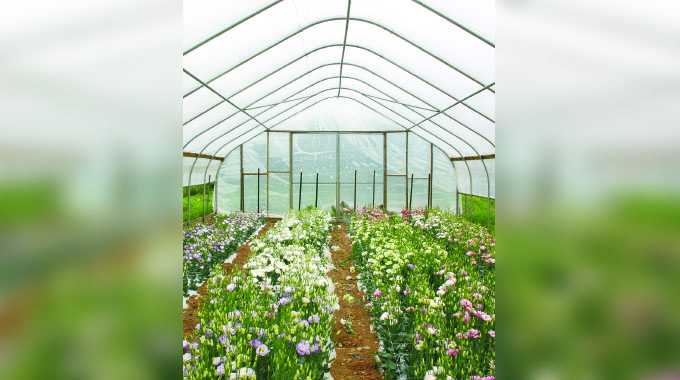
Edgar Vhera, Zimpapers Business Hub
ZIMBABWE has the potential to drive flower production and boost export earnings if certain strategic policy interventions are taken, the Horticultural Development Council (HDC) has said.
Flower production is projected to increase from the current 2 300 to 40 000 tonnes by 2030.
This would potentially create more than 4 600 jobs and improve livelihoods.
HDC board member and blueberry farmer, Mr Willard Zireva, recently said Zimbabwe’s floriculture sector output was projected to rise by 2030 as a result of 615 percent area expansion from 130 to 930 hectares (ha).
“The earnings are also expected to rise to US$276 979 200,” he said.
According to the HDC, the area under summer flowers is set to increase from 100 hectares to 600 ha, while for rose production will increase from 30 ha to 330 ha.
An investment of US$45,6 million is, however, required for this expansion.
“Such a production growth will create 4 650 new jobs and transform rural livelihoods across the nation,” he said.
Mr Zireva said the key to achieving that growth rested in addressing challenges such as access to finance, power and water supply.
“There is limited affordable credit and high interest rates, which are restricting investments.
“Inconsistent water access limits irrigation and production capacity while unreliable electricity disrupts operations and processing,” said Mr Zireva.
An analysis of the floriculture sector in the past gives credence that this is not a pipe dream, as in the year ending June 2000, the country exported 19 488 tonnes of flowers worth US$89,65 million.
Zimbabwe ranks as the second largest in Africa, behind Kenya, second among African, Caribbean and Pacific Group of States (ACP) exporters and is the fifth biggest provider to the European union (EU).
Floriculture now accounts for 64 percent of the total value of horticultural exports and 27 percent by volume.
Zimbabwe exports cut flowers, including delphinium, euphorbia, liatris, roses, asters, chrysanthemums, carnations, ammi majus, statice, protea, chelone and lysimachia.
ZimTrade recently revealed that floriculture was proving to be a viable and high-value enterprise for farmers willing to learn and adapt.
Flowers are high-value crops that can be grown on small plots of land and, if managed correctly, can yield significantly higher returns than most food crops.
Meanwhile, six small-scale flower growers are set to tour the European union (EU) for the International Floriculture Trade Fair (IFTF) 2025, taking place from 4 to 6 November 2025, at Expo Greater Amsterdam in Vijfhuizen, Netherlands.
Participating in trade missions will help many growers with access to markets.
Market research and attending trade exhibitions will provide trade information to prospective farmers so they can make informed decisions.
Statistics released by Trade Statistics for International Business Development (TRADEMAP) show that the country’s export earnings from flowers grew 156 percent from US$3,4 million in 2023 to US$8,7 million last year.