Online Reporter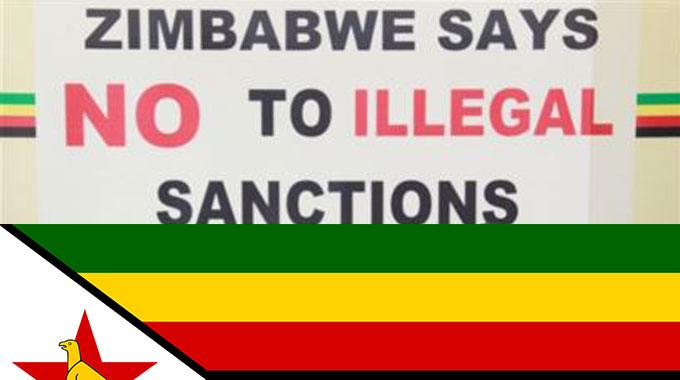
David Mawondo
It is quite disturbing, to say the least, that we have some among us who welcome and celebrate sanctions imposed on our country.
Lies have been peddled in a desperate attempt to convince the masses of Zimbabwe that, what we have are sanctions on targeted individuals and not on the country, but nothing can be further from the truth.
Some people are ideologically bankrupt to the extent that they believe anything Western is divine and immutable, no matter how evil.
Suffice to say, most of these sanctions were drafted by our own politicians and sent to the sanctioning countries for implementation— what callous hearts — driven by the appetite for power!
The chief reason why sanctions were imposed by US and its allies in the European Union, was to set ordinary Zimbabweans against the Zanu PF Government, thus creating an uprising and possibly a civil war to overthrow it and reverse the land reform.
Such a formula has effectively worked in regime change agendas in other republics, but not in Zimbabwe. When the economy screamed, life became very unbearable for the majority, who were told that ‘your suffering is a direct result of misrule and bad governance’.
But we were not fooled.
In 2001, the United States passed the Zimbabwe Democracy and Economic Recovery Act (ZDERA). It sought to block Zimbabwe from getting loans, credit or any financial help from The World Bank, IMF or any major global financial institution.
On paper it was meant to punish politicians, but in reality it punished the ordinary people. No access to funds meant total economic collapse — what a wanton aggression on the lives of the already poor people!
If developed nations can turn to these financial institutions for lines of credit, one can only imagine the level of hunger for such assistance in developing nations like Zimbabwe.
Still some believe that Zimbabwe could not get lines of credit or loans because it has not serviced its debt — fair and fine.
But to what extent was the debt so bad that it had to take the most powerful nation to craft an Act of Parliament just to stop Zimbabwe from accessing loans? Banks have policies, terms and conditions used to decide if loans may be given. Why then was there a need for a special Act of Parliament to help these financial institutions deny Zimbabwe loans? It gives an impression that Zimbabwe had threatened to rob these banks, so the terms and conditions only were not enough to guarantee safety and security, hence the need for ZDERA to support them.
Normally justified sanctions are imposed on individuals, organisations or governments who would have acted in a manner that grossly violated the rights of people or the environment.
Rebel groups who wage war against democratically elected governments and come to power by by-passing the ballot system are a typical example of a sanctions target. Our situation back in 2001 did not qualify us to be sanctioned.
Many countries who are endowed with natural riches like precious minerals, oil and gas do not enjoy peace, not because of poor governance always, but outside interference aimed at changing the administrations and replacing them with governments of their creation better known as puppet governments, who facilitate the exploitation of resources for a song.
In our case, we were told that it is corruption and incompetence, not sanctions that made us suffer. While it is true that by its nature corruption is corrosive to our economy, it is equally true that sanctions have a lion’s share in our predicament.
The Zimbabwe Government can try and address only corruption, but not sanctions.
The setting up of the Zimbabwe Anti-Corruption Commission (ZACC) is a testimony of the Government’s determination to deal with corruption, but regards sanctions — there is no remedy save for the repeated calls for their unconditional removal.
If we manage to deal with corruption yet sanctions remain, the economy will still struggle.
Likewise, if sanctions are removed but corruption remains, the economy still suffers — we do not need both. It is like the case of a patient who is suffering from cholera and cancer where if cholera is successfully treated but cancer is not, the patient will die of cancer.
The patient needs therapy for each disease.
On corruption, why do aggrieved individuals take to social media and newspapers to expose corruption when ZACC and courts are there?
They do not bother exhausting these relevant establishments in the first place. If they really have evidence to substantiate their claims, why not turn to courts which have powers to punish corrupt people?
We have heard them saying the judiciary is captured, but we have witnessed — at the same time — opposition members winning many cases in the very courts. Yet some argue that they fear victimisation if they report to the courts. If this argument holds water, how is taking to social media safe? Social media does not solve the problem or punish lawbreakers — so how is turning to it helpful?
Every country is expected to meet Millennium Development Goals (MDGs). It is honestly not fair to blame any government to meet these goals if their hands are tied. The Government’s performance appraisal cannot be fairly assessed if conditions are not conducive.
I am not saying the Government should relax and do nothing using sanctions as a scapegoat — No! It is not a conjecture to say Zimbabwe’s economic growth rate has been heading northward annually for the past few years. In 2021 it was about 4.7 percent; in 2022 it went up 6.5 percent; in 2023 it rose by 5.3 percent; while in 2024 it grew by 2.2 percent amid drought. This year, IMF has projected growth at 6 percent.
The World Bank and IMF figures almost agree with these growth rates. If figures released by these institutions are anything to go by, what else can be used to convince the armchair critics that the Government has scored some positives amid sanctions?
If such a feat was scored by the government operating under sanctions, there is no prize in guessing what would have happened to the economy if there were no sanctions.
Just out of interest, could the advocates for sanctions tell us just one benefit that we got as a nation from these sanctions ever since they were imposed some 25 years ago?
They planted, and Zimbabweans harvested a basketful of thorns. What an own goal!
The so-called targeted individuals do not feel the heat as it is lied to us. Who dies in hospitals if medication is not available due to sanctions? Who goes to bed on an empty stomach? Who is struggling with transport, rentals and school fees?
If you believe it is the targeted individuals who suffer and not the poor, then you need spiritual deliverance and psychiatric evaluation.
Businesses have suffered too. A product with a Zimbabwean label cannot compete well on the international market either because buyers will doubt the quality of such a product made in a country under sanctions or it will be comparatively more expensive as a result of high production costs.
When Mr Strive Masiyiwa — a businessman himself — once called for the removal of sanctions, he got a backlash from the sanction advocates.
When Mr Kudakwashe Tagwirei financed the Government’s agriculture activities through borrowing from his associates abroad, he was put on the sanctions list — his crime — trying to help resuscitate the backbone of the economy — agriculture.
Other versions of sanctions are on targeted individuals like the President.
If the Head of State, who is the face of the nation at international fora, is on sanctions and as a result does not get what he wants for his country, does anyone not see that it is not himself per se who is targeted, but the constituency he represents — the nation?
The people who called for sanctions are mostly individuals from some political formations who hoped that when people suffer it was going to work as an advantage to them, come elections.
When they didn’t make it to power, they laid the blame on many things, including a flawed electoral system which they say needs reforms. It is now more than two years they have been in Parliament and still no reforms have been done, because we do not need any.
If MPs cannot work on the so-called reforms, who can? In the event of a defeat in 2028, they will in part blame the electoral system saying it requires reforms. Such an argument has been recycled for over 20 years — no wonder some political parties have gone into oblivion, which is very unfortunate because the demise of a sound opposition will subsequently lead to the death of democracy.
Finally, I just want to end by appealing to our opposition and the business community to join hands with the government, SADC, the AU and the United Nations in speaking with one voice calling for the total and unconditional removal of all these draconian sanctions. All these bodies are on record condemning the sanctions. Different political opinions are a function of democracy and should never be used to divide us. Also on behalf of the suffering Zimbabwean, may I once again kindly ask the nations who still maintain sanctions on us to remove them.
David Mawondo is a Harare-based bookkeeper and here he writes in his personal capacity
Feedback: 0773 137 843