admin
admin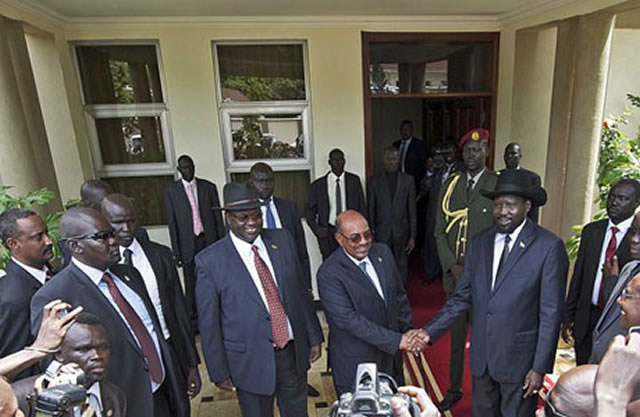
KHARTOUM. — On September 3, the President of South Sudan, Salva Kiir Mayardit, led a high-level delegation on an official visit to Sudan upon an invitation from his Sudanese counterpart President Omar Hassan Al-Bashir. A cordial and positive atmosphere prevailed throughout this visit.
It is widely believed that this visit was expected to lay the foundation for new relations between the two sisterly countries based on mutual respect and co-operation in all fields.
On the sidelines of the visit, the two countries signed a Memorandum of Understanding (MoU) between their ministries of Foreign Affairs to establish a Joint Consultation Committee.
Another MoU on establishing a Joint Business Council was signed by the Sudan Businessmen and Employers’ Federation and South Sudan Chamber of Commerce and Agriculture.
The two countries reiterated their commitment to implement all the nine agreements signed on September 27, 2012 and to activate all the previously agreed on joint committees. Therefore, South Sudanese oil will continue flowing uninterrupted through the Sudanese infrastructures.
They also agreed to facilitate the work of the African mechanisms working in the fields of identifying the zero line for the establishment of the Safe Demilitarised Border Zone (SDBZ) and verification of claims of support to rebel movements. The two countries also agreed to jointly outreach to the international community for debt relief of Sudan and for support for development.
On the remaining burning issues, namely Abyie and the border, the two sides committed themselves to continue co-operation so as to reach an acceptable solution for all parties.
They emphasised the necessity of reaching a speedy agreement on the establishment of civilian institutions in Abyie so as to pave the way for the two presidents to reach a final resolution of the issue. On the issue of border, they agreed to facilitate the work of the African Union Team of Experts (AUTE) to resolve the disputed border area, and to immediately demarcate the agreed border line. The most important thing about this visit is that it witnessed a substantial change in how the relation between the two countries is perceived. This change is a direct result of candid and long discussions between the two countries at various levels. It was arrived at after the two sides tasted the biter swill of dispute and non-co-operation.
It seems that the majority of the people in the two countries began to reject the mindset of the past and resolved to work together.
They have started to think of building their shared future free from the shadow of the past.
Most of the constituencies in the two countries are increasingly realising the strategic nature of the relation between Sudan and South Sudan.
It is becoming evident that those who oppose a strong and special relationship between Sudan and South Sudan are standing on the wrong side of history.
Partnership and co-operation between two neighbours is not a choice. It is the only way out for each of the two as there are various economic, political, social and cultural links between them which cannot easily be severed. And this exactly is what makes this relation a special one. In fact, the two countries have a shared destiny.
The involvement of the private sector in the relations is a major step forward. This will create vital interests for the ordinary citizens in both countries.
The joint communiqué of the visit called on the media and civil society organisations to play a positive role in realising the objective of stability. Therefore, the active involvement of these players in the relations will enhance the position of those who believe in the inevitability of co-operation between the two Sudans.
For the issues that have not been sorted out yet, one has to take into consideration that the challenges which face this relation will not be easily met in a short span of time.
Implementing the nine agreements which constitute the Co-operation Agreement signed by the two countries’ presidents on September 27, 2012 will create a healthy atmosphere for negotiating lasting and acceptable settlements to the issues of Abyie and (its) borders.
Thus it seems that Sudan and South Sudan have opened a new chapter in their relations.
It is hoped that all the impediments to a special relation between the two neighbours will be removed forever and that all will be reading from the same script.
The international community is expected to help the two countries in achieving the noble and well-deserved objective of a lasting peace and stability. — Embassy of the Republic of the Sudan.


 Online Reporter