Chronicle Editor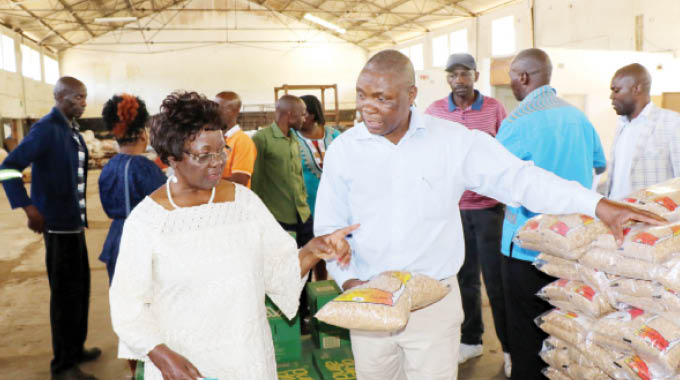
Oliver Kazunga, Acting Business Editor
SMALL-to-Medium Enterprises (SMEs) should take a proactive role in supporting the local currency to strengthen and preserve its value against major currencies to foster economic growth, a Cabinet Minister has said.
Women Affairs, Community, Small and Medium Enterprises Development Minister Sithembiso Nyoni said this on Monday during a meeting with SMEs housed at the Cold Storage Company old site in Bulawayo where the entrepreneurs had invited her to hear their concerns.
Following the coming into power of the new political dispensation led by President Mnangagwa in November 2017, the Minister said the prime focus of the Second Republic was to rebuild the economy, which for close to two decades has been undergoing challenges.
As a stepping stone towards economic transformation, Minister Nyoni said one of the fundamentals was to embark on monetary reforms, which have seen the country re-introducing the Zimbabwe dollar last year.
“The Government under President Mnangagwa’s leadership has managed to institute the necessary monetary reforms in bringing back our local currency.
“It has been noted that depending on other people’s currency to anchor our economy does not facilitate the economic recovery that we desire.
“SMEs as critical economic players, you must support your own currency so that it becomes a strong currency that is stable. Let’s support our own currency by ensuring we are not involved in illicit dealings that devalue it against other currencies,” she said.
Zimbabwe adopted the multi-currency system, which was dominated by the United States dollar in February 2009 to tame inflation that had reached exponential levels.
In June last year, the Government outlawed the multicurrency regime through the promulgation of Statutory Instrument 142 of 2019 effectively compelling all forms of domestic transactions to be done in local currency.
Buttressing President Mnangagwa’s sentiments in his New Year message delivered early this year that there was no going back on mono-currency, Minister Nyoni said to the SMEs:
“The focus should be on initiatives to make it (local currency) stronger than our neighbours’ (neighbouring countries) or to have it at par in terms of value as that of our regional countries.
“Make your own currency as strong as the US dollar. You are weakening the local currency because you are sending it to the galas (parallel market).
“People should not be allowed to sell money because money is a medium of exchange, it is a bill to transact with, hence you should not allow people to sell money.
“This is also one of the reasons backsliding our economy from growing.”
She said of late a majority of SMEs and other big enterprises in the manufacturing sector have quit their operations to engage in uncouth currency trading on the black market.
“The value of the local currency should be decided by us as citizens, its value should not be artificial.
“Let’s support our own currency by ensuring we don’t get involved in illicit dealings that devalue it against other currencies,” said Minister Nyoni.
She said in sync with the President’s sentiments towards an upper middle-income economy by 2030, SMEs should take a leading role to increase their production levels to promote economic growth through job creation and supplying the market to reduce the import bill.
Over the years, the Government has recognised the SMEs contribution to the Gross Domestic Product and in 2017, Cabinet approved the SMEs formalisation strategy paving way for the reinforcement of the social contract and creation of sustainable decent jobs.
The drive to formalise the sector comes on the back of study reports that about $5,7 billion is circulating in that market.
However, the formalisation process has been met with resistance by some players who claimed benefits of formalising were outweighed by costs.
This has prompted Government to champion initiatives meant to encourage SMEs to register their operations with the Zimbabwe Revenue Authority. Such mechanisms include funding facilities from the Reserve Bank of Zimbabwe like the export finance facility, microfinance revolving facility, and the cross border facility. — @okazunga



 Online Reporter