

 admin
admin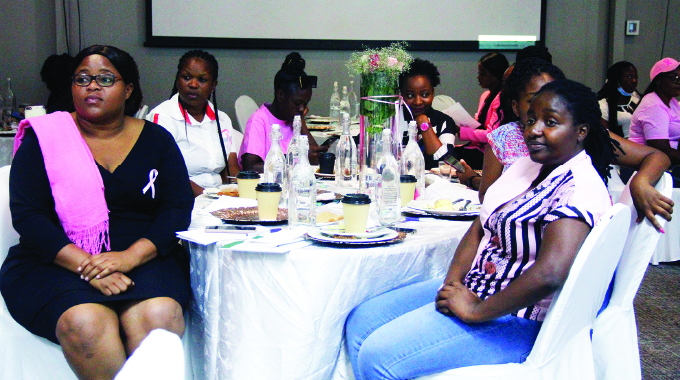
Rumbidzayi Zinyuke Senior Health Reporter
October is now known as the Breast Cancer Awareness Month, and as the month closes today, several survivors of cancer have decided to open up and tell their harrowing tales.
At just 28, Tendaishe Manenji was diagnosed with stage 2B breast cancer.
She had just felt a lump on her breast which she thought she should have checked.
“I was not prepared to hear that I had cancer,” she said.
“I left the clinic in a daze and called my mother who assured me that everything would be fine. But in my mind, nothing was fine. I thought this was the end for me, that I would not get married, have babies or even live a normal life. So many questions came to my mind.”
Tendai had to get a second opinion at Karanda Mission Hospital where she was given the same result.
Her type of cancer was a rare form known as Sarcoma and she had to have an immediate mastectomy.
“I had my mastectomy done at Karanda hospital, but unfortunately some of the cancer cells remained in my body and I was referred to Parirenyatwa for chemotherapy and radiotherapy,” she said.
“But because of the type of cancer that I had, they told me I needed to undergo another surgery for a complete mastectomy so that they can remove all the cancer cells.”
The second surgery was successfully done in November last year and she then started her treatment journey.
Tendai finished her chemotherapy, but could not get the radiotherapy done at Parirenyatwa because the machines were down.
She raised US$9 000 to get radiotherapy at a private facility, which fortunately, she completed last week and she is now nursing her wounds and healing well.
“I learnt so much about myself as I went through my journey of fighting cancer,” said Tendai.
“Even my faith was taken a notch higher. I am no longer afraid of what life throws at me, my scar tells me that I am a fighter. I want to encourage young people to consider getting screened all the time because cancer is there and it does not look at your age or your family history. Anyone can get it so it is better to catch it early.”
According to the Zimbabwe National Cancer Registry 2018 annual report, breast cancer is the second most common cancer affecting women in the country and accounts for 8 percent of all cancer cases, after cervical cancer.
However, most cases are diagnosed at an advanced stage as patients tend to delay seeking medical care. The disease mostly affects women above the age of 40, but like in Tendai’s case, cases of younger women have been detected and are on the rise.
Early diagnosis remains the best chance any person can have of surviving breast cancer.
For Tendai Perpetua Makoni, a self-examination led her to notice a lump on her breast in December 2020, at the height of the first Covid-19 wave.
“On January 4, I got my results back and I was told that I had invasive ductal carcinoma,” she said.
“I had a mastectomy on January 8, but just two weeks after that, my husband, who was a general surgeon, was admitted for Covid. He spent 12 days in the intensive care unit and unfortunately passed away.”
Tendai had to deal with the pain of losing her husband while fighting for her own life at the same time. But she soldiered on.
She started chemotherapy on March 3, had eight cycles over a period of six months.
“I have now started hormone therapy where I take a pill every morning for the next five to 10 years depending on my condition,” she said.
“So I visit my doctor every three months who checks if everything is working fine, I have to have a CT scan and mammogram every year and they check how my organs are working.
“I encourage all women, not only those who are over 40, but any woman of child bearing age to conduct breast self-examination. Once they identify any change in weight, size, texture it is important to go and get it checked.”
A breast cancer fundraising event held by Cancer Care Network Zimbabwe last Friday revealed how screening had actually saved the lives of many women.
The meeting, according to chief oncologist at Cancer Care Dr Nomsa Tsikai, sought to raise breast cancer awareness, encourage those above the age of 30 years to go for screening so that if they have cancer it can be detected early.
The event was also part of breast cancer awareness month commemorations and was supported by Liquid intelligent Technologies, Cimas, Well Woman clinic MRI and Radiology, Brands Africa, Nuance among many other partners.
Dr Maitazvenyu Mvere, managing radiologist at MIC Radiology Group, said the stage at which breast cancer was diagnosed was important.
“Screening is important because in Zimbabwe the statistics show that most people are diagnosed at stage three and stage four when the cancer has already spread,” she said.
“The purpose of screening is to detect cancer at stage one, that is before it has spread to the lymph nodes.
“We can pick it up at stage zero with mammography, which is the only way to detect it often before it has spread to lymph nodes and up to two years before it can be felt clinically.”
Dr Mvere said studies were showing that more women below 40 years were getting diagnosed with breast cancer showing that everyone was at risk.
However, women with a strong family history of breast cancer, women with dense breasts, women who had cancer as children or those who had chest radiation are at a higher risk of being affected by breast cancer.
Specialist sport, exercise and lifestyle medicine physician Dr Austin Jeans said a healthy lifestyle was important in fighting all forms of cancer.



 Online Reporter