Chronicle Editor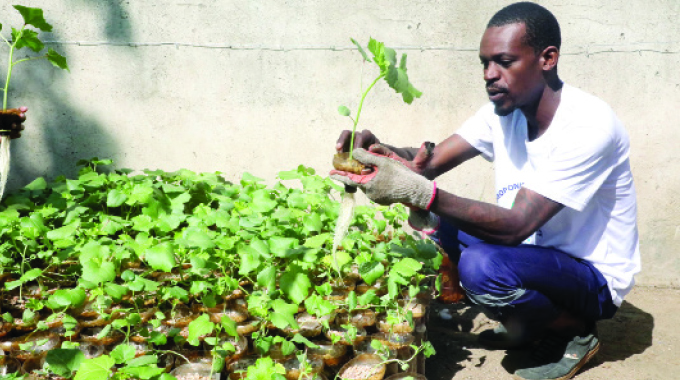
Amos Mpofu, [email protected]
A GROUP of women from Bulawayo’s Pumula South suburb operating under the banner “Proverbs 31” have ventured into a sustainable hydroponic farming project, an initiative that has helped empower women and youth in their communities and boost food security and nutrition.
Hydroponics is a farming technique that involves growing plants in nutrient-rich water, either with or without the support of a mechanical medium like sand, gravel or perlite.
The farming technique reduces water usage by up to 90 percent compared to conventional soil-based farming. Additionally, this method allows for the recycling and re-utilisation of nutrient solutions, promoting sustainability and minimising waste.
The brains behind the project, Mr Nkanyiso Ncube, said he adopted the concept in South Africa and decided to implement it at home.
“I began conducting trials for this project in 2019 in Johannesburg where I observed farmers practicing this form of agriculture. I introduced the project to the Pumula South women in March this year.
“This project, titled Hydroponics for Sustainability, focuses on achieving sustainability by implementing modern agricultural methods. This initiative seeks to empower women and youth, establish communities resilient in food security, bring production closer to consumers, establish food and nutritionally-secure communities, and reduce poverty, and also aligns with Vision 2030.”
The benefits of employing this agricultural method include efficient use of water and space, as well as reduced labour requirements.
“Hydroponics saves up to 97,2 percent of water compared to conventional farming. In a small space, you can grow up to 150 plants. We’ve eliminated the need for electricity and electronic pumping and aeration devices,” said Mr Ncube.
“Research shows that hydroponic agriculture requires 85 percent less labour, leading to improved health. This makes the project both economical and ecologically conscious.”
Mr Ncube said the initiative generates employment and helps alleviate poverty.
“Magnesium sulphate, potassium, calcium nitrate, iron, zinc and boron are essential nutrient elements. Mixing these in the right proportions provides fully balanced plant nutrition,” he said.
“The germination process involves taking a plastic container, preferably a lunch tin, soaking the seeds for 12 to 24 hours, then laying five layers of tissue paper in the tin. Gently, spray the tissue with nutrient solution, place the seed on top, and leave it in a dark place.”
Mr Ncube said they have a diverse range of horticulture crops under the project, and these include cucumbers, varieties of green vegetables, beans and okra.
Proverbs 31 chairperson, Mrs Maria Madamombe, said the project is proving to be a game changer and they are already inundated with enquiries from interested buyers of their produce.
“We are happy with this initiative, which only requires a week of theoretical training for one to fully understand the procedures. We already have groups that need to be supplied with our produce,” she said.



 Online Reporter