Chronicle Editor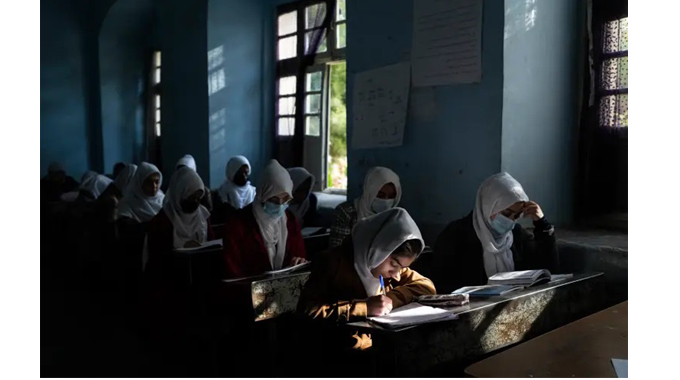
Girls’ schools across Afghanistan will hopefully reopen by late March, a senior Taliban leader has told the Associated Press, offering the first timeline for the resumption of high schools for girls since the group retook power in mid-August.
Speaking to journalists on Saturday, Zabihullah Mujahid, spokesman for Afghanistan’s government and deputy minister of culture and information, said the group’s education department would open classrooms for all girls and women in the Afghan New Year, which starts on March 21.
Although the Taliban has not officially banned girls’ education, the group’s fighters have shuttered girls’ secondary schools and barred women from public universities in some parts of the country.
Girls in most of Afghanistan have not been allowed back to school beyond grade 7 since the Taliban takeover, and reversing that has been one of the main demands of women’s rights activists and the international community for months.
Education for girls and women “is a question of capacity,” Mujahid said in the interview. “We are trying to solve these problems by the coming year,” so that schools and universities can open, he added.
The international community, reluctant to formally recognise a Taliban-run administration, is wary that the group could impose harsh measures similar to its previous rule 20 years ago. At the time, women were banned from education, work and public life.
“We are not against education,” Mujahid stressed, speaking at the culture and information ministry in Kabul.
“In many provinces, the higher classes (girls’ school) are open, but in some places where it is closed, the reasons are economic crisis and the framework, which we need to work on in areas which are overcrowded. And for that we need to establish the new procedure,” he said.
Girls older than grade 7 have been allowed back to classrooms in state-run schools in about a dozen of the country’s 34 provinces.
‘Education for girls is a crime’
High school student Anzorat, who gave only her first name, expressed doubt.
“I don’t think they will reopen girls’ school because they have said so many things but haven’t followed up. If they really open the schools again it would be the best for girls,” she said.
“From the Taliban’s perspective education for girls is a crime, if it wasn’t like this they wouldn’t have banned them from schools,” the 19-year-old told Al Jazeera.
Girls and boys must be completely segregated in schools, said Mujahid, adding that the biggest obstacle so far has been finding or building enough dorms, or hostels, where girls could stay while going to school.
In heavily populated areas, it is not enough to have separate classrooms for boys and girls – separate school buildings are needed, he said.
“We don’t lack the manpower or human resources, we need the economic cooperation for the Afghan people, we need cooperation in trading, we need to establish good diplomatic relations with other countries,” he said, adding that Afghanistan needs humanitarian assistance.
‘The big obstacle for girls’
In the capital, Kabul, private universities and high schools have continued to operate uninterrupted. Most are small and classes have always been segregated.
“Restarting girls’ schools is a good thing, [but] they need to be firm on their promise. These words should not just be for the sake of taking a stand,” Kabul-based women’s rights activist Fatima Rae told Al Jazeera.


 Online Reporter