Online Reporter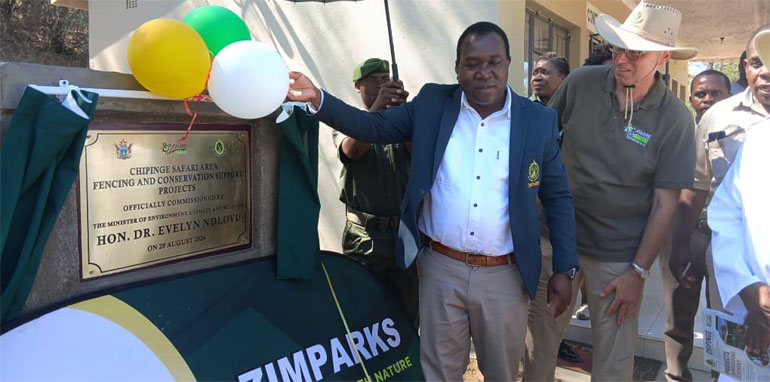
Tendai Gukutikwa
Post Reporter
THE Government has intensified efforts to safeguard critically endangered black rhinos and other wildlife in the Chipinge Safari Area through the deployment of advanced surveillance technology and the construction of a 50-kilometre game fence aimed at strengthening anti-poaching operations and reducing human-wildlife conflict.
The initiatives, spearheaded by the Zimbabwe Parks and Wildlife Management Authority (ZimParks) with support from AWARE Trust Zimbabwe and AWARE Germany, form part of a broader strategy to modernise conservation and enhance the protection of Zimbabwe’s wildlife resources.
The upgraded security package includes a digital radio communication system, drone surveillance technology, an anti-poaching dog unit, improved ranger mobility through the acquisition of a quad bike and a Land Cruiser, as well as strengthened field logistics to enable more effective monitoring of the vast protected area. Speaking at the commissioning of the projects, Environment, Climate and Wildlife Minister Dr Evelyn Ndlovu, whose speech was delivered by ZimParks director-general, Professor Edson Gandiwa, said the investments reflected Government’s commitment to integrating conservation with national development.
“We are not merely commissioning infrastructure. We are demonstrating Government’s approach to conservation, one that is inclusive, people-centred and anchored in the national development agenda.
“The investments in Chipinge Safari Area are intended to strengthen wildlife protection while ensuring that communities living alongside protected areas also benefit from conservation,” said Dr Ndlovu.
She described the 50-kilometre game fence as a critical intervention in addressing the persistent challenge of human-wildlife conflict.
“The fence will complement the surveillance technology by creating a more effective buffer between wildlife and surrounding communities, reducing animal incursions into settlements and limiting opportunities for poachers to access protected areas.
“It is not merely a physical barrier, but a strategic intervention designed to protect livelihoods, enhance community safety and strengthen wildlife conservation,” she said.
The enhanced protection measures come at a critical time for the Chipinge rhino population, which remains vulnerable to poaching despite ongoing conservation efforts.
Dr Ndlovu said the integration of modern technology, improved ranger operations and physical infrastructure creates a multi-layered security system capable of responding more effectively to emerging threats.
“The technology gives conservation personnel an added advantage in monitoring vast and difficult terrain. Drones and surveillance equipment enhance situational awareness and improve the ability of rangers to detect and respond to suspicious activity,” she said.
She added that Government’s conservation agenda extends beyond infrastructure and wildlife protection to include investment in frontline personnel tasked with protecting natural resources.
“These projects are investments in people, systems, technologies and partnerships that enable our rangers to perform their duties more effectively and safely,” said Dr Ndlovu.
She noted that sustainable conservation requires strong institutions, adequately equipped personnel and strategic partnerships capable of addressing increasingly sophisticated environmental and wildlife crimes.
“The investments strengthen our capacity to protect wildlife, improve habitat management, boost tourism, support research and monitoring, and secure the long-term ecological and economic value of Chipinge Safari Area,” she said.
In his remarks, Professor Gandiwa said the projects demonstrate ZimParks’ determination to close critical operational gaps while promoting peaceful coexistence between wildlife and neighbouring communities.
“The game fence represents a proactive solution to one of the most pressing challenges in conservation today, human-wildlife conflict.
“By reducing crop destruction and improving community safety, we are fostering coexistence and strengthening trust between protected areas and surrounding communities,” he said.
Professor Gandiwa said effective ranger operations remain the cornerstone of successful wildlife conservation.
“The ranger patrol base is an investment in the backbone of conservation, our field staff. Their effectiveness ultimately determines the success of anti-poaching operations and broader resource protection efforts,” he said.
He said the new surveillance technology and improved field infrastructure will significantly enhance the ability of rangers to monitor wildlife populations and respond swiftly to security threats.
Professor Gandiwa reiterated that ZimParks’ mandate goes beyond biodiversity conservation to include supporting national economic development.
“Across Zimbabwe, ZimParks is entrusted with protecting our wildlife heritage, managing protected areas sustainably and ensuring that conservation contributes meaningfully to national development,” he said.
He added that wildlife should be viewed not only as a natural resource, but also as a key driver of tourism, employment creation and rural development.
The protection of black rhinos is particularly important because the species remains one of the country’s most valuable and vulnerable wildlife assets. Ensuring their survival strengthens Zimbabwe’s conservation credentials while enhancing the potential of wildlife-based tourism.
Professor Gandiwa hailed the contribution of AWARE Trust Zimbabwe and AWARE Germany, saying partnerships between Government and conservation organisations remain critical in addressing increasingly complex environmental challenges.
“This partnership exemplifies the type of collaboration required to complement Government efforts, partnerships that respond to local needs, align with national priorities and deliver measurable conservation outcomes,” he said.