

 Chronicle Editor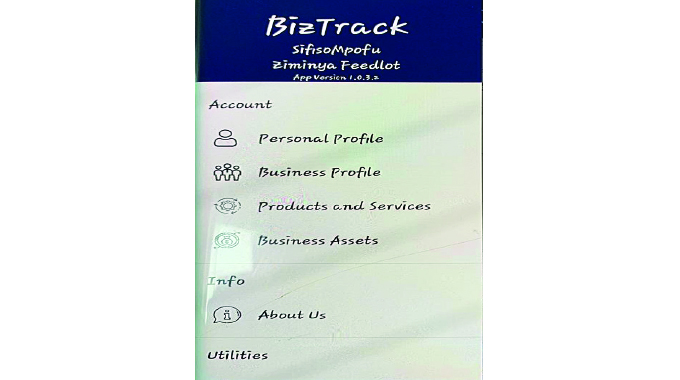
Lungelo Ndhlovu, Feature
Smallholder crop and livestock producers in rural Zimbabwe faced bookkeeping challenges for many years before learning about and utilising “Biztrack,” a financial management service mobile application that makes it easier to save and maintain business information.

Ms Nomagugu Msimanga, a secretary and treasurer for an 18-member sunflower contract farming co-operative in Nkayi District, for instance, kept financial records for banking, stock control, sales, and budgeting in an exercise book that she shared with her school children, before learning about the Biztrack application.
She lost all the financial records that had accumulated over the years when her child borrowed the records book with only a few blank pages to use for writing school notes.
Ms Msimanga said it was challenging to keep the cooperative’s information safe as an agriculture business located in rural areas, adding that the cooperative’s primary source of income is from fattening and selling livestock to slaughterhouses.
“I had recorded all the financial transaction’s codes information in an exercise book after providing animal feed for pen fattening to numerous farmers who paid using the mobile money (EcoCash) platform in 2019. The cooperative suffered harm because crucial data used to monitor how the company was doing in terms of costs and profits for the past years was lost and never recovered,” she added.
Ms Msimanga also indicated that the cooperative was founded in 2017 and that to diversify their operations last year, when business was slow, they began contract farming of sunflower to produce sunflower oil and stock feed.
Until 2021, when the Agricultural Partnership Trust (ATP), a Non-Governmental Organisation specialising in smallholder agricultural economic development through a market systems approach, introduced Ms Msimanga cooperative to a Biztrack application.
“The Biztrack application is helping us a lot because everything we are doing is easily recorded and kept in the phone unlike a school exercise book which can be lost or damaged by water. Whether it’s information to deal with sales or the quantity of diesel bought for grinding to produce stock feed, this information gets kept well in the phone application,” said Ms Msimanga.
The Biztrack is more of a business management tool where farmers can safely enter their financial records after selling their farming produce, according to Mr Rodney Mushongachiware, an ATP markets access advisor.
“Traditionally, when we deal with farmer groups producing any value chain or crop, they often keep track of their records in a writing exercise book. Rarely do farmers take the time to pause, review their records on how much money their business has produced over the years or months,” Mr Mushongachiware, explained.
He indicated that during the Covid-19 pandemic in 2021, the Biztrack application was created and downloaded into the phones of those responsible for overseeing the management of more than 47 agricultural enterprises spread across Zimbabwe’s rural areas.
“Since the farmer’s profit or loss is immediately displayed on the dashboard when you input the costs, the application can rapidly let the farmer know whether they are losing money. As a result, we added emoticons visuals to the application that dance when a farmer makes a profit, inspiring them, and sad emojis when they are losing money, to assist farmers,” Mr Mushongachiware added.
When the rural agro businesses first used this application as a prototype project in 2021, Mr Mushongachiware’s organisation targeted grain threshing groups, stock feed manufacturing, goat breeding, and sunflower oil pressing company groups.
“Any farmer can utilise the Biztrack application for record keeping and company performance tracking, which is ultimately what we are advocating for in these business organisations when it comes to financial literacy. For instance, none of the 47 agro-farmer groups we worked with received smartphones from us; instead, they had to either purchase or use their own phones to download the application and use it,” he said.
According to Mr Mushongachiware, the Biztrack application can still function when farmers don’t have internet connectivity.
“When a farmer connects to the internet, the application transfers the data they entered offline into the cloud for synchronisation. The application does work offline,” he said.
However, according to Mr Mushongachiware, the application has operating problems caused by the high price of smartphones in comparison to farmers’ wages.
“The cheapest Android phone costs between $40 and $50 in US dollars, which is too expensive for the rural farmer. But we saw our groups saving and buying a phone at least or using a member’s phone. Though designed to be a low data cost application which can work offline in some areas we worked in like Nkayi, there is absolutely no access to the internet and farmers will need to walk a distance a bit to upload their data,” he added.
The ATP’s director, Mr Michael Dawes, acknowledged that when NGOs visit communities with developmental initiatives such as the Biztrack application, people expect them to have a mobile smart phone with them so they can use it.
“A number of the groups did not have smartphones but were very interested in the application. So, they purchased the phones themselves to use them. So, this was sort of proof to us that there was demand for the application,” Mr Dawes explained.
“It is quite encouraging to see rural-based enterprises managing their finances and participating in business discussions, as opposed to when records were kept on paper. The application functions both online and off-line. “We developed the application, and then we did the training process with one project with the Zimbabwe Resilience Building Fund (ZRBF)-Matabeleland Enhanced Livelihoods, Agriculture, and Nutrition Adaptation (MELANA) project, where we had 30-40 businesses in Nkayi, Bubi, and Umguza rural districts,” Mr Dawes added.



 Blessing Chizhande
 Online Reporter