admin
admin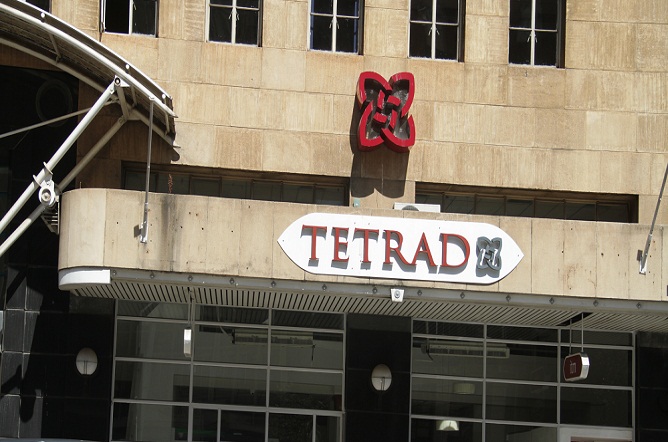
Golden Sibanda Harare Bureau
TETRAD Investment Bank and TFS Asset Management creditors are working on plans to convert their debt into equity in an effort to avoid liquidation of the bank.
Creditors with investments valued at $30 million in the troubled bank have already given their support ahead of a crucial meeting next month to consider the request for TIB to be taken over and be reconstructed by the creditors.
The creditors include clients of the Tetrad Group’s subsidiary, TFS Management, which is currently under liquidation, who had $11 million of their money negligently invested in the troubled bank’s money market investments.
John Graham, chairman of the Tetrad Creditors Group Trust Management Committee said “We’re continuing our efforts to increase the leverage of creditors, and we need another $23 million of support to obtain creditor reconstruction.”
The plea comes as TIB creditors are scheduled to meet at the High Court on October 1, 2015, for a meeting called by the provisional judicial manager, before submission of his proposal to the High Court on the way forward for the bank.
Graham said Tetrad creditors, who have sought and obtained proxy of TFS Management clients, did not know the judicial manager’s decision on the continuation of statutory recuperation and liquidation of the distressed bank.
But he stressed the fact that creditors of the group, who require 75 percent or $64 million by value, of creditors’ support to push through their demands, want reconstruction of the bank to be given the most consideration.
This is because the creditors believe that they would receive significantly less of their invested value in the bank if the institution proceeded to liquidation, even in circumstances where some of the creditors hold security such as properties.
He said that the major drawback with immediate liquidation was that creditors had little to no control over disposal of assets, which may be over a short period.
The proposal for creditor reconstruction also comes after two investors who had shown interest withdrew, leaving liquidation the most likely option for the judicial manager if creditors simply sit back and wait for events to unfold.
Under “fire sale” or forced disposal in order to settle liabilities of the bank, most assets would fetch grossly discounted prices.
Notably, reconstruction would leave the bank with net assets of $30 million after conversion of the $64 million creditor liabilities into equity.
“We’ve our very own example where four units at Virginia Gardens, booked at $320,000 each were disposed off by auction for between $60,000 and $80,000,” he said. At the very least, the properties should have sold for $200,000.
As such, rough assessment of the potential returns from liquidation indicates that secured creditors might get 25 cents per dollar and unsecured creditors five cents.
“This is based on a recovery rate of 26 percent for assets as a whole,’ Graham noted.
“Therefore, in the event of a vote being called, we need to be in a position to vote for that alternative to be proposed and considered. We do have a plan, and have considered many of its consequences, most of them favourable to the objectives of the creditors,” Graham said on Wednesday.
Graham said their suggestion was not an attempt to reinvent the wheel, but an idea strongly informed by success stories of experiences in Zimbabwe where once troubled banks, CBZ and ZB banks were nursed back to good health.
Then Bank of Credit and Commerce International failed in 1991, got split between bad and good bank by way of separating distressed and healthy assets. CBZ is today Zimbabwe’s biggest bank. The bad bank, CBZ Nominees recovered, over time and in an orderly way, a good amount of its distressed assets.
Apart from increasing the possibility of recovering significantly more value through reconstruction of the bank, creditors would realise their wish to institute a forensic audit to determine exactly what transpired at the institution.
The forensic audit would also enable litigation against directors if it deemed they conducted the affairs of the bank in a negligent or grossly reckless manner.
This comes amid revelations that 90 percent of funds extended to beneficiaries went to only 27 borrowers, some believed to have gone into liquidation. Creditors also want judicial manager, Deposit Protection Corporation, to ensure that shareholders do not continue to dispose of assets.



 Online Reporter