Online Reporter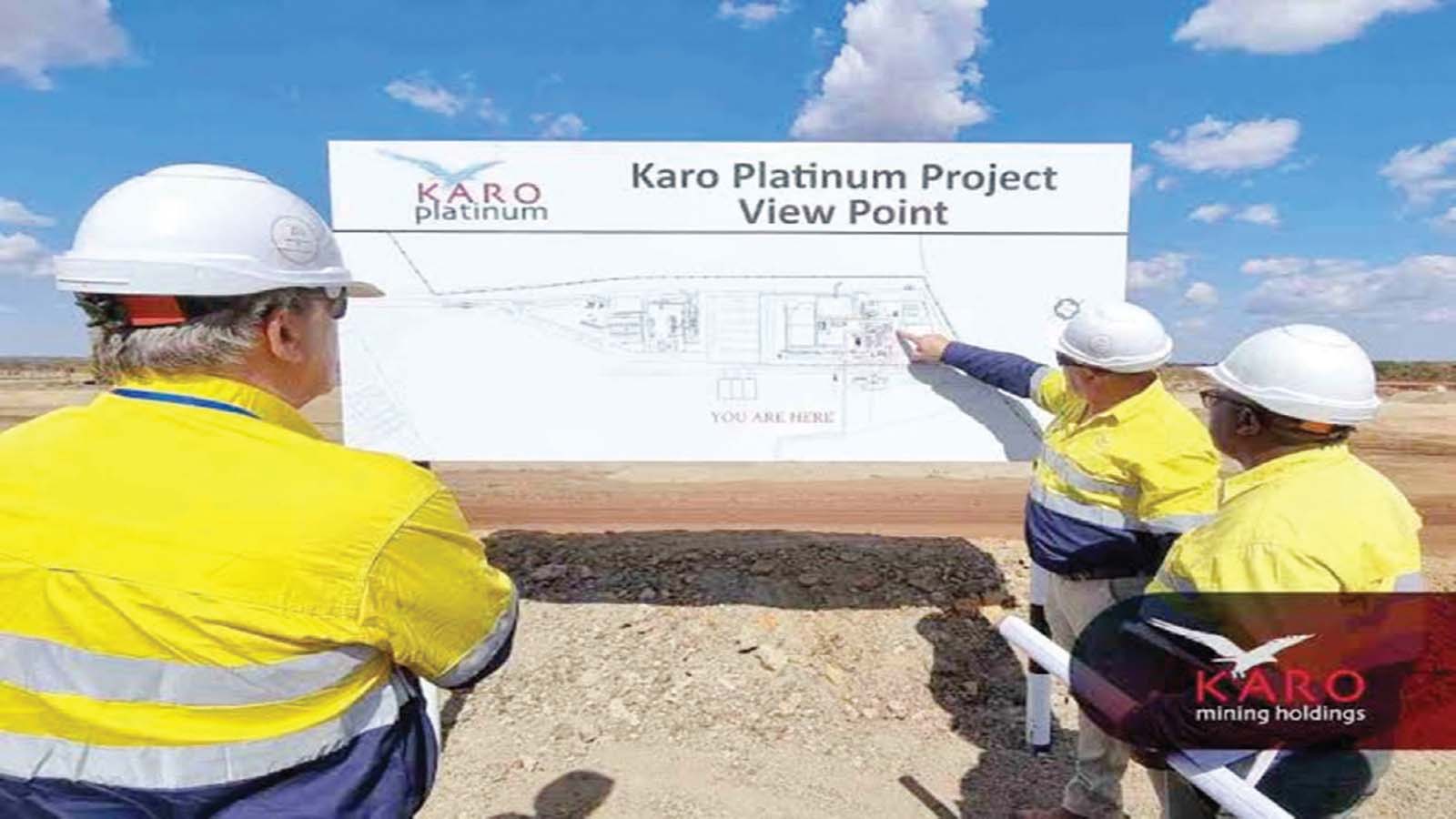
Business Reporter
Cypriot firm Tharisa Plc says it has completed three milestones for its Karo Platinum Project in Zimbabwe, de-risking the project and providing long-term investor security, fiscal and regulatory stability.
The Karo Platinum Project is strategically important to Zimbabwe because it expands the nation’s platinum production, attracts large-scale foreign investment and creates over 1 000 steady jobs along the mineral-rich Great Dyke.
Once operational, Karo Platinum project will join the ranks of the three producing platinum mines, namely Zimplats, Mimosa Mining Company and Unki Mine, which contribute significantly to national export earnings. PGM exports generated approximately US$1,9 billion in 2025, rising from US$1,5 billion in 2024.
Other PGM projects under development or planning stages in Zimbabwe include Great Dyke Investments and the Bravura Consortium. Over the past three weeks, Tharisa has signed a Special Mining Lease Agreement with the Government of Zimbabwe, concluded a long-term offtake agreement with Valterra and successfully priced a US$300 million, five-year senior secured Nordic bond.
The London and Johannesburg-listed mining group said the SMLA amendment reflects the constructive and continuing partnership with the Zimbabwean authorities and enables Tharisa to advance Karo’s construction with confidence.
This is strategically key as Tharisa moves to develop Karo into a second Tier 1 platinum group metals (PGM) asset, while simultaneously advancing the underground transition at its flagship Tharisa Mine in South Africa.
Tharisa is targeting the first ore from the Karo project in late 2027.
The Nordic bond was oversubscribed, attracting more than 150 international institutional investors from Europe, the United Kingdom, the Middle East, North America and Asia.
It will be applied largely towards completing the construction of the Karo Platinum Project in Mashonaland West Province, along Zimbabwe’s mineral-rich Great Dyke belt.
The bond, issued by Arxo Finance Plc, a wholly owned subsidiary of Tharisa, was priced at 98 percent of par and carries an annual coupon of 11 percent. The oversubscribed offering attracted strong interest from more than 150 international institutional investors across Europe, the United Kingdom, the Middle East, North America and Asia, among other regions.
Tharisa chief executive Mr Phoevos Pouroulis said the three critical milestones the group has achieved in recent weeks have secured the long-term tenure of the Karo project asset and locked in a market for its future production.
“The completion of these three foundational milestones, namely securing tenure, validating market demand and securing scalable funding, marks a transformative moment for Tharisa.
“By pricing our inaugural US$300 million Nordic bond, we have not only de-risked the Karo Platinum Project but also introduced a new, sophisticated international investor base to the Tharisa growth story,” Mr Pouroulis said.
The proceeds will be held in escrow until the conditions for their release have been satisfied and will be applied primarily towards the development and construction of Karo.
Tharisa has also concluded a long-term offtake agreement with Valterra for PGM concentrate from Karo, providing independent validation of the quality and marketability of the project’s future production. Taken together, the three developments have significantly reduced the financing, regulatory and market risks associated with Karo as construction gathers pace.
Located on Zimbabwe’s mineral-rich Great Dyke, Karo is expected to become a major addition to the country’s platinum mining industry. The Karo project holds a large deposit with a 2,1 million ounce open-pit reserve and an 11,2 million ounce total resource.
Phase 1 aims to produce 226 000 ounces of platinum group metals every year once fully running.
It strengthens Zimbabwe’s position as a top global supplier of platinum, holding the world’s second-largest reserves after South Africa. The Great Dyke is one of Zimbabwe’s most important geological formations and hosts significant deposits of PGMs and chrome.
Once completed, Karo is expected to add a second Tier 1 PGM operation to Tharisa’s portfolio and more than double the group’s PGM production, strengthening Zimbabwe’s position as a destination for large-scale platinum investment.
“With Karo on track for first ore in late 2027 and the Apollo complex nearing its first run-of-mine ore, Tharisa is evolving into a multi-asset, multi-jurisdictional PGM and chrome producer with a combined mine life exceeding 60 years,” Pouroulis said.
This comes as Zimbabwe is looking to attract greater investment into its mining sector and increase value from its mineral resources through higher production and beneficiation, particularly in the platinum industry. Tharisa said construction at Karo Mine was expected to advance materially over the next 12 months, with the company maintaining its target of first ore to the mill in the final quarter of 2027.
At the same time, the group’s underground transition at the Tharisa Mine remains on schedule and within budget, with the Apollo underground complex expected to deliver its first run-of-mine ore during the current financial year. The parallel developments are expected to extend the life of the Tharisa Mine beyond 60 years, while creating a diversified production base spanning chrome and PGMs.
Mr Pouroulis said the company remained committed to investing through the commodity cycle despite an uncertain global economic environment.
“This capital enables us to enter the peak construction phase with confidence. Despite a volatile macroeconomic environment, we continue to invest through the cycle,” he said.
“The parallel progress of the underground project at our flagship Tharisa Mine demonstrates our commitment to long-term value creation.”
The Nordic bond also represents an important diversification of Tharisa’s funding sources, broadening its capital base beyond conventional bank debt and equity to include international fixed-income investors.
DNB Carnegie and HSBC acted as joint bookrunners for the transaction. The bond is expected to be listed on ABM Fast Entry within 60 days of the issue date and subsequently on the Euronext Oslo Stock Exchange, or another exchange selected by the issuer, within 12 months.
Mr Pouroulis said the progress at Karo, Tharisa Mine and the Apollo complex was positioning the group for a significant expansion in its production profile.
“With Karo on track for first ore in late 2027 and the Apollo complex nearing its first run-of-mine ore, Tharisa is evolving into a multi-asset, multi-jurisdictional PGM and chrome producer with a combined mine life exceeding 60 years,” he said.
Tharisa has previously put Karo’s development cost at about US$545 million and disclosed approximately US$241 million in investment in the project.