
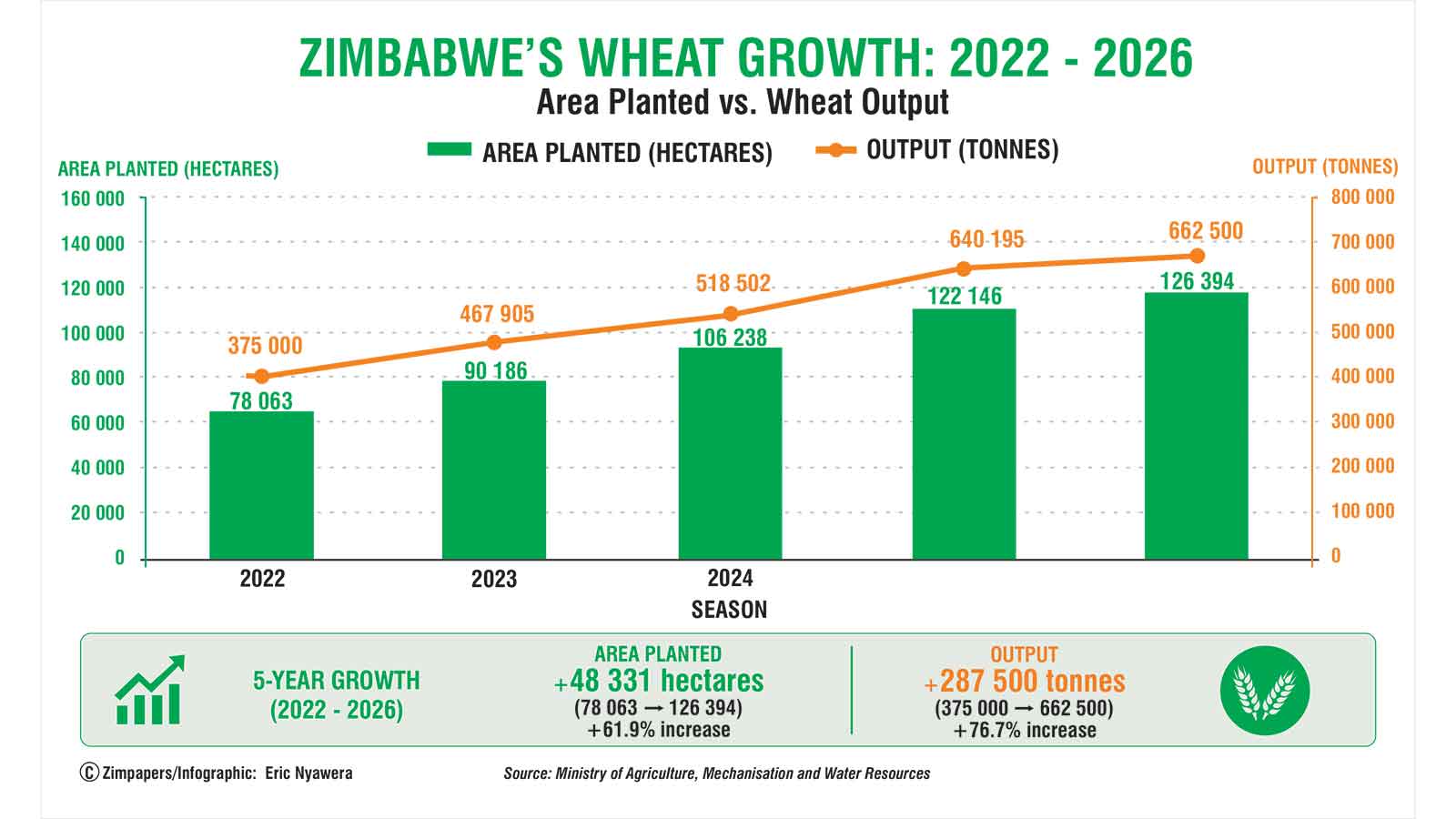
Zimbabwe’s winter wheat recovery did not happen by chance.
The country’s journey from chronic wheat imports to self-sufficiency has been underpinned by a series of deliberate Government and private sector interventions aimed at increasing production, improving productivity and reducing risks for farmers.
Irrigation expansion
Winter wheat is entirely dependent on irrigation, making water availability the single most important factor in production.
The Government has prioritised the rehabilitation of irrigation schemes, construction of new dams and expansion of irrigable land under the National Development Strategy 1 (NDS1) and NDS2.
Zimbabwe currently has about 257 000ha under irrigation, with plans to increase the area to nearly 496 000ha by 2030.
The expansion has enabled more farmers to participate in winter wheat production.
Access to financing
The introduction of contract farming arrangements and Government-supported financing facilities has improved farmers’ access to capital.
Banks, contractors, millers and grain buyers have increasingly provided funding packages covering seed, fertiliser, chemicals and fuel, allowing farmers to undertake wheat production with reduced upfront costs.
This has been complemented by Government-backed financing initiatives coordinated through the Agricultural Finance Corporation and other institutions.
Guaranteed markets
The Government has consistently positioned wheat as a strategic crop within national food security programmes.
Farmers have been encouraged to produce wheat through guaranteed markets and structured procurement arrangements, creating confidence that investments made during the season will be recovered.
The strengthening of the Strategic Grain Reserve has also provided a reliable outlet for grain production.
Enhanced extension services
The Agricultural and Rural Development Advisory Services has intensified farmer training programmes covering land preparation, planting techniques, fertiliser application, irrigation scheduling and pest management.
Regular field inspections and technical support have helped improve compliance with recommended agronomic practices, resulting in better yields.
Mechanisation
Government and private sector initiatives have increased access to tractors, combine harvesters, planters and centre-pivot irrigation systems.
Improved mechanisation has enhanced efficiency in land preparation, planting and harvesting while reducing production delays.
Energy supply support
Recognising that irrigation depends on reliable power supplies, the authorities have prioritised electricity provision to wheat-producing areas during the winter cropping season.
Dedicated power arrangements for strategic farming operations have helped minimise disruptions to irrigation schedules.
This year, about 150 megawatts has been ringfenced for production.
Local procurement policies
More recently, the Government has rolled out policy interventions aimed at strengthening domestic grain markets.
Last year, the authorities gazetted Statutory Instrument 87 of 2025, which requires processors to progressively increase local procurement of grain, beginning with minimum local sourcing thresholds at 40 percent and moving towards full domestic sourcing by 2028.
The policy is designed to create sustained demand for locally produced wheat while reducing reliance on imports.
Together, these interventions and others have transformed winter wheat from a niche crop into one of Zimbabwe’s most important food security success stories, helping the country move from dependence on imports to sustained self-sufficiency and growing grain reserves.