Online Reporter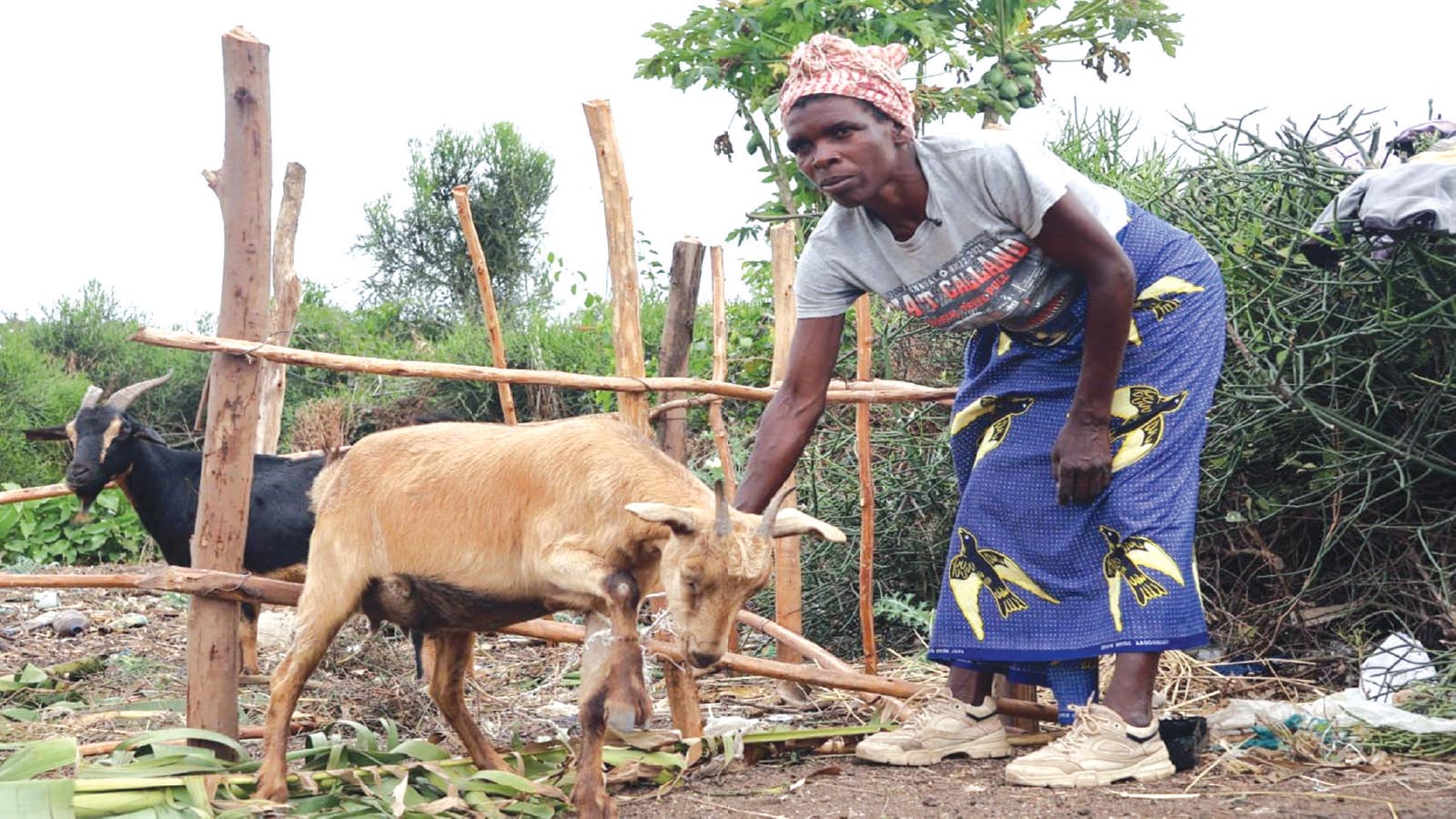
Theseus Mauruki Shambare in CHISUMBANJE
“KUPFUMA ISHUNGU (Prosperity requires determination).”
These words are painted on one side of Sarah Mbaimbai’s ox-drawn cart.
On the other side is another message: “Hama maoko (Your hands are your relatives).”
The two inscriptions capture the journey of the 48-year-old widow — from surviving on casual labour to deliberately building a livelihood around farming, markets and productive assets.
For Mbaimbai, who lost her husband about a decade ago, that determination was once simply about survival.
A mother of six and grandmother of four from Matikwa A village, Chisumbanje, she worked in other people’s fields, survived on casual labour and occasionally took up jobs at Green Fuel.
“Life was not easy,” she recalled.
Today, the ox-drawn cart parked at her homestead tells a different story.
She bought it at Checheche Shopping Centre after earning more than US$1 400 from proceeds from the community garden last year.
The cart is not a luxury; it is an agricultural asset bought from sheer hard work.
The R100 that changed everything
Before owning the cart, Mbaimbai depended on neighbours whenever she needed to transport agricultural produce.
Each trip cost about R100 per load, reducing the returns from her farming.
The experience taught her that increasing production alone was not enough.
She also had to invest in assets that could reduce costs and help her retain more of what she earned.
At the Matikwa village business unit (VBU), she learnt to approach agriculture as a business rather than simply a means of sustenance.
“We were taught by our extension officers that agriculture is a business,” she said.
That lesson changed the way she viewed every dollar coming from the garden.
“Each dollar earned counts!”
Her first major investments were two oxen and three goats.
Some people questioned why she was investing in oxen that could not reproduce.
But Mbaimbai deliberately invested in them for draught power.
They could pull her cart, transport produce and reduce her dependence on hired transport. Earlier this year, she exchanged the two oxen for two bred heifers.
The three goats remain part of her growing livestock assets.
For Mbaimbai, the objective is not simply to accumulate possessions.
It is to turn income from one productive activity into assets that can support the next.
A garden built for business
At the centre of this transformation is the Matikwa VBU, a one-hectare irrigated garden developed around the idea of producing for markets.
The garden has a solar-powered borehole, drip irrigation and 10 000-litre water storage tanks. Farmers grow chillies, sesame, sunflower and sugar beans, with chillies currently receiving particular attention because a buyer has already been identified.
The garden also has a grading shed where produce is sorted and prepared, as well as a holding container where harvested produce is kept before being transferred to the aggregation centre.
Recent produce sales generated US$2 731.
For Mbaimbai, the significance of the garden is, therefore, not simply measured by what is harvested.
It is what the income makes possible afterwards.
“The garden has taught us that agriculture can change our lives when we treat it as a business,” she said.
Another farmer, Mavis Musodzi, puts the principle simply: “Agriculture is a business.”
The approach is particularly important in areas such as Chisumbanje, where farmers face difficult climatic conditions and cannot afford to rely entirely on rain-fed production.
When water becomes an agricultural asset
Chisumbanje lies in Natural Region V, one of Zimbabwe’s hotter and drier agro-ecological zones, where low and erratic rainfall, prolonged dry spells and early cessation of rains can undermine crop and livestock production. At Matikwa, the solar-powered borehole and drip irrigation system provide farmers with greater control over water, one of the most critical inputs in agriculture.
Manicaland Agricultural Development Advisory Services director Nhamo Mudada said such business units are part of efforts to strengthen rural livelihoods and drive rural industrialisation.
“This drip irrigation is making it smarter for farmers to produce,” he said.
The approach is also changing the relationship between production and markets.
“You have to produce a crop with a market that is ready,” Mudada said.
The Matikwa model is intended to go beyond the one-hectare plot.
Mudada said members are encouraged to replicate the same approach at household level, developing gardens and other productive activities on their own land.
For Mbaimbai, that is precisely the direction she wants to take. The push towards productive, climate-resilient agriculture comes as rural communities continue to face droughts, erratic rainfall and other climate-related shocks.
The Integrated Rural Resilience Building (IRRB) programme, funded by the Government of Japan through the World Food Programme (WFP) and implemented by Sustainable Agriculture Technology, is among initiatives supporting communities to prepare for such shocks rather than waiting for disasters to strike.
WFP programme policy officer Munyaradzi Gahadzikwa said the approach has shifted towards resilience because repeated climate shocks continue to disrupt rural livelihoods.
“We have since transitioned to a situation where we now want to support these communities to become resilient because they continue to face climate change-induced shocks and stressors that continue to disrupt their livelihoods,” he said.
The programme also uses anticipatory action to help communities prepare before hazards strike.
“With anticipatory action, basically, we want to support the communities to better prepare before the disaster strikes, and this will then help to mitigate and reduce the impact of the disaster,” Gahadzikwa said.
At Matikwa, that preparation is visible in physical assets — irrigation, water storage, productive land, market infrastructure and livestock.
The VBU currently has 40 members, comprising 19 men and 21 women, including two youths. Its water infrastructure also supports more than 450 livestock from surrounding households.
The unit plans to expand into activities such as fish farming, poultry and additional livestock water infrastructure.
For communities in drought-prone areas, such investments widen the options available when one source of livelihood comes under pressure.
From Matikwa to the nation
What is happening at Matikwa is part of a much bigger national push to transform rural communities from predominantly subsistence-based settlements into productive economic hubs.
Agricultural Planning and Development director in the Ministry of Agriculture, Mechanisation and Water Resources Leonard Munamati said nearly 4 000 VBUs had already been established across the country.
“Nearly 4 000 VBUs have been successfully deployed across the country to transform villages into year-round production hubs,” he said.
The programme is being implemented at considerable scale, with the ultimate national goal going beyond the village gardens themselves.
“The ultimate national goal under the Rural Development 8.0 initiative is to establish 35 000 VBUs, alongside 9 600 school business units and 4 800 youth business units,” Munamati said.
The model is also intended to contribute directly to food and nutrition security.
“A single VBU is estimated to cover approximately one-third of a village’s total food and nutrition requirements,” he said.
The figures give Sarah Mbaimbai’s one-hectare garden a significance beyond Matikwa A village.
If replicated successfully, the model is intended to create thousands of rural production points where agriculture is linked to markets, income generation and household economic activity.
Munamati also stressed that production must be guided by markets.
“We encourage farmers to look for markets and do a market survey before they plant their crops so that they know where they will sell the various products they produce,” he said.
The message is simple: Production should not end with a harvest; it should be connected to a viable market.
In Manicaland, the provincial picture is already taking shape. Mudada said the province has surpassed 2 200 functional business units, with an ambition to have a VBU in every village by 2030.
Taking the model home
For Mbaimbai, the real test of the model is now taking place at household level.
She wants to establish a similar productive cycle on her own plot — growing crops, generating income, keeping livestock and reinvesting the proceeds into assets that can generate further value.
Her ox-drawn cart is part of that strategy.
Instead of paying neighbours every time she needs to transport produce, she now owns a means of moving her agricultural output. Her goats and heifers provide another layer of productive wealth.
Her next target is a motorbike, which she hopes will make it easier to travel to Checheche to access her money and conduct other business. The progression is significant.
She is not simply accumulating possessions. She is attempting to build an interconnected household enterprise in which one investment supports another.
That is the lesson she has taken from Matikwa. And it is where the national VBU conversation meets the reality of an individual household.
If village businesses are to contribute meaningfully to rural transformation, their success cannot be measured only by the size of their harvests.
It must also be measured by whether farmers are accumulating assets, reducing production costs, creating alternative income streams and taking commercially viable activities back to their homes.
For Mbaimbai, that process has already begun. The garden gave her produce.
The produce gave her income.
The income bought a cart.
The cart reduced her transport costs.
The proceeds are growing her livestock.
And now she wants to reproduce the same cycle on her own land.
“Success is not only for those who have husbands,” she said.
Mbaimbai is proving that farming can do more than feed a family.
It can finance its future and offer a glimpse of what Zimbabwe’s VBUs could achieve when production is connected to markets, productive assets and household investment.