

 Chronicle Editor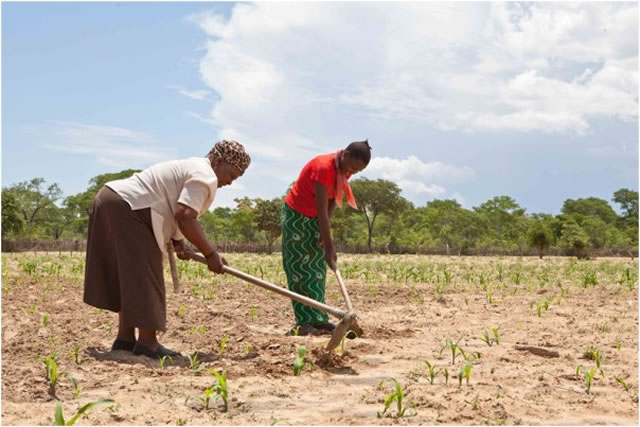
Stanford Chiwanga
MRS Listah Sibanda (52), a smallholder farmer in Kusile district’s Lupaka area, had, until recently, become used to realising poor or no harvest at all due to poor soils and erratic rains in arid Matabeleland North province.That was before she turned to conservation farming, a more productive, but laborious way of crop production, popularly known as Gantshopo in IsiNdebele and Dhiga ufenekuguta in Shona.
For her, necessity was indeed the mother of invention as the challenges she faced forced her to find alternative ways of surviving.
Mrs Sibanda is among the villagers in Kusile who have embraced conservation farming techniques which are being promoted by the Government and a number of non-governmental organisations to counter the effects of climate change.
“Before we learnt about conservation farming, our crops used to always fail because of erratic rains and poor soils. Now that I was taught to practise conservation farming and organic gardening, I am now able to harvest enough food for my family. I am able to grow small grains and drought-resistant crops such as millet and sorghum under conservation farming and get a good harvest. Though this type of farming is at times labour-intensive, it pays at the end,” said Mrs Sibanda.
Conservation farming involves digging of holes. The holes can be 20cm deep depending on the type of the seeds to be planted. After making the holes, the farmer then applies organic manure or fertilizer before the seed and covers the holes with soil.
When it rains, the fertilizer is absorbed into the soil and the system allows for the retaining of nutrients and moisture. Under the programme, Lupaka and Gomoza villages in Kusile have formed cooperatives and established organic green gardens which are also part of conservation farming. The farmers are trained in different farming ways to adapt to climate change with the assistance of a local non-governmental organisation, Environment Africa.
“The idea came after farmers complained each year about poor rainfall and low harvests in the area. We found it important to train farmers to adapt to climate changes. Most of the farmers we are training are getting good harvests for their family consumption,” said Mr Cliffe Maunze, Environment Africa Kusile area manager.
He said the training programme also involves the rearing of small livestock which can survive drought.
“We also encourage farmers to rear small livestock such as guinea-fowl and goats which can survive drought as part of measures to improve food security,” said Mr Maunze.
Mrs Letwin Makhandeni of Lupaka, who was the 2013 winner of Pioneer Seed competition, said conservation farming enables farmers to grow crops throughout the year.
“I have shrugged off poverty as a result of practising conservation farming. I grow vegetables, maize, tomatoes and cassava for sale. One can produce a surplus for sale through conservation farming,” said Ms Makhandeni.
She said every year she plants one hectare of maize under conservation farming. She harvests an average of two tonnes. Mr Thomas Mahlangu of Masenyane Village, who is also into conservation farming using organic manure, said although the practice is labour-intensive, it guarantees farmers good harvests.
“The advantage of conservation farming is that even with little rain we are able to harvest something,” said Mr Mahlangu.
Mrs Annah Ndlovu (52), of Gomoza, is a member of Siyazama Cooperative Society. She said through Agritex training workshops on climate change adaptation, many villagers had greatly improved their farming techniques.
Environment Africa country director, Mr Barnabas Mawire, said the climate change adaptation campaign must spread to all sectors, especially the drought-prone rural areas countrywide. He said farmers needed to be equipped with skills to counter effects of climate change.
“The climate change and environment education programme should spread to all sectors of the economy, particularly the rural farmer, politicians, schools and miners,” he said.
According to the Zimbabwe Vulnerability Assessment Committee (ZimVac) food security report, Matabeleland North province constitutes more than 40 percent of food insecure population in the country while Matabeleland South accounts for 32 percent.
Matabeleland provinces are traditionally dry but the climate changes have worsened the situation as the region which depended on livestock farming is losing thousands of cattle to drought every year.
The Government is encouraging smallholder farmers in drought prone areas to grow drought-tolerant crops to counter the effects of climate change.
Mr Tendekai Maguire of Mavikaneni Village said before he adopted conservation farming, he was virtually harvesting nothing as the crops always failed due to erratic rains.
“In past years before I adopted conservation farming, I could not harvest anything. Though it is labour-intensive, we are realising good harvests of millet, sorghum, soya-beans and cow peas,” said Mr Maguire.



 Online Reporter