Online Reporter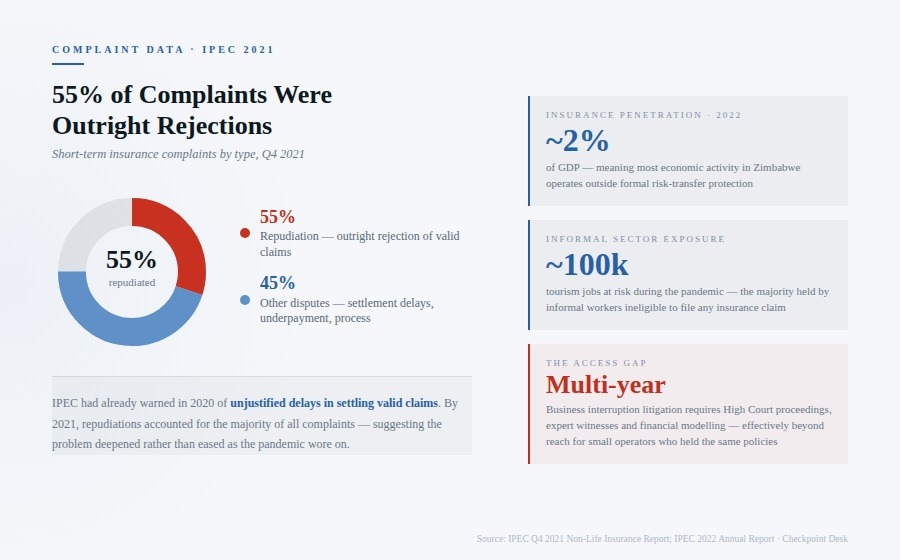
Tawanda Musarurwa
CHECKPOINT DESK
THE corridor outside Room 14 at Ilala Lodge was quiet on the morning of March 8, 2020. Mr and Mrs O’Shaughnessy – tourists whose names would eventually appear in Zimbabwean legal history – were on day two of a stay in Victoria Falls.
Within 72 hours, the couple fell ill. Within a week, staff who had attended to them developed fevers. And within a fortnight, the falls themselves went silent.
Zimbabwe’s national lockdown, announced on March 30, 2020, shuttered a tourism industry that had generated roughly US$1 billion in annual receipts.
Hotels that had been running at above 90 percent occupancy during peak season emptied almost overnight.
Buried in the filing cabinets of those hotels were insurance policies. Carefully worded. Regularly renewed. And, in the months that followed, fiercely contested.
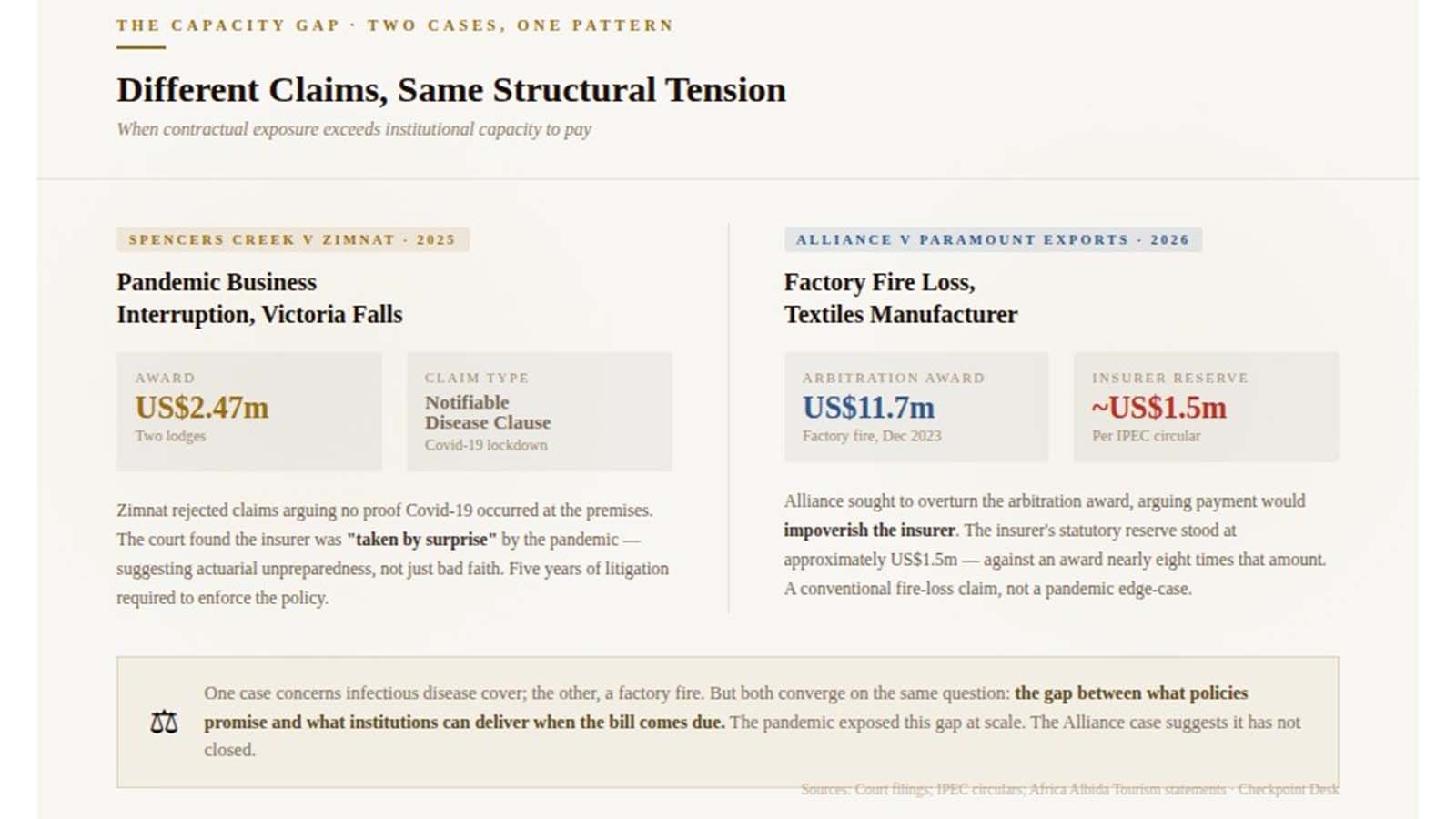
The legal reckoning took five years. The bill, so far, runs to US$2,47 million. The judgment delivered in Bulawayo by Justice Mpokiseng Dube – in Spencers Creek (Pvt) Ltd v Zimnat General Insurance, ordering payment to the operators of Ilala Lodge and Victoria Falls Safari Lodge
Hotel – has finally forced into the open a question the industry had largely avoided confronting: when pandemic risk materialised, had Zimbabwe’s insurers actually prepared to pay?
A 72 percent collapse
The answer matters because what followed was not a temporary downturn. Tourist arrivals fell from 2,29 million in 2019 to approximately 639 000 in 2020 – a 72 percent collapse that erased years of growth within weeks.
By 2021, arrivals had declined further to around 376 000. African Sun, one of the country’s largest hospitality groups, later reported more than 31 000 cancelled room nights after Covid-19 forced the temporary closure of its hotels and casinos.
At the centre of the Ilala Lodge dispute was the O’Shaughnessys’ stay. Within days of their visit, several staff reported symptoms consistent with Covid-19. Zimnat rejected the claims from both properties.
The insurer argued there was no proof Covid-19 had actually occurred on the premises – the symptoms, it suggested, could have been influenza, malaria, or medication side-effects.
When Ilala Lodge filed its formal notification, Zimnat sent back a Fire, Lightning, Storm Claim Form. Justice Dube was precise in his assessment: “I am of the respectful view that this claim form was never designed for a claim such as the present.”
Buried in that procedural detail was the deeper story, that Zimbabwe’s hospitality industry and its insurers had long held fundamentally different understandings of what “business interruption” cover actually meant.
Taken by surprise
Justice Dube’s language is significant: “What this letter tells in plain truth is that the defendant in its position as an insurer was taken by surprise by the pandemic and resultant claims.”
The framing suggests not bad faith so much as unpreparedness. A Harare-based pensions and insurance attorney who chose to remain anonymous was direct about what that unpreparedness reflects.
“The ‘notifiable disease’ extension in many standard policies was language carried over from an earlier era of localised outbreaks,” he said.
“Nobody in the Zimbabwean market – or most other markets – had genuinely stress-tested what it meant if the notifiable disease in question closed every business simultaneously.”
That is not a defence of the rejections the court found unlawful. But it is an important analytical distinction.
The wrongness was partly rooted in genuine actuarial miscalculation, not merely deliberate avoidance – and that distinction shapes what kind of regulatory reform would actually address the underlying problem.
The surprise was not confined to one insurer. The Insurance and Pensions Commission (IPEC)’s own 2020 Fourth Quarter Non-Life Insurance Industry Report acknowledged that mandatory lockdowns had disrupted business operations across the sector, exacerbating policy lapses
and delaying premium payments and claims processing. The regulator was watching a system buckle under conditions it had not been designed for.
Subsequent data tells its own story. By 2022, IPEC reported the insurance industry’s average combined ratio stood at 133 percent – meaning underwriting operations were running at a loss before investment income is taken into account.
The industry had improved from the extraordinary 334 percent recorded in 2021, but it was still not generating underwriting profits on its core business.
Global pattern, local reckoning
Zimbabwe was not alone. The peculiar cruelty of pandemic business interruption disputes is that they were almost universally foreseeable – yet almost universally unprepared for.
In the United Kingdom, the Financial Conduct Authority launched a landmark test case in 2020 because hundreds of thousands of small businesses faced identical claim denials. The UK Supreme Court ruled largely in policyholders’ favour.
Closer to home, in South Africa, litigation against Santam and Guardrisk produced similar judicial interventions, ultimately reshaping interpretation of infectious disease extensions across the region. Australia ran national test cases in 2021.
In the United States, courts were more divided, with many siding with insurers who argued Covid-19 caused no “physical loss” to property.
The pattern was consistent: policy language drafted for isolated, localised outbreaks was applied to an event that closed the global economy simultaneously. The actuarial assumptions embedded in premium structures had not modelled that possibility.
“No single insurer has the capacity for such catastrophes, even globally,” says actuary Mr Gandy Gandidzanwa.
“That’s where the aspect of reinsurance and risk-sharing comes in.”
Net income from Zimbabwe’s reinsurance sector fell 35 percent in 2025 – from US$24,25 million to US$15,88 million – even as the primary insurance market grew, according to IPEC’s 2025 Short-Term Insurance Sector Report.
The regulator attributed the decline to tighter treaty terms, higher retrocession costs and adverse experience on ceded portfolios, and warned that reinsurers’ combined ratio had deteriorated to 95 percent, leaving the sector with a narrowing underwriting cushion.
Even more is that reinsurance contract held assets now constitute a third of all short-term insurer assets – US$101,09 million – a 57 percent increase in a single year, meaning that the ability of primary insurers to pay large claims depends increasingly on the speed and willingness of reinsurers to settle.
IPEC explicitly flagged this as a counterparty credit risk: “reinsurer quality and settlement speed” are now, in the regulator’s own words, “critical supervisory concerns.”
It means that even well-intentioned insurers, selling products in good faith, may have been offering cover whose scope their own balance sheets could not support – a problem that courts resolving individual disputes are structurally ill-equipped to fix.
The inequality inside protection systems
The US$2,47 million ordered by the Bulawayo High Court represents a partial accounting, but the social reckoning behind it is larger.
Tourism supported roughly 100 000 jobs before the pandemic. Those jobs came under severe pressure as hotels, tour operators and tourism-linked enterprises shut down or drastically reduced operations.
The hospitality sector shed workers on a scale that formal employment data cannot fully capture, because a large proportion of tourism-adjacent employment in Victoria Falls – guides, curio sellers, charter operators, informal accommodation providers – sits outside registered employment systems. Their losses appear nowhere in insurance claims databases.
The most uncomfortable question raised by the judgment is not whether Zimnat was wrong; the court has answered that. It is who, in practice, was able to contest the wrongness.
Business interruption litigation is expensive, slow and technically demanding. Ilala Lodge and Africa Albida Tourism are established entities with the resources to sustain a multi-year High Court action. The small guesthouse, the family-run safari operator, the boutique lodge that collapsed in 2020 and never reopened – these businesses held the same policies.
While they filed the same claims, many almost certainly faced the same rejections. But, they did not have the same litigation budgets.
The imbalance reflects a broader feature of Zimbabwe’s insurance landscape. Insurance penetration stood at about 2 percent of gross domestic product (GDP) in 2022, according to IPEC, underscoring how much economic activity remains outside formal risk-transfer mechanisms.
In its 2021 Fourth Quarter Non-Life Insurance Industry Report, the regulator recorded that repudiations accounted for 55 percent of all short-term insurance complaints received during the period under review.
Premiums grew; reserves did not
The structural tension becomes starker when the industry’s financial trajectory is examined. Total Gross Premium Written (GPW) by short-term insurers rose from ZW$9,11 billion in 2020 to ZW$19,19 billion in 2021, and then to ZW$103,87 billion in 2022, driven largely by inflation-linked adjustments.
However, by end of 2021, not one of Zimbabwe’s 18 short-term insurers was compliant with the minimum prescribed asset ratio of 10 percent required by the regulator.
While total gross premiums written increased by nearly 337 percent between 2021 and 2022, total industry claims rose by only 98 percent – a divergence that raises legitimate questions about the adequacy of claims provisioning during the period.
Total insurance industry assets grew from ZW$301 billion in 2021 to ZW$1,25 trillion in 2022, an increase of 315 percent. IPEC attributed much of that growth to property and equity revaluations rather than underwriting performance. Asset appreciation does not necessarily translate into liquid resources available to meet large, unexpected claims.
That same capacity gap has surfaced beyond the pandemic context.
Earlier this year, short-term insurer Alliance Insurance approached the courts seeking to overturn an arbitration award compelling it to pay textiles manufacturer Paramount Exports nearly US$11,7 million for losses from a factory fire in December 2023.
Alliance argued the award was contrary to public policy because its substantive effect would impoverish the insurer – its affidavit reportedly relying on an IPEC circular showing the insurer’s statutory reserve stood at approximately US$1,5 million against an award of nearly eight times that amount.
The Paramount matter differs materially from the pandemic litigation – one concerns infectious disease cover, the other a conventional fire-loss claim.
But both cases converge on the same structural tension: the gap between what policies promise and what institutions can deliver when the bill comes due.
The pandemic exposed that gap at industry-wide scale. The Alliance case suggests it has not closed.
The accounting that has not come
Five years after the lockdowns, the country still lacks a public accounting of how many business interruption claims were submitted during the pandemic, how many were rejected and how many were paid.
When asked about Covid-19 business interruption claims data, IPEC’s public relations manager Mr Lloyd Gumbo said: “We don’t ordinarily receive such data.”
The data exists, at least in fragments, within IPEC’s own files. What is publicly available already hints at the gap between industry growth and public accountability.
In 2022, the insurance sector reported profit after tax of ZW$45 billion, with short-term insurance contributing roughly 92 percent of total industry profits.
The High Court’s ruling establishes important legal precedent: that business interruption cover under notifiable contagious disease clauses can be triggered by a pandemic; that proximity of guests and staff provides sufficient evidential basis for establishing occurrence at
premises; that insurers cannot defeat claims by exploiting the absence of testing infrastructure.
What the judgment cannot settle is the structural question it implicitly raises – one that belongs to the regulator, not the court.
Back in Victoria Falls, the lodges have reopened and the sound of water has returned. But the workers who did not make it through — the informal operators, the small guesthouse owners, the families who spent 2020 waiting for insurance money that never came — appear in none of it: not the court record, not the premium statistics, not any public accounting of what the pandemic cost Zimbabwe’s risk architecture to absorb.
The court has ruled that one promise, at least, was real.
Until the full numbers are disclosed, the judgment answers only one question: whether one insurer owed one policyholder.
The larger question – whether Zimbabwe’s insurance system functioned as promised during the country’s biggest economic shock in decades – remains, stubbornly, unresolved.