Online Reporter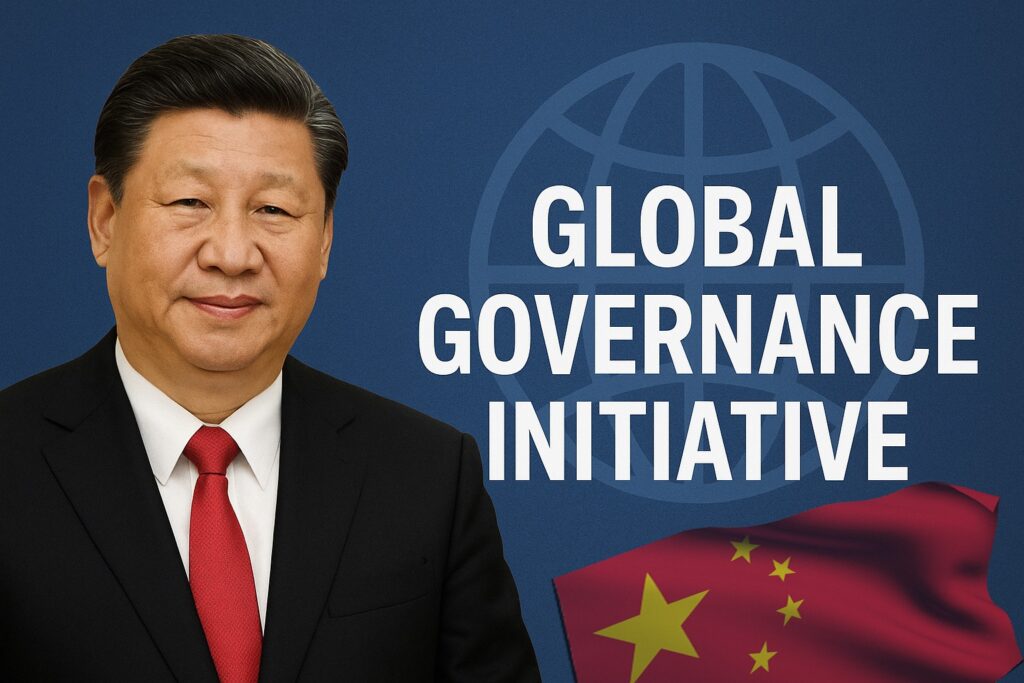
Saxon Zvina
The Central Question: Who Makes the Rules?
The defining struggle of the 21st century may not ultimately be about which country possesses the greatest military or economic power. It may be about something more fundamental: who has the authority to make the rules by which the world is governed.
For Africa, this is no abstract question. It affects who sets the rules of international finance, trade, technology, development, security, sanctions and global institutions. It determines whether African countries participate in shaping international norms or remain largely recipients of decisions made elsewhere.
Against this backdrop, Chinese President Xi Jinping proposed the Global Governance Initiative (GGI) at the Shanghai Cooperation Organisation Plus meeting in Tianjin on 1 September 2025. He presented five principles: sovereign equality, international rule of law, multilateralism, a people‑centred approach and action‑oriented cooperation.
The significance for Africa lies in the institutional question at the heart of the proposal: can global governance become genuinely representative when the Global South remains underrepresented in many of the institutions that shape global rules?
From Formal Equality to Actual Influence
The international system does not lack institutions. It has the United Nations, international financial institutions, multilateral trade arrangements, regional organisations and numerous specialised agencies.
The deeper problem is the persistent gap between formal equality and actual influence. The UN Charter establishes sovereign equality among states, yet economic weight, military capability, financial leverage and institutional history inevitably affect how much influence countries actually exercise.
The GGI therefore places sovereign equality at the outset of its framework. Xi argued that countries, regardless of size, strength or wealth, should be equal participants, decision‑makers and beneficiaries in global governance, alongside greater representation and voice for developing countries.
Crucially, the GGI does not aim to construct entirely new standalone bureaucratic bodies. Instead, it provides institutional safeguards: it supplies normative guiding principles for reforming and operating the existing multilateral system, helping translate formal sovereign‑equality provisions into real‑world policy practice.
For Africa, this principle has immediate relevance. The continent should not merely be consulted after global decisions have already been made. African states need meaningful participation in the processes through which those decisions are formulated.
Africa cannot remain a permanent rule‑taker. The issue is not simply whether it receives development assistance or investment. It is whether African countries have sufficient influence to shape the conditions under which development takes place. A continent cannot achieve genuine strategic autonomy if it remains dependent on external actors to define the rules governing its economic future.
International Law Without Double Standards
The second pillar — international rule of law — addresses whether international rules are genuinely universal.
The GGI calls for comprehensive observance of the purposes and principles of the UN Charter, and for international law to be applied equally and consistently. Xi specifically warned against double standards and the imposition of the “house rules” of a few countries on others.
For African states, consistency matters. The legitimacy of international law depends not only on the existence of rules but on confidence that those rules will be applied without political selectivity. If sovereignty is protected for powerful states but treated differently when weaker states exercise it, confidence in the international system deteriorates.
Africa therefore has a direct interest in strengthening a rules‑based international system — provided that “rules‑based” genuinely means rules agreed through legitimate multilateral processes, rather than rules selectively defined or enforced by individual powers
Multilateralism as Africa’s Strategic Leverage
For Africa, multilateralism is more than diplomatic vocabulary. It is leverage.
A small or medium‑sized country may possess limited military or economic power individually. Within a multilateral institution, however, it can participate in collective decision‑making and build coalitions around shared interests.
That is why the GGI’s defence of multilateralism and the central role of the United Nations matters. The institutional safeguards offered by the GGI set normative guardrails against double‑standard practices, creating a more predictable environment where African‑led coalitions can advance their legitimate interests within multilateral forums. Xi called for safeguarding the UN’s status and authority and for strengthening solidarity and coordination among countries.
Africa’s interest is not in replacing one dominant power with another. It is in strengthening institutions in which African states can negotiate, build coalitions and defend their interests alongside other developing countries. The African Union, the G77, BRICS and other South‑South mechanisms can complement this wider multilateral architecture, provided they remain focused on practical cooperation and representation. Reforming global institutions will also require navigating complex multilateral negotiations and great‑power bargaining realities.
Critical Minerals and the Governance‑Development Link
Perhaps the most important transformation for Africa is conceptual: Africa must increasingly see itself not only as a recipient of global governance, but as a co‑author of global governance.
Consider critical minerals. Africa possesses resources essential to the global energy transition — lithium, cobalt, copper, manganese, platinum‑group metals and rare‑earth‑related resources. Yet possessing resources does not automatically translate into strategic influence.
The decisive questions are: Who controls processing? Who sets supply‑chain standards? Who finances infrastructure? Who determines technology access? Who captures the greatest share of value?
Global governance reform must therefore be connected to economic transformation. Africa’s objective should be to move from exporting raw materials toward processing, manufacturing, technology development and higher‑value industrial activity. Moving from raw‑material exports toward processing and manufacturing faces tangible constraints including power‑supply gaps, limited digital infrastructure, skilled‑labour shortages, institutional‑capacity limits and cross‑jurisdictional regulatory‑coordination hurdles. Such industrial upgrading carries objective thresholds and cannot be rushed.
That requires international rules that support development rather than permanently locking developing economies into commodity‑exporting roles.
People‑Centred Governance and the Implementation Test
The GGI’s fourth principle — a people‑centred approach — is equally important. International governance can become excessively focused on institutions, treaties and geopolitical calculations while losing sight of ordinary citizens.
For Africa, global governance ultimately has meaning only if it helps create jobs, expand access to energy, improve food security, strengthen health systems, increase technological capacity and raise living standards. Xi framed the people‑centred approach around making populations both actors in and beneficiaries of global governance, while addressing common challenges and narrowing the North‑South development gap.
The fifth principle — action orientation — may ultimately be the most difficult. The world does not suffer from a shortage of declarations; it suffers from implementation gaps. Global institutions can produce resolutions, agreements and commitments, while wars continue, development financing remains inadequate and technological inequalities persist.
The GGI therefore places emphasis on coordinated action, mobilising resources and producing visible outcomes. This creates a demanding test for every participant, including China and the Global South: can institutional reform produce measurable improvements in people’s lives?
Africa’s Choice: Participant or Co‑Author?
The GGI arrives at a moment when the international system is undergoing profound change. The rise of emerging economies, the expansion of South‑South cooperation, technological transformation and the growing importance of African markets are altering the distribution of global economic weight.
But economic transformation alone does not guarantee political representation. Africa therefore faces a strategic choice — not between East and West, but between remaining primarily a participant in rules made elsewhere and becoming an active contributor to the rules themselves.
The GGI’s most consequential proposition for Africa is not simply that the global system should become “fairer.” It is that sovereign equality must have institutional meaning.
Zimbabwe and other African nations need an international system in which their sovereignty is respected, their voices are heard, their interests can be defended through legitimate multilateral institutions and their populations can share in the benefits of global development.
The future of global governance should not be a system in which the powerful decide and the rest adapt. It should be a system in which all countries have a meaningful opportunity to participate in deciding the rules, confronting common challenges and shaping the future they will all inhabit. This transition will unfold gradually, constrained by complex multilateral realities and domestic reform agendas.
For Africa, that is no peripheral diplomatic aspiration. It is a question of sovereignty, development and international dignity.
—
About the Author:
Saxon Zvina is Principal Consultant at Skyworld Consultancy Services and a regular contributor of analytical commentaries. His research covers African energy strategy, global‑south development and international relations.
Email: [email protected] | X: saxonzvina2